
Within and Without
Into and beyond nature with Georgia Nassikas, Joseph Cortina, and David Carlson; community history marks Touchstone’s 50th
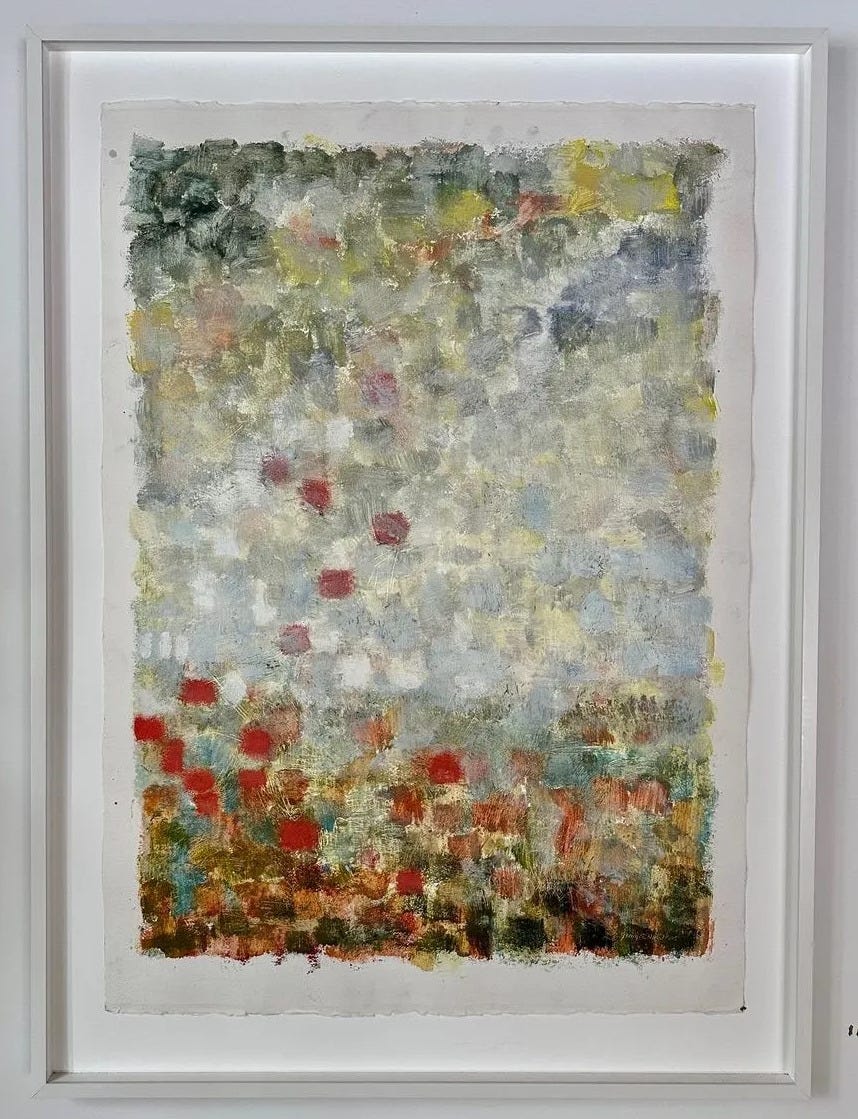
Georgia Nassikas, “Cellular” (McLean Project for the Arts)
IN HER ENCAUSTIC ABSTRACTIONS, GEORGIA NASSIKAS provides the same intimate perspective on micro and micro. The 11 paintings in her show at the McLean Project for the Arts at Berlage Arts & Education Center fill the surface -- either paper or wooden panel -- from edge to edge, beckoning the eye into unchartable expanses. Whether the view is through an imaginary telescope or a simulated microscope, in “From the Cellular to the Celestial” the sense of vastness is identical.
The artist’s pictures are not exactly all-over compositions. There are hints of traditional landscape in some paintings, which suggest the blurry separation between earth and sky. A few vary the format by featuring planet-like totalities, their richly mottled patterns contained within “Celestial” circles. These pictures evoke things that are far distant, yet are as closely observed as the cellular vistas.
Nassikas mixes earth-toned pigments with beeswax (from her own hives) and resin, applies the material in rhythmic daubs, and then melts and further mingles the substance with a blowtorch. The third element, seen in only some of the pictures, is gold leaf -- also earthly in origin, but shiny and distinct. The glimmers both enhance and punctuate the organic whole, pulsing like energy from an unseen source.
If Joseph Cortina’s work is even more immersive than Nassikas’s, that’s a matter of format rather than skill. The artist’s line drawings of waves have been converted into projections that ripple across the floor and walls of a small, darkened gallery adjacent to the one that holds “From the Cellular to the Celestial.” Like the sea, Cortina’s “CREST + HOLLOW” is in continual motion, although its gentle currents are more akin to those of a small pond than a great ocean.
The eddies of light surge across the observer and also atop each other. Three mottled pastel ovals, projected on the floor, are continually jostled by curving lines that sweep across them. The effect suggests the movement of air currents as much as water, and also invokes the waves of various forms of universal energy. Most of those are invisible, but one isn’t: light, the very force which with Cortina has sketched an ever-fluctuating cosmos.
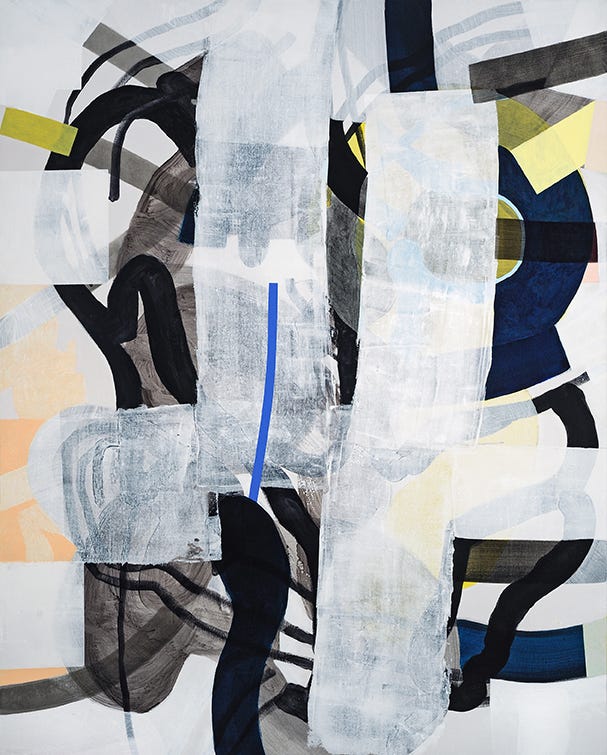
David Carlson, “Love” (courtesy of the artist)
Where Nassikas and Cortina symbolically reveal, David Carlson literally obscures. His “Subtle Connections,” just around the corner from the entrance to Nassikas’s show, consists of five abstractions that are partly overpainted in semi-opaque white. The semi-hidden pictures, made between 2026 and 2023, are all clearly the work of the same painter, but contain many disparate elements. The shapes are usually curved and freehand, but include some that appear to have been made with the aid of a straight-edge. While all the paintings feature bright hues, some are more much more colorful overall than others. A few patches of pigment are textured as if finger-painted.
Carlson is influenced by Buddhism and Taoism, according to his statement, which may be why his pictures partially emulate East Asian calligraphy and ink paintings. The closer to such models the paintings adhere, the most coherent they are. The most cogent entry is “Love,” in which small patches of blue, peach, and other colors are dominated by white, black, and gray. Carlson begins as an exuberant colorist, and then overpaints his the way almost to minimalism.
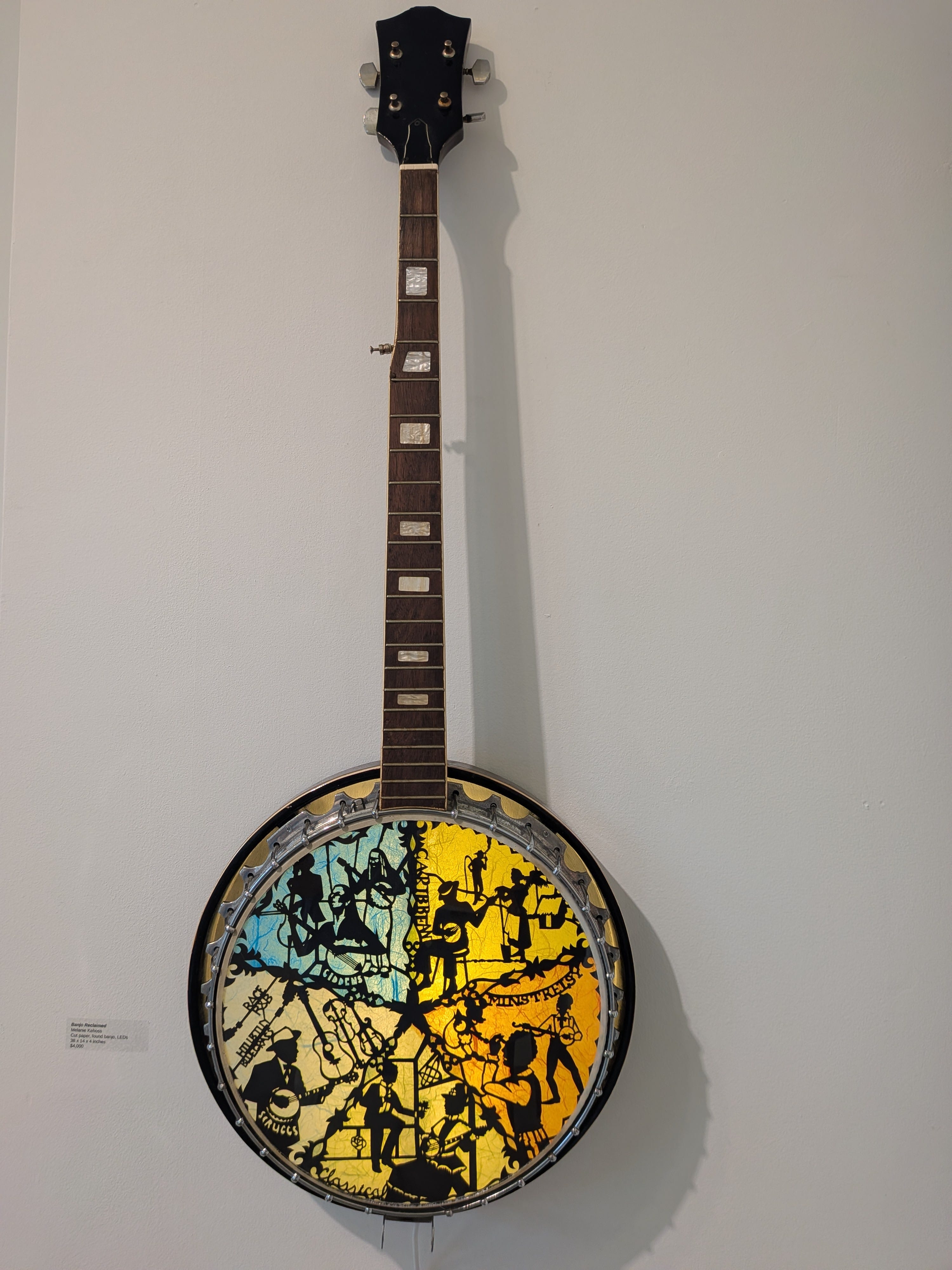
Melanie Kehoss, “Banjo Reclaimed” (photo by Mark Jenkins)
HISTORY IS THE MOTIF OF “FIFTY: A COMMUNITY MEMOIR,” an exhibition that marks Touchstone Gallery’s half-century as a local visual-art mainstay. But one of the most striking pieces is a starkly evocative reaction to current events: Saya Behnam’s “Hormuz no. 1” is a spiky cluster of paper scraps, colored with earthy pigments from the Strait of Hormuz and partly burned. As a testament to the futility of war, the piece is both sweeping and specific.
Juried by Laila Abdul-Hadi Jadallah, Fabiola R. Delgado, and L. Kasimu Harris, “Fifty” assembles works by 36 artists. The show features a few items that portray recognizable people and places -- Washington’s monumental core gets quilted by Aynex Mercado -- but most entries depict abstract or archetypal subjects. Among the latter group is dana brotman’s neo-expressionist portrait of a boy, rendered in characteristically bold shades of purple and metallic green.
The show’s theme is neatly expressed by “Farmor - Ttal,” one of Sally Canzoneri’s lenticular juxtapositions of an older and a newer image. Photographs of separate faces, one in color and the other black-and-white, merge or emerge, depending on the viewer’s vantage point. Melanie Kehoss, who deploys silhouetted figures in historical vignettes, has found an ideal framework for four scenes of musicians: an actual banjo. This American-invented, African-inspired instrument evokes the evolution of Black and White music, whether separated or blended, in the U.S.A.
The artworks’s layering can signify either memory or complexity, as in Reem Bassous’s “Ascension,” a vast painting on unstretched canvas. It’s essentially an abstraction, yet incorporates much nature imagery, including a tree and a vertically oriented -- ascending? -- fish. The picture uses such identifiable forms to represent all the earthly elements, seen and unseen, that surround and sustain us.
Georgia Nassikas: From the Cellular to the Celestial
Joseph Cortina: CREST + HOLLOW
Subtle Connections: Works by David Carlson
Nassikas through Aug. 15; Cortina & Carlson through Sept. 10 at McLean Project for the Arts at Berlage Arts & Education Center, 6910 Fleetwood Rd., McLean. mpaart.org/mpaberlagecenter. 703-790-1953.
Fifty: A Community Memoir
Through Aug. 16 at Touchstone Gallery, 901 New York Ave. NW. touchstonegallery.com. 202-682-4125.