
Well Built
Places deconstructed and reconstructed at MOCA Arlington. Also: Karolak’s lines and Koh’s curls; Black D.C.’s legacies; Butler and Leonets’s skies; Posey’s microscopic view
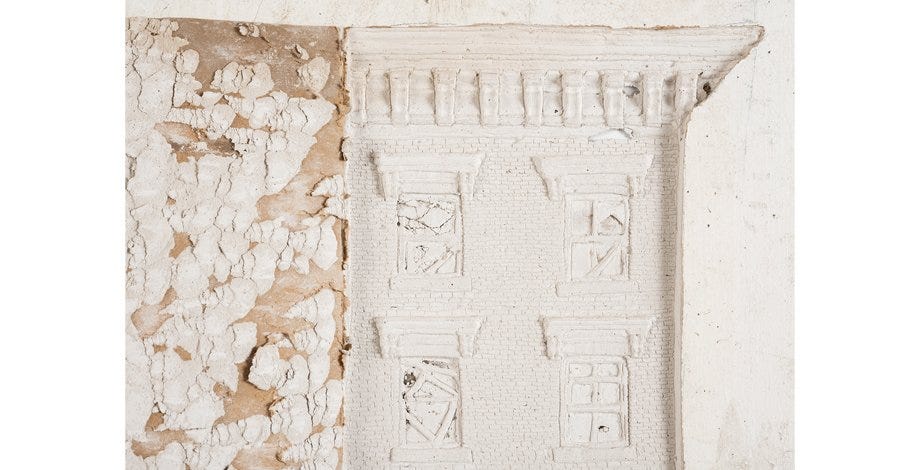
Nicholas Wisniewski, “Tree of Heaven: Harford Road & Central Ave” (detail) (Museum of Contemporary Art Arlington)
A LOT HAS HAPPENED TO CITIES since the 17th century, when urban scenes first became a popular genre of painting. The grandeur captured centuries ago by Vermeer and Canaletto may still exist in Europe, but American cities are a messier subject. Especially Baltimore, the long-neglected city excavated by artist-builder Nicholas Wisniewski. He’s one of the three contributors to “Within Reach: Artists and the Built Environment,” a Museum of Contemporary Art Arlington exhibition.
Playing with scale and material, Wisniewski builds house models from construction materials and incises renderings of houses into sheets of battered drywall. The latter process began with what the artist’s statement calls “an obviously futile act of repair”: He would take a section of drywall from an abandoned house, etch a picture of the structure’s facade into the slab, and then return it to the building.
The most interesting thing about this gesture is its bid to maintain continuity. Visual art has long been aligned with modernist architecture. Indeed, it could be argued the art museum is contemporary architecture’s essential product. But Wisniewski wants no part of obliterating his city’s architectural legacy and replacing it with flashy monumentality. His goals are as modest as his materials. If Baltimore can’t thrive as a city, at least it can endure as a DIY art project.
Curated by Blair Murphy, the show also features Gerardo Camargo, another artist who knows his way around construction sites, and Megan Mueller, who photographs streets and sidewalks of her native Los Angeles and digitally stitches them together to make semi-abstracted murals. To bring these flattened cityscapes into the third dimension, the artist sometimes mounts them so that they slip partly off the wall and onto the floor. Mueller reduces her hometown to found patterns, but gives these motifs a sense of place.
A Mexico-born local artist, Camargo employs found materials to craft geometric designs, yet emphasizes evidence of hand labor. If his work at MOCA contrasts architectural forms with materiality, his concurrent show at Stone Tower Gallery is keyed more to the latter. At the center of “On Behalf of New Myths,” which was curated by Fabiola R. Delgado, is a sort of ramshackle shrine made of used drop cloths and filled with construction tools.
These well-used objects can be seen as offerings to some deity, and the god in question might be the snake whose sinuous contours unify one of the show’s two banners. Made of used sandpaper, tape, and drywall dust, these hanging artworks depict the anonymous, and partial, faces of construction workers. That these laborers are mostly Mesoamerican is underscored by the presence of the sacred serpent. While the workers engage in gritty and mundane toil, their folklore tells of a mythical plane of existence.
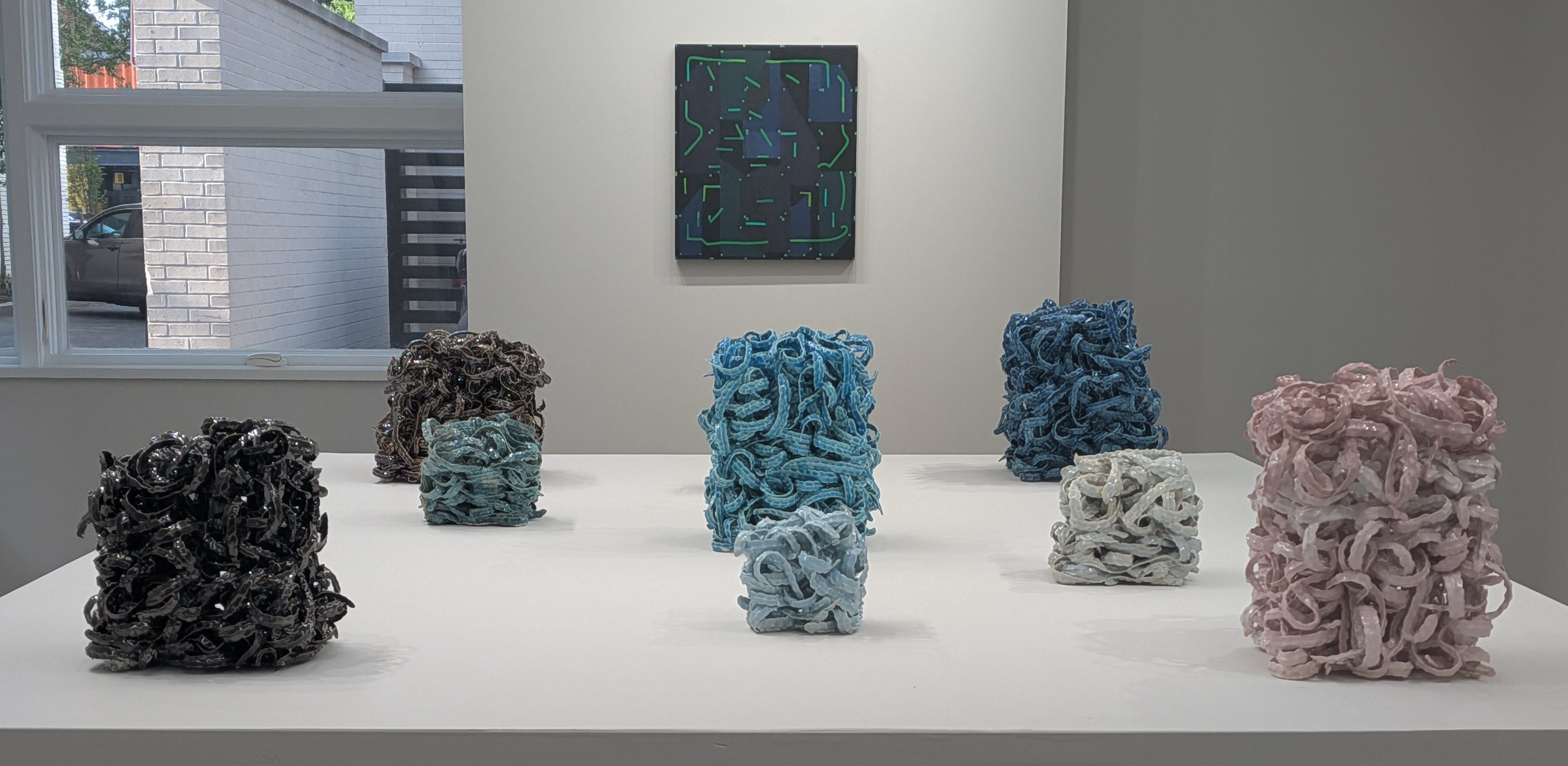
Installation view of “Throughlines” (photo by Mark Jenkins)
THERE’S AN ARCHITECTURAL QUALITY to the drawings and paintings of Jason Karolak, one of the two artists showing in PFA Gallery’s “Throughlines.” The broken lines of some of the Brooklyn artist’s minimalist drawings, made with pencil that’s partially overlaid with ink, suggest floor plans for imaginary buildings. That may be intentional, since Karolak’s interests include “utopian architecture and communal societies,” according to PFA’s biographical note.
The three Karolak paintings in this selection are as dense and dark as the drawings are open and mostly white. The pictures are loosely painted, yet from a distance their shapes appear precise. Atop the multi-layered compositions are pseudo-diagrammatic lines similar to those in the drawings, rendered in lighter colors. They suggest unreadable neon signs blazing on darkened streets, or portals into the darkness. The effect may not conjure utopia, but the sketchy forms do seem archetypal.
The show’s other contributor is Ara Koh, a Seoul-born local ceramicist. Her stoneware pieces are rough rectangles made of tangled tendrils, always in glistening shades of a single color. The serpentine curls appear organic, yet are pressed into near-geometric forms that indicate human intervention. The artist’s titles, which include “Gnarly Magic” and “Blue Glazed,” tend to refer only to the sculptures’s visual aspects. Yet the coiling energy of Koh’s style has metaphysical implications: The surging clay filaments seem to embody an unyielding life force.
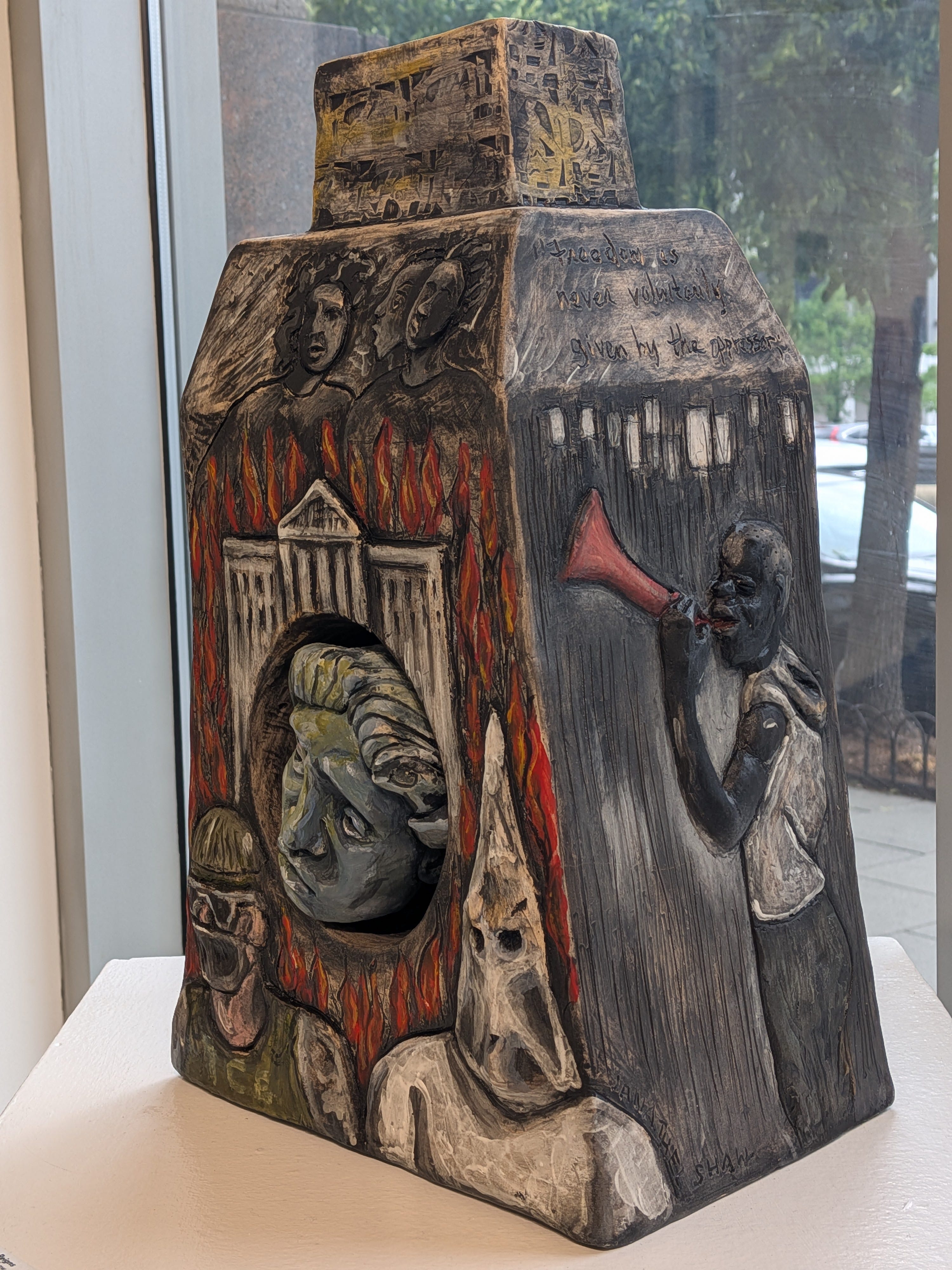
Janathel Shaw, “Chaos Reigns” (photo by Mark Jenkins)
LOCAL COLOR IS NOT THE ONLY HUE in “Ain’t No Home: History and Legacy in the Black Community.” This Touchstone Gallery exhibition, keyed to the venue’s 50th anniversary, presents work by eight local artists, including Sheldon Scott, Jermaine “jET” Carter, and Touchstone regular Janathel Shaw. Many of the pieces are familiar from previous solo shows.
Among the items that employ local landmarks are Carter’s photograph of the Howard Theater, printed on honeycomb-patterned wood, and Blu Murphy’s drawing-collages of children in front of such iconic backdrops as a Metrorail map or monumental Washington. The young people are fixed in place by the recognizable locations, but offered the possibility of a freer future.
The past is even more palpable in Neville Barbour’s “Leaving,” which places two of the artist’s exquisitely detailed photo-derived drawings inside a battered suitcase. Sheldon Scott embodies legend in his “Self Portrait as John Henry,” which distills the “steel-driving man” to a black-and-white photograph of a hand that holds a sledgehammer. Equally totemic is Paula Mans’s sculptural painting of a cotton plant that emerges from a Black person’s mouth.
Not unexpectedly, the most complex entry is by Shaw. Her “Chaos Reigns” is a history of protest and reaction etched on the four sides of a bell- or beaker-shaped sculpture. The imagery is raw and the rendering stark, but the apparent moral is the necessity of resilience. Perhaps Shaw’s ceramic bell is a chime of freedom.
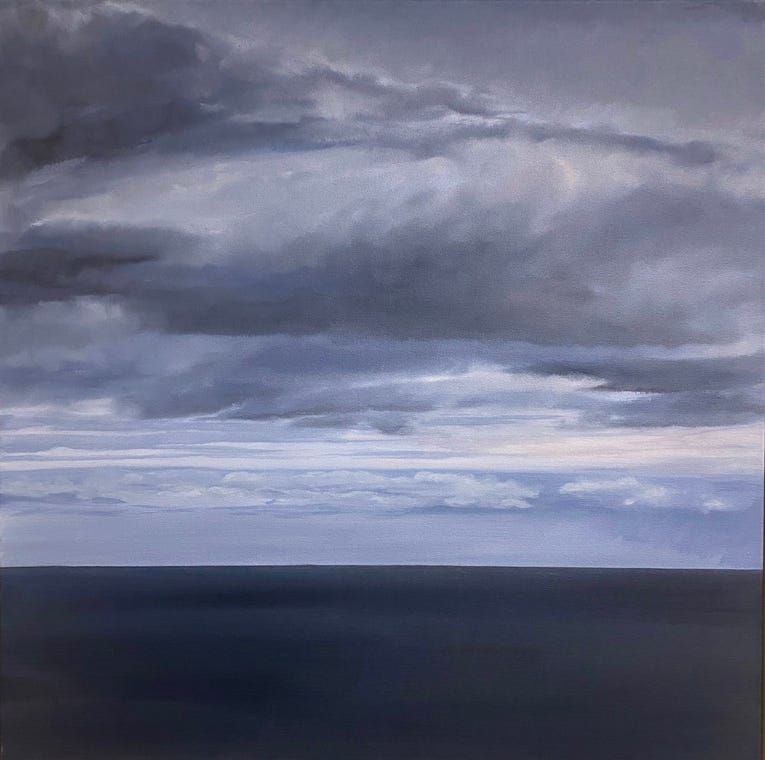
Lizzie Butler, “Scent of the Storm II” (Amy Kaslow Gallery)
THERE’S A LOT OF SKY in the paintings of Lizzie Butler and Jaroslav Leonets, the two landscape artists paired in Amy Kaslow Gallery’s “Lovely Day.” But where Butler’s pictures are fluid and ethereal, Leonets’s are chunky and earthy. Perhaps it’s significant that Butler’s firmaments often soar over vast expanses of water, which echo the colors and textures of what’s above. But several of the Londoner’s scenes center on green-and-brown patchwork fields, and rivers often course through Leonets’s views of his native Ukraine during the tranquil years just before the Russian invasion.
Part of the contrast is simply technique. Butler’s style is gauzier and more layered, with soft edges and multi-tiered hues. Light appears to emanate from unseen sources, or to reveal itself primarily in the form of reflections. Sunlight also gambols on liquid surfaces in such Leonets canvases as “Fast Water,” but his forms are harder-edged and firmer. That’s true even when the subjects are clouds, which appear to be made of something much more substantial than water vapor.
Perhaps the essential difference is that Butler pursues transcendence while Leonets seeks preservation. The Briton’s often gray-tinged pictures flirt with abstraction, and focus on areas where the border between water and sky is indistinct. The Ukrainian’s are far from photorealistic, but offer a sense of real places and a specific era. While Butler seeks to let go, Leonets insists on holding on.
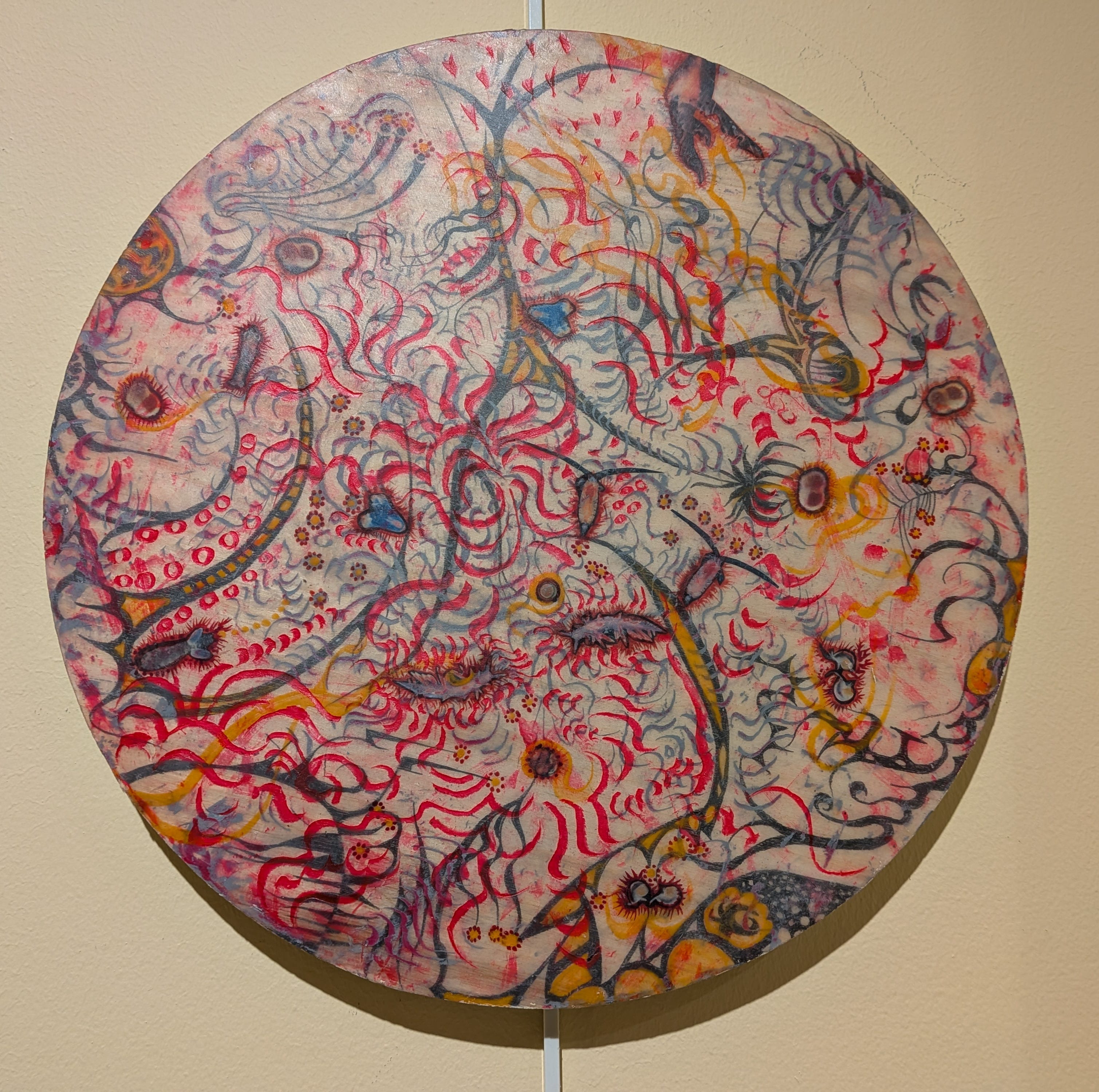
Kelly Posey, “Nat. Geo: Psychedelic Zooplankton” (photo by Mark Jenkins)
AMONG THE INSPIRATIONS FOR KELLY POSEY’S Arts Club of Washington show is a period the Maryland artist spent in China as a teacher of high-school art and English. She arrived with a cache of old issues of National Geographic, which she encouraged her students to cut up for collages. For “Nat Geo Series: Re-imagining Our World,” Posey did the same. Her Arts Club of Washington show features crowded and colorful collage-paintings, coated with encaustic and sometimes including low-relief sculptural touches.
All but two of Posey’s mixed-media pictures are round, and the circular shape suggests a gaze through a telescope or microscope. The metaphorical use of the latter device is evoked not only by the teeming compositions but also by such titles as “Nat. Geo: Psychedelic Zooplankton.” The legible phenomena aren’t necessarily minuscule, but the visual elements bob and flow, as if in some sort of fluid medium.
The actual liquid materials, of course, are varieties of paint, including oil and watercolor. These both underpin and overlay the collaged bits, cohering the randomly juxtaposed found images. Given that Posey’s stated intent is to invite viewers “to reconsider established understandings of our planet,” her technique is as urgent as it is inventive.
Within Reach: Artists and the Built Environment
Through May 24 at the Museum of Contemporary Art Arlington, 3550 Wilson Blvd., Arlington. 703-248-6800.
Gerardo Camargo: On Behalf of New Myths
Through May 31 at Stone Tower Gallery, Glen Echo Park, 7300 MacArthur Blvd., Glen Echo. glenechopark.org/partnershipgalleries. 301-634-2222.
Jason Karolak & Ara Koh: Throughlines
Through June 6 at PFA Gallery, 1932 9th St. NW (entrance at 1917 9 1/2 St. NW). pazofineart.com. 571-315-5279.
Ain’t No Place: History and Legacy in the Black Community
Through May 25 at Touchstone Gallery, 901 New York Ave. NW. touchstonegallery.com. 202-682-4125.
Lovely Day
Through May 31 at Amy Kaslow Gallery, 7920 Norfolk Ave., Bethesda. amykaslowgallery.com.
Kelly Posey: Nat Geo Series: Re-imagining Our World
Through May 30 at the Arts Club of Washington, 2017 I St. NW. artsclubofwashington.org. 202-331-7282.