
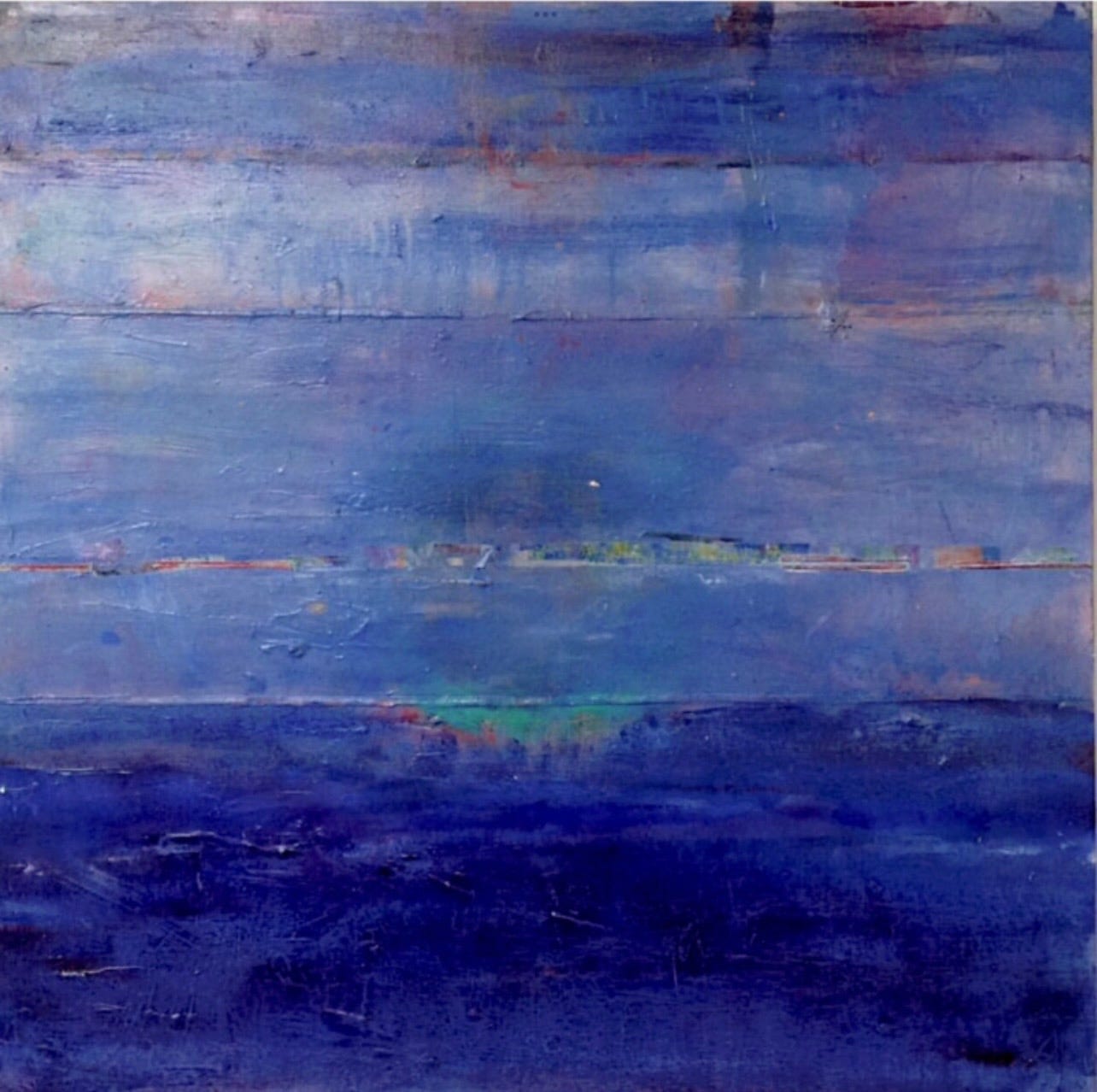
Sarah Spector, “Blue Orb” (courtesy of the artist)
THE MAJORITY OF THE PICTURES IN SARAH SPECTOR’S Waverly Street Gallery show are landscapes, yet those aren’t the focus of the exhibition. On one wall are two-dozen tiny watercolors, plus a lone drawing, that depict the gentle contours and soft light of Block Island. That locale probably didn’t prompt the title of “Transcendent Terrains: Outer Landscapes and Inner Temples,” whose larger canvases are mixed-media abstractions. But it does suggest that the local artist sees a connection between observable and internal realms.
Like the 1950s abstract expressionists who surely must be among her inspirations, Spector glories in the qualities of paint. Large slabs of color are heavily worked, and drips punctuate the compositions. Horizontal streaks and furrows complicate the vibrant color fields, which are sometimes set off by such bold contrasts as the smudgy azure bar that bobs at the top of the mostly orange “Blue Smoke Hovering.” The titles of many of the paintings refer to the sun, the sky, or the ocean -- phenomena that are both specific sights and boundless concepts.
Roughly half of the larger pieces are collage-paintings that incorporate such detritus as paper scraps, snippets of gold foil and even a painted bottle cap. These pictures invert the strategy of the other ones, in which objects appear to be submerged beneath the pigment. Perhaps the buried items are just thick areas of paint, but the unexplained crags and curves add mystery and a sense of depth to the artworks. Gazing into a Spector painting is like peering into a vast expanse of sea or sky: Part of the appeal is imagining things unseen.
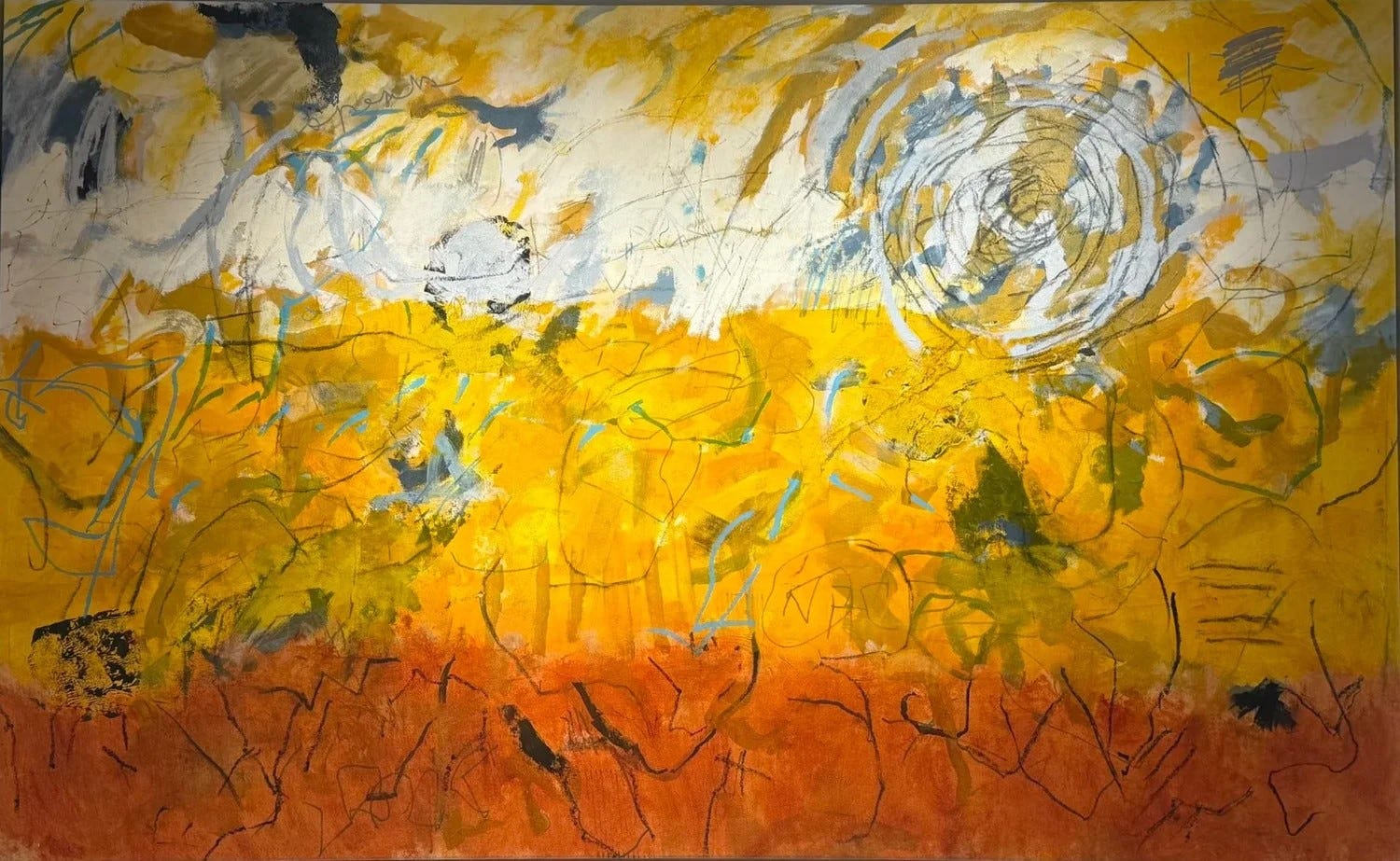
Joyce McCarten, “Cottonwood Canyon” (Studio Gallery)
ANOTHER ABSTRACTIONIST WHO’S INSPIRED BY LANDSCAPE, Joyce McCarten makes paintings in which gesture is just as important as color. The exuberant pictures in “At Home Everywhere,” a Studio Gallery show curated by the artist with Julie Sagatov and Dylan Price, are predominantly mixed-media and energized by scribbly lines and scrubby brushstrokes. “Cottonwood Canyon,” with its charcoal-like scrawls and underlying earth tones, even suggests a cave painting.
As that picture’s title indicates, McCarten sometimes names paintings after specific locations. But her depictions are more about sensations than recognizable sights. One of the most realistic ones, “Down in the Tulips,” is an immersive closeup rather than a sweeping panorama, and “First Glimpse of Mendocino” has a distinctively icy vibe that isn’t very Californian. “I travel to rattle my perspective,” the artist notes in her statement, and these paintings may shake the viewer’s perceptions as well.
About half of the paintings in Cheryl Ann Bearss’s “Whispers of the Woods” depict a single archetypal tree, gnarling upward until it twists out of the frame. These dynamic pictures are more realistic than impressionist, but they deliberately remove their subjects from their natural contexts, instead placing them against brooding black, gray, or brown backdrops. Each canvas is a one-tree drama.
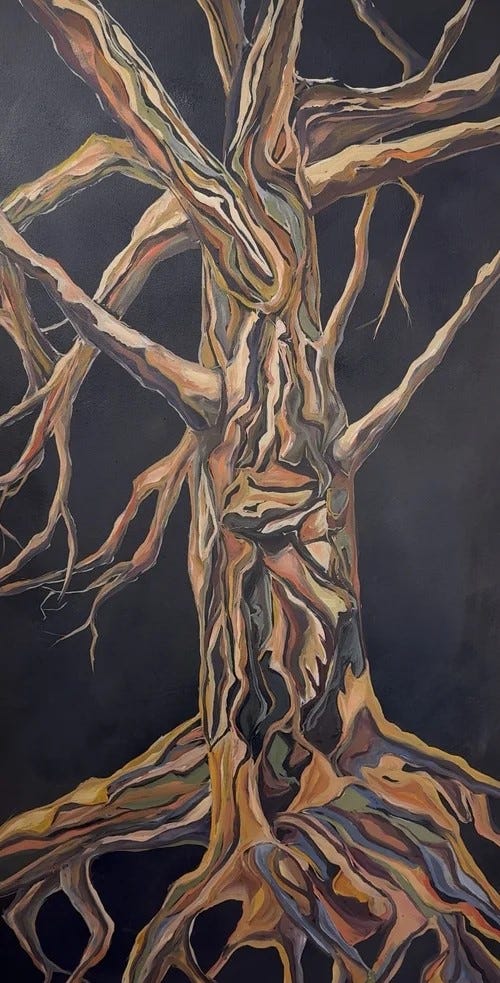
Cheryl Ann Bearss, “Rooted” (Studio Gallery)
The show, downstairs at Studio Gallery and curated by Mira Hecht, also includes more naturalistic arboreal landscapes. In these, trees snuggle each other in groves or are secondary to rocky streams and lakes. But all nine pictures are strongly vertical, as if to celebrate the essential trajectory of trees. The human eye may naturally shift from side to side, but Bearss seeks to send it spiraling toward the highest branches.
In the month of 9/11’s 25th anniversary, Deborah Addison Coburn revisits some paintings she first exhibited 20 years. These pictures are the among most striking in the artist’s “Reflections of the Bluest Day,” which was curated by Gabby Mizes. But several more recent works in show, which adjoins Bearss’s, are equally potent.
The title painting, made in 2026, simply depicts two parallel tan horizontals at one side of a sky-colored field. More explicit are “Jacob’s Ladder,” a semi-abstract rendering of skeletal wreckage jutting upward, and “25 Years Later,” in which the red stripes on a U.S. flag, overlaid with chicken wire, drip bloodily. Other pictures are less pointed, but with hints of destruction and conflagration. Coburn constructs sturdy lines in the colors of steel and concrete yet imbues them with a sense of fragility.
Robert Cwiok’s orange-heavy collages, also at Studio and curated by the artist and Iza Thomas, might be described as semi-Cubist bagatelles. The artist assembles scraps of cut paper, most often in hard-edged, right-angled patterns that suggest principles of architecture and city planning. In fact, the background of “Petal Pin” is partly a map of the L’Enfant-Ellicott plan for central Washington, although the mostly blue pinwheel atop it is among these pictures’s more curvilinear forms. Text features in such pieces as “Art and Commerce,” which arrays the names of artists, filmmakers, actors, musicians, and such curators as onetime Washingtonian Walter Hopps. Cwiok’s collages may appear to be abstract exercises in form, but their details gleam with local color.
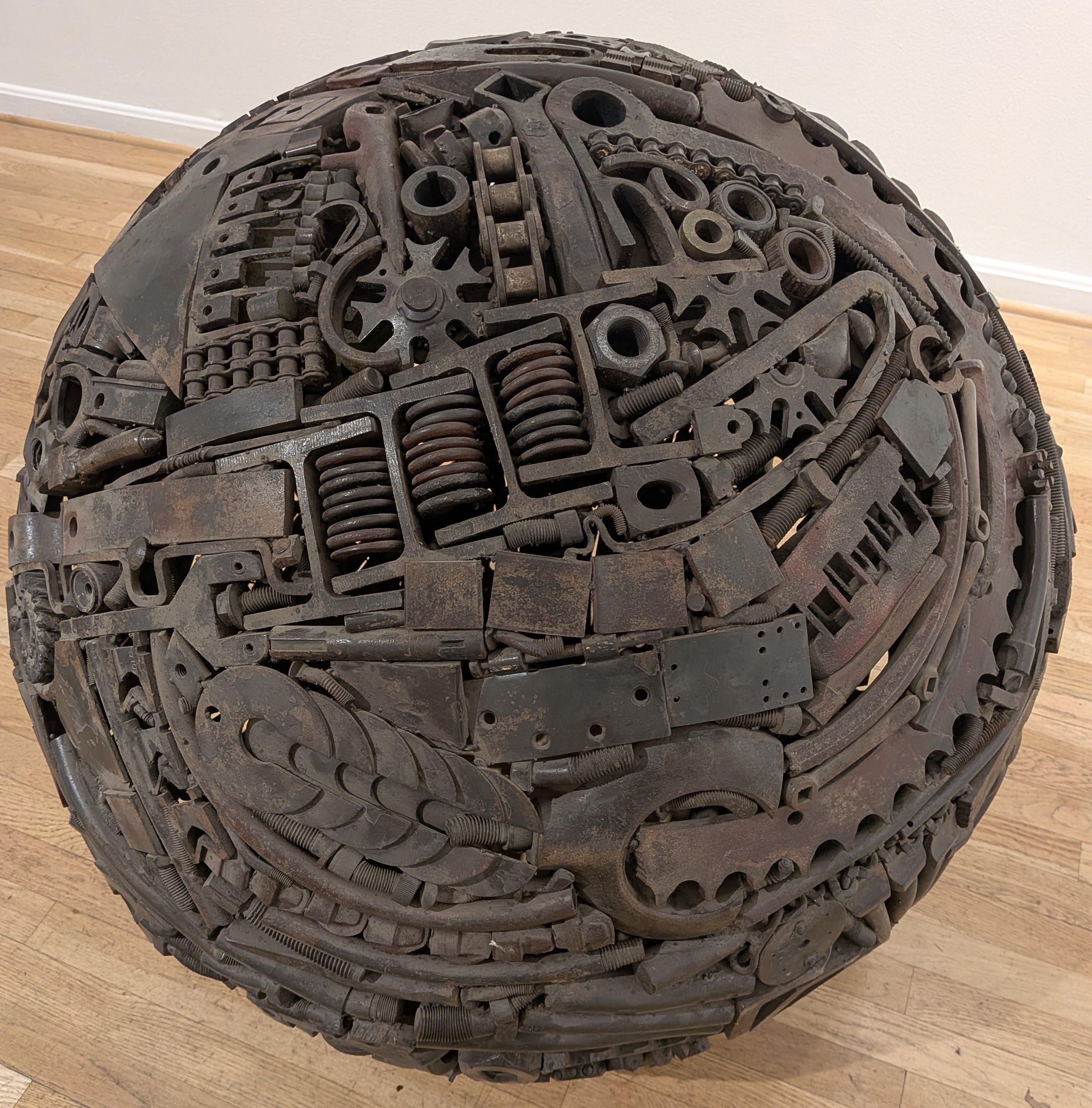
Michael Malpass, “Globe” (photo by Mark Jenkins)
A FUND-RAISING EVENT FOR IA&A AT HILLYER doubles as a quick overview of recent D.C. art. “Auction in the Alley” features 42 works by more 30 artists, most of them local. While many of the entries were made since 2020, there are callbacks to earlier eras, notably Tom Wolff’s poignant photographic portrait of masterly realist painter Manon Cleary, who died in 2011.
Among the other highlights are two early-1980s Michael Malpass sculptural assemblages. Both are imposing spheres made of scraps of black metal hardware, but one appears solid while the other is airy. (Malpass, who died in 1991, never lived in the D.C. area, but his work was included in the local Hechinger Collection of tool-related art.)
Many contributors offer pieces that are in their familiar modes, yet fresh. Among these are Ellyn Weiss’s fluid and atmospheric hybrids of drawing and stain painting; Abol Bahadori’s sleekly mysterious pictures of veiled woman on some sort of red planet; Helen Frederick’s elegantly glittering mixed-media drawing; and Joan Belmar’s stark yet lush abstractions, which combine etching, collage, and painting. More familiar, if no less impressive, are Sookkyung Park’s epic origami sculpture of a wave; Michèle Colburn’s abstract-floral watercolor atop gunpowder residue; and two eco-themed Taina Litwak text-infused collage-paintings, one of leaves and the other of birds.
Text also features in three other notable pieces. Chris Combs’s playful “Blurred Words” places a rough wooden frame around a one-line LED display that electronically spits trios of rhyming or near-rhyming words or phrases. Jun Lee, who makes exquisite large woodcuts of animals, pairs the phrase “All Power to the People” with the image of mighty feline. Kirsty Little embosses the word “pandemonium” so it appears to be submerged under an array of colored ribbons. It’s a gambit that exemplifies the show, which is full of art that’s tidy and well-crafted but with hints of anxiety beneath the surface.
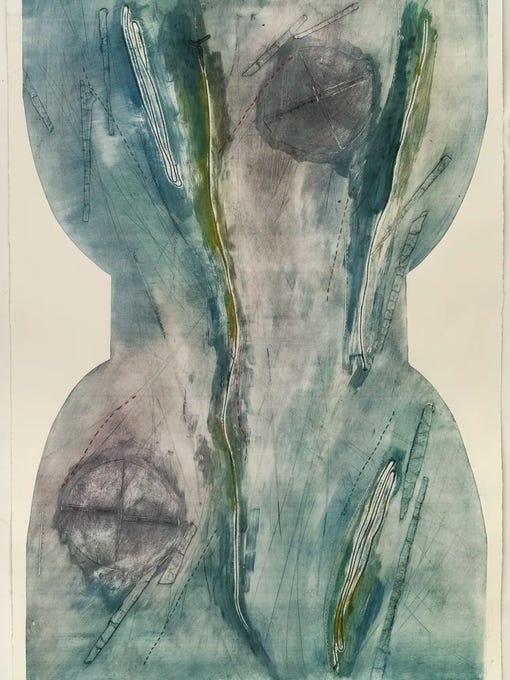
Kristine DeNinno, “Madonna I” (Washington Printmakers Gallery)
KRISTINE DENINNO HAS AN HOURGLASS FIGURE -- several of them, in fact -- in her Washington Printmakers Gallery exhibition, “At the Seams.” The suburban-Maryland artist makes large collographs and monoprints of streamlined female forms into which she stitches fiber darts and panels, thus invoking domestic *labor traditionally done by women. The goal is to craft “symbols of strength and resistance,” according to the artist’s statement.
Symbolism aside, DeNinno’s work is distinguished by exceptional skill, intriguing textural contrasts, and a distinctive palette. Bluish-green and brownish-purple dominate, often as watery tones but also as harder shapes, creases, or boundaries. Including the five smaller, older pieces on display in the back room, the show offers an absorbing overview of the artist’s style and motifs. The colors are muted, but the detailing is vivid.
Also at the gallery is Caryn Martin’s front-window installation, which arranges crumpled, blue-tinted paper both close to the glass and further back. The effect is fluid and immersive, suggesting an oceanic whirlpool frozen in space.
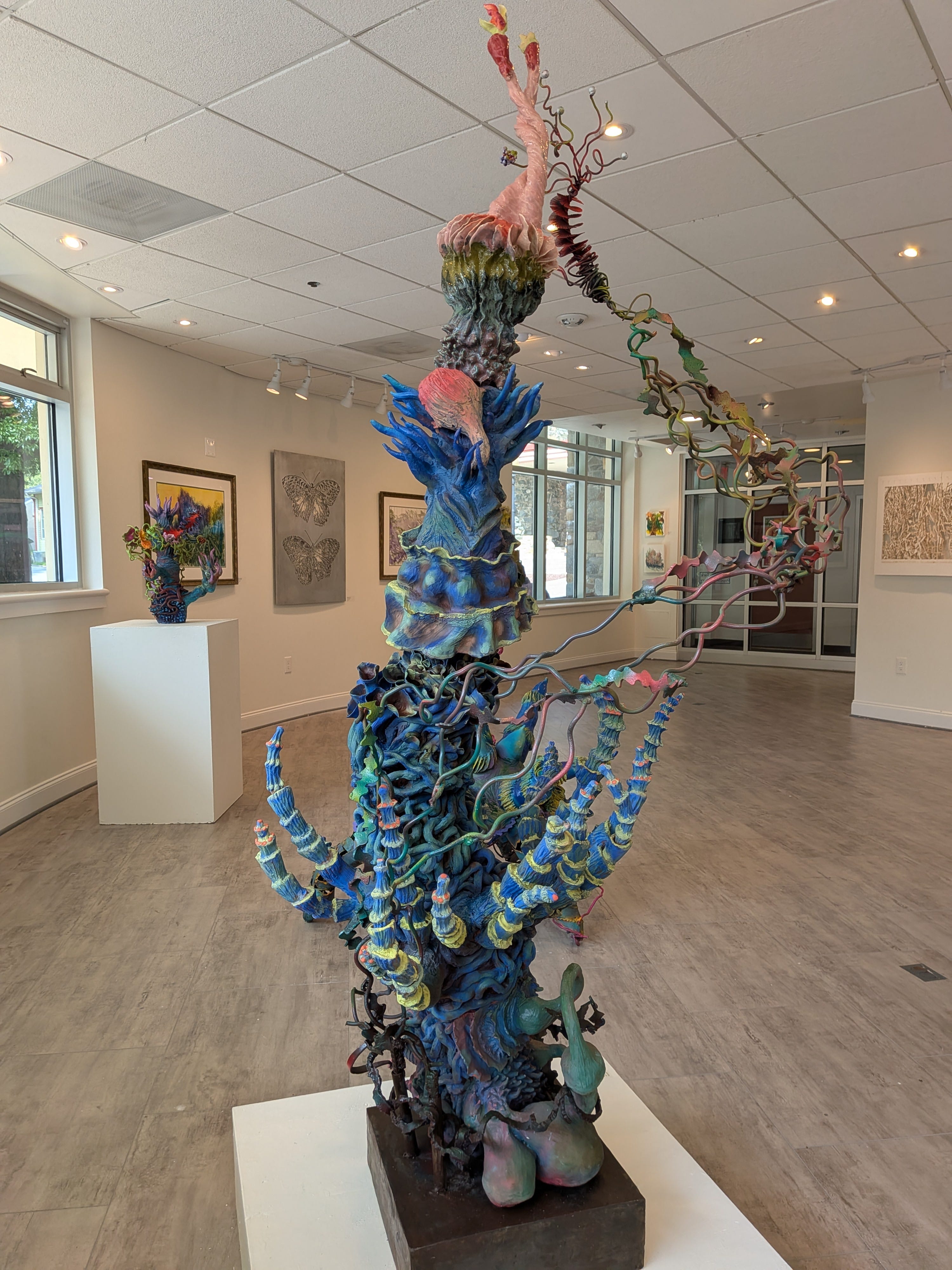
Nicole Fall, “Symbiosis” (photo by Mark Jenkins)
NATURE TAKES ABUNDANT FORMS, most of them three-dimensional, in “Natural Progressions,” a three-artist show at Glen Echo Park’s Popcorn Gallery. Janet B. Waters makes delicate mixed-media abstractions that hint at the natural world. Blake M. Conroy painstakingly cuts paper or metal into silhouetted vignettes of intricate foliage. The largest entries are by Nicole Fall, who builds on steel frames painted-clay sculptures of fanciful creatures.
The most realistic works are Conroy’s, two of which are densely multi-level, if far from literal. Waters’s color-conscious approach draws from nature’s complexity and fecundity but also expresses joy in her own materials. Fall invents her own miniature universe of fantastic beasts -- or are they plants? All three participants, who hail from D.C. and the Baltimore region, treat nature more as an inspiration than a specific model, a strategy that yields extravagant results.
Sarah Spector: Transcendent Terrains: Outer Landscapes and Inner Temples
Through Sept. 26 at Waverly Street Gallery, 4600 East-West Highway, Bethesda. waverlystreetgallery.com. 301-951-9441.
Joyce McCarten: At Home Everywhere
Deborah Addison Coburn: Reflections of the Bluest Day
Cheryl Ann Bearss: Whispers of the Woods
Robert Kwiok
Through Sept. 26 at Studio Gallery, 2108 R St. NW. studiogallerydc.com. 202-232-8734
Auction on the Alley
Through Sept. 24 at IA&A at Hillyer, 9 Hillyer Court NW. athillyer.org. 202-338-0680.
Kristine DeNinno: At the Seams
Through Sept. 27 at Washington Printmakers Gallery, 1675 Wisconsin Ave NW. washingtonprintmakers.com. 202-669-1497.
Janet B. Waters, Nicole Fall, and Blake M. Conroy: Natural Progressions
Through Sept. 27 at Popcorn and Stone Tower Galleries, Glen Echo Park, 7300 MacArthur Blvd., Glen Echo. glenechopark.org/partnershipgalleries. 301-634-2222.