
Systems Management
Sculpture in a diverse “Continuum.” Also: Tawny Chatmon’s exaltations; Rosemary Feit Covey’s excavations; Matthew Curry’s gestures; Eric Johnson chronicles a disappearance; and Scott Davis disorients
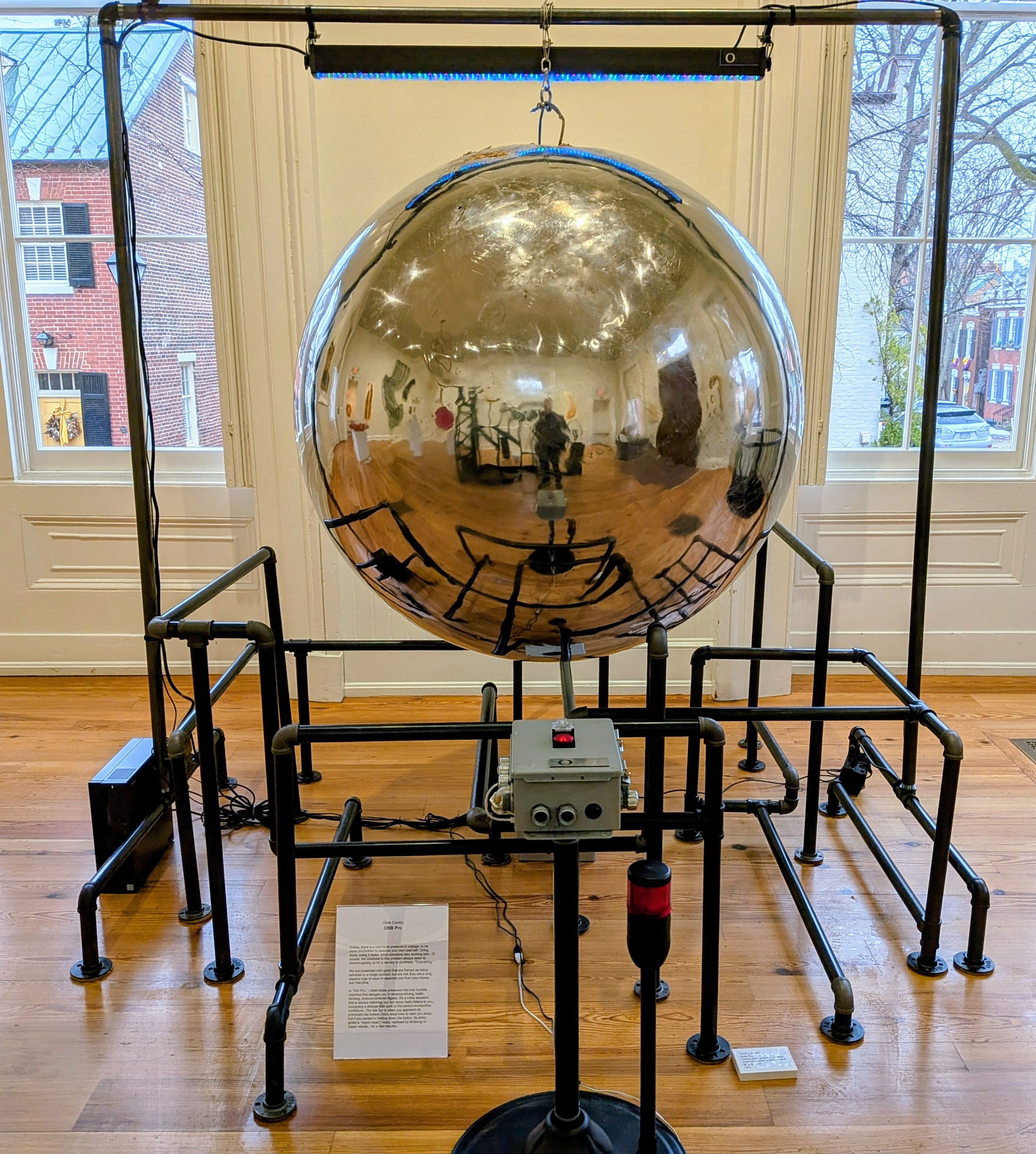
Chris Combs, “ORB Pro” (photo by Mark Jenkins)
SOLIDITY AND EPHEMERALITY DOVETAIL, sometimes in the same piece, in “Continuum,” an impressive seven-artist sculpture invitational at the Athenaeum. Much of the work turns on juxtaposition, whether visual or conceptual, and many of the entries are whimsical. Several explore the nature of systems, or systems of nature. There are even a few nods to Dadaism and Surrealism.
Marcel Duchamp’s bicycle-wheel readymade inspired Roger Cutler’s “Ascending,” in which a similar wheel spins -- potentially -- at one end of a black-painted wooden structure that’s partly a staircase. To climb the stairs would be to move, symbolically, from the respective scale of subatomic particles to the entire universe, according to a gallery note.
In the venue’s basement are Seemeen Hashem’s sculptural mashups, often incorporating parts of musical instruments. These assemblages recall Surrealist author de Lautréamont’s description of something as “beautiful as a chance encounter on a dissecting table of a sewing-machine and an umbrella” -- except that Hashem leaves little to chance. Her fabrications are neat and nearly symmetrical.
Valerie Theberge, Brian Kirk, and Jackie Hoysted all draw from the natural world, but with very different results. Theberge weaves wire into organic forms that she then covers with glass tiles, yielding elegant objects that appear soft and hard at the same time. Kirk, whose work is the most diverse, incorporates a shed snakeskin into an encaustic painting and constructs glass sculptures that, like Theberge’s, transfigure mutable natural shapes into hard-edged permanence. But Kirk also makes prints on paper with the rust of oxidized metal tools, memorializing industry rather than nature.
Newer technologies underlie Hoysted’s “Symbiotica II,” an immersive installation in a secluded, darkened gallery. An update of a work the artist presented four years ago at Glen Echo Park’s Stone Tower Gallery, the piece is inspired by mycelium, underground fungal networks that connect plants and trees. Such tendrils are represented by flickering generative patterns projected on three walls and pod-like lights networked on the floor. The latter turn from blue to yellow when a visitor inserts a finger into a pulse monitor, thus plugging humanity into its unseen, underappreciated environment.
Chris Combs’s “ORB Pro” is also interactive, but the system it evokes is anything but natural. With playful irony, the high-tech artist employs a large reflective chrome sphere and other metal parts to embody the virtual world of the Internet. A prattling female voice represents the web’s endless flow of distraction, which Combs has made interruptible by pressing a red button. Holding down that button temporarily switches the chatter to soothing natural sounds, but only after -- hilariously -- the voice has implored the netizen not to hush its monologue.
The show’s largest pieces are not the most literally substantial. Carl Johnson weaves steel wire with cotton and sends undulating ribbons of the hybrid material -- melding natural and industrial -- across the floor and up the walls. Making the most extravagant use of the Athenaeum’s high-ceilinged space, Johnson fills much of the room with diaphanous curves, towering yet ethereal. They illustrate just one of the ways that “Continuum” twists expectations for sculpture.
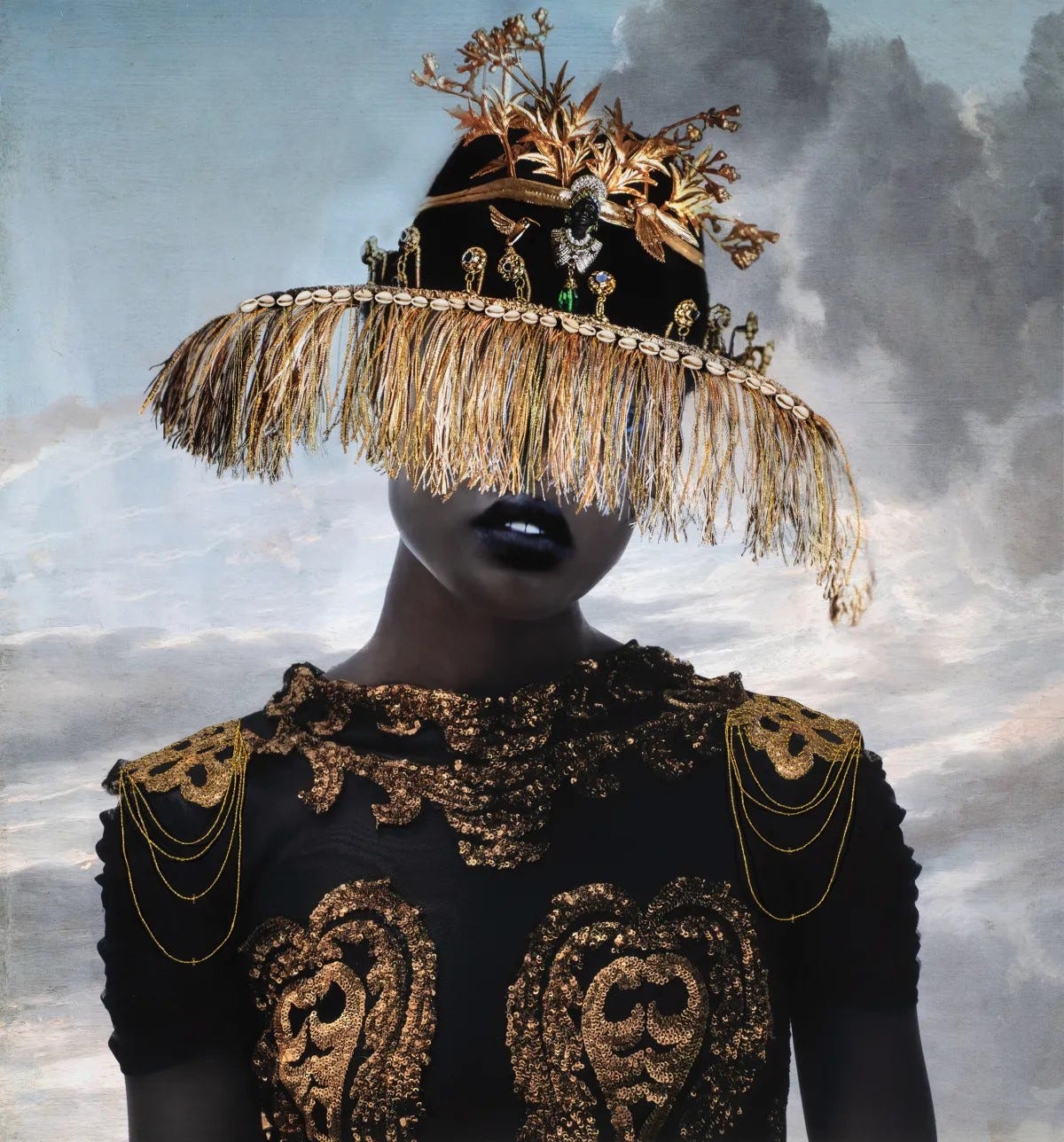
Tawny Chatmon, “Not Your Blackamoor” (National Museum of Women in the Arts)
TAWNY CHATMON’S EMBELLISHED PHOTOGRAPHS have always looked like museum pieces, so they hang most satisfyingly in several galleries of the National Museum of Women in the Arts. The Baltimore artist’s “Sanctuaries of Truth, Dissolution of Lies” offers examples of four series that present Black history and culture in the manner of Old Master paintings and Byzantine mosaics.
The photo-collagist’s style is deliberately sumptuous. Her staged and sometimes digitally manipulated photographic portraits intend to exalt their subjects, who are often children. Most of the added details are in gold, a color that symbolizes wealth, divinity, and -- in East Asian art -- enlightenment. Chatmon’s more recent pictures feature less ornamentation than the ones from 2018-2019’s “The Redemption” series. But “The Restoration,” an ongoing project, does incorporate such adornments as gilded oval 3D frames that encircle several individual women or girls.
Exquisitely but Puckishly, Chatmon uses the style of Dutch Golden Age portraits and still lifes to dignify such everyday foods as soft-serve ice cream and watermelon. The latter, of course, has connotations of racism, a scourge the artist addresses directly with pictures of children who hold Black racist memorabilia. These fraught items, some of which are actually on display, take the place of the symbols of power, prosperity, and devotion that feature in Renaissance European likenesses. As Chatmon seeks to uplift her Black subjects, she also highlights the history they have to overcome.
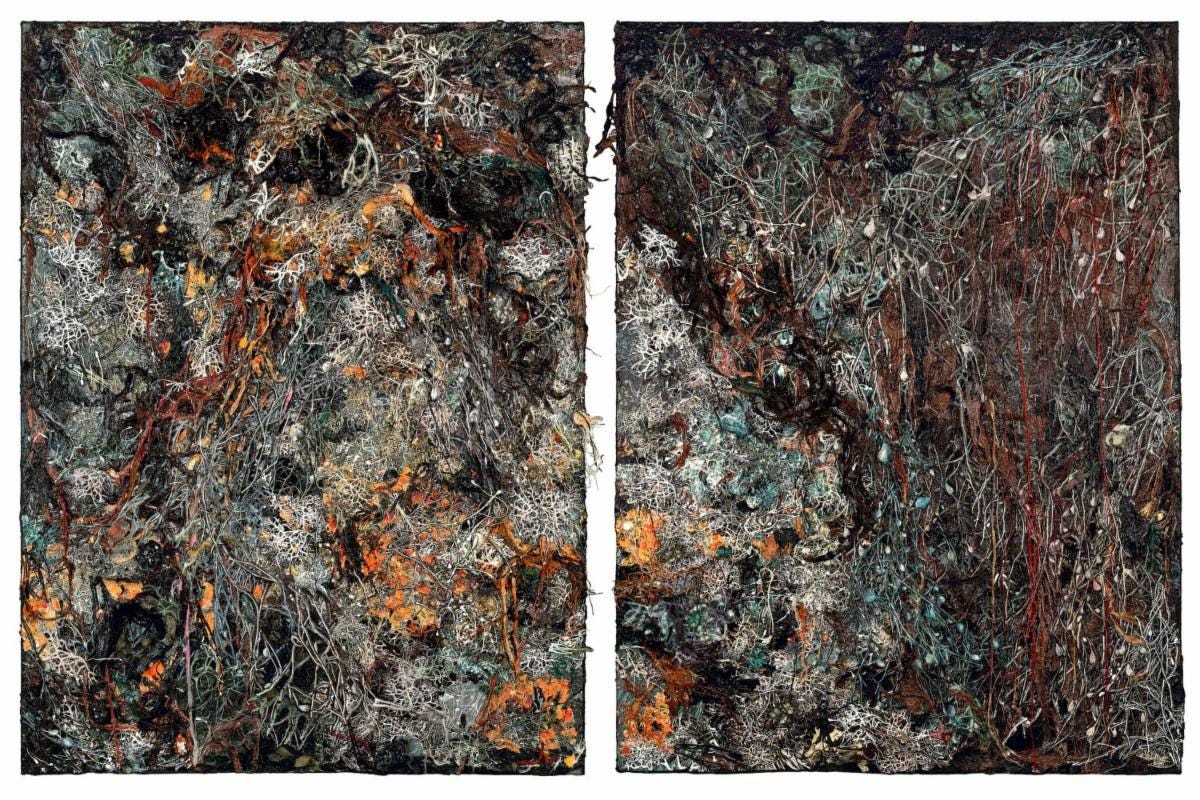
Rosemary Feit Covey, “Thanatopsis I and II” (Morton Fine Art)
PRINTMAKING IS EXCAVATED AND EXTRAPOLATED in the work of Rosemary Feit Covey, whose Morton Fine Art show is intricate and prolific. “Cutting Near the Edge” consists of just six pieces (one of them a diptych) but contains a good-sized forest’s worth of twigs, tendrils, and berry-like pips. Cataloging the ingredients of merely one of these engrossing, densely textured artworks would be a daunting task.
Feit Covey, born in South Africa and based in Northern Virginia, takes inspiration from “Thanatopsis,” an early-18th-century poem by Massachusetts author William Cullen Bryant. Most of the artist’s recent print-based sculptures are named for the poem, a contemplation of death whose thematic darkness is embodied by the pictures’s dominant palette. Only one of the works, the blood-hued “Touch Me If You Dare,” isn’t monopolized by black. But throughout the prints are bursts of color that suggest trace minerals embedded in gray stone or furtive blooms glimpsed deep in shadowed woods.
The artist must be compelled by such undergrowth, since she titled one piece “Lichens and Other Extraterrestrials.” Other works evoke more domestic materials: “Thanatopsis VI” suggests lace-work, and “Thanatopsis VII” fur and hair. The latter artwork, tangled with hanging thread, is the least tethered to a traditional picture frame. But none of these relief sculptures is a regular rectangle. Edges are ragged and torn, and found objects protrude every which way. Feit Covey may be thinking of death, yet “Cutting Near the Edge” doesn’t convey a sense of resignation. These sculptures swell with unruly life.
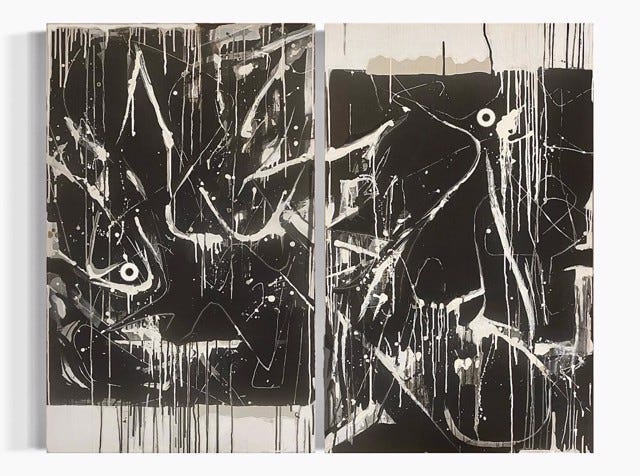
Mathew Curry, “Both Sides” (Addison/Ripley Fine Art)
DRIPS ARE ESSENTIAL TO “ALTARS,” Matthew Curry’s show at Addison/Ripley Fine Art, yet the D.C. artist’s work doesn’t recall Jackson Pollock’s. The spatters and blotches that characterize these mostly black-gray-and-white pictures seem more in the style of British gonzo illustrator Ralph Steadman. And what are those white-painted steel discs whose crisply tooled forms, one per painting, set off the frantic gestures? They might be symbolic on-off buttons for cellphone-screen-shaped artworks that, the gallery notes, are inspired by “personal technology.” (One picture is titled “Swipe Left.”)
A veteran art director and graphic designer, Curry works across various disciplines. This show includes two video loops in which forms similar to those in the mixed-media paintings come to life, as well as a digital collage that’s the only full-color item. Black pigment from several of the pictures appears to trickle onto the adjacent wall, but the drips are actually printed on stick-on vinyl that can be neatly removed when the show concludes.
Despite such crafty tricks, Curry’s work is mainly handmade, and most of the pieces include improvised details that couldn’t be digitally generated. The pictures often feature low-relief black-on-black forms, some of which resemble fish or reptile scales. These marks, barely visible but intriguingly beckoning, demonstrate that there’s something more individual than personal technology: the trace of the human hand.
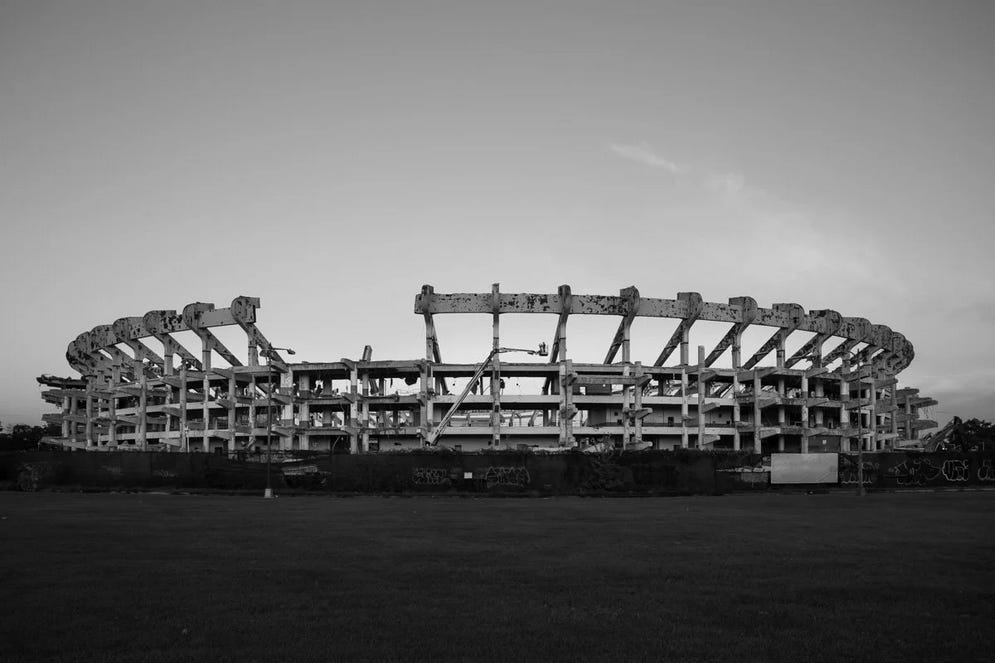
Eric Johnson, “RFK Stadium October 7, 2025” (Multiple Exposures Gallery)
MOST PHOTOGRAPHS OFFER AT LEAST A HINT OF NARRATIVE, but the shows at Multiple Exposures often take a tricky approach to storytelling, spinning episodic tales based purely on visual affinities. That’s not the case with the gallery’s current exhibition, Eric Johnson’s “The Last Days of RFK Stadium.” Presented in strict chronological order, the D.C. photographer’s 22 black-and-white pictures document the 2025-26 disappearance of the structure that debuted in 1961 as D.C. Stadium.
The stark images can be seen as journalistic, tracing the process from the basically intact edifice on January 17, 2025 to an empty, snow-covered lot in the final frame 373 days later. Yet Johnson’s pictures evoke myriad places and things -- a modern Stonehenge under a black, full-moon night; the ribcage of a beached, largely decayed whale; and, almost finally, the ruin of an ancient city.
Viewers needn’t have any personal connection to the vanishing stadium to find some of these photos poignant. The increasingly desolate upright supports reach yearningly for the sky, which seems to expand as the building recedes. As Johnson watches, RFK shrinks from a sturdy, self-contained hulk to a spindly frame for the firmament above it.
THE SKY IS ALSO AMONG THE SUBJECTS of Photoworks’s “Dis/Orientation,” but Scott Davis’s black-and-white pictures, unlike Johnson’s, are not grounded. The billowing shapes lack an identifiable vantage point and thus are gently dizzying. Davis, also a D.C. photographer, was inspired by East Asian screen paintings and Alfred Steiglitz’s pioneering 1925-34 abstract cloud photos, according to a gallery note.
While Davis’s 10 cloud studies can appear vast, the exhibition’s other 35 pictures are tiny closeups that sit quietly inside wooden frames. Some of the objects depicted in the smaller photos are recognizable, if occasionally oriented in eccentric ways. But these pictures aren’t concerned with representation. Davis’s cups, bottles, and leaves may not look as cosmic as his clouds, but both sets of photos are exercises in light, shadow, and insubstantiality. Glimpsed through Davis’s lens, glass and metal become as airy as water vapor.
Continuum: An Athenaeum Sculpture Invitational
Through March 8 at the Athenaeum, 201 Prince St., Alexandria. nvfaa.org. 703-548-0035.
Tawny Chatmon: Sanctuaries of Truth, Dissolution of Lies
Through March 8 at National Museum of Women in the Arts, 1250 New York Ave. NW. nmwa.org. 202-783-5000.
Rosemary Feit Covey: Cutting Near the Edge
Through March 7 at Morton Fine Art, 52 O St. NW, #302. mortonfineart.com. 202-628-2787. Open by appointment.
Matthew Curry: Altars
Through March 7 at Addison/Ripley Fine Art, 1670 Wisconsin Ave. NW. addisonripleyfineart.com. 202-338-5180.
Eric Johnson: The Last Days of RFK Stadium
Through March 8 at Multiple Exposures Gallery, Torpedo Factory, 105 N. Union St., Alexandria. multipleexposuresgallery.com. 703-683-2205.
Scott Davis: Dis/Orientation
Through March 7 at Photoworks, Glen Echo Park, 7300 MacArthur Blvd, Glen Echo. glenechophotoworks.org. 301-634-2274.