
Striking It Glitch
All sorts of snags at Addison/Ripley; Bob Burgess encounters color; at 250, the U.S. looks a bit off; stories on fabric and paper; Wayson R. Jones turns from pumice to paper
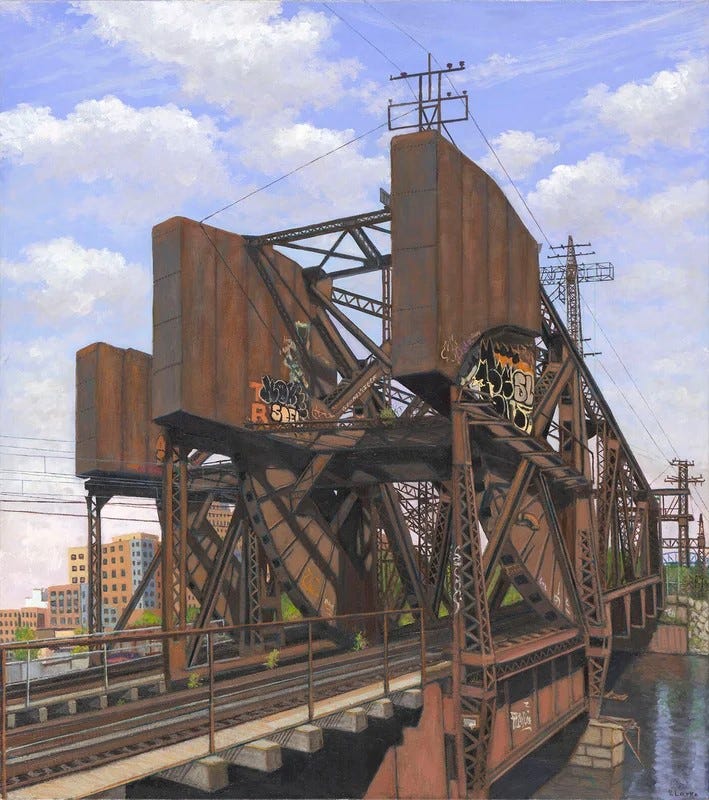
Valeri Larko, “Bronx Drawbridge, Starlight Park” (Addison/Ripley Fine Art)
THE CURATOR OF “GLITCHSCAPE,” TREVOR YOUNG, paints highways, airliners, and factories, so it’s hardly surprising that he picked Valeri Larko’s “Bronx Drawbridge, Starlight Park” for the 14-artist Addison/Ripley Fine Art exhibition. Larko’s precise depiction of the rusted and graffitied structure is stern and brawny, yet also elegant. It’s one of this fascinatingly diverse show’s several industrial vignettes, the most epic of which is Young’s own “Residual Sun,” a vast scene of a mysterious mechanism that contains a glowing red-orange orb.
Yet Young didn’t select only paintings of metal edifices. “Glitchscape” makes multiple sorts of links between representational and abstract pictures, not all of which appear glitchy. Thus “Residual Sun’s” central feature suggests a kinship with “Radiance Series: Dawn,” one of Mira Hecht’s luminous paintings of overlapping circles. The latter is cleanly rendered and entirely abstract, but its shapes and its play of light and dark complement Young’s otherwise quite different picture.
The more literally glitchy entries include Alex Schaefer’s semi-abstracted oil renderings of $1 and $5 bills; Reem Bassous’s suite of 30 unruly, graffiti-like black and gray gestures lined up tidily atop an international orange field; and five almost-sculptural paintings by Jason Gubbiotti. The last’s idiosyncratic works simultaneously build up and strip away, arraying brazen color contrasts atop hand-built and sometimes etched wooden panels.
The manner in which Gubbiotti interlocks form and abstract image resembles the strategy of near-realist Lindsay Mueller, who paints nature closeups on shaped wooden panels whose surfaces are lumpily distended by oil and acrylic pigment and other media. Although Taegan Treichel’s “Bell Garden” is just two-dimensional, its fairy-tale vision of a tightly compacted garden feels as immersive as Mueller’s contributions.
Sometimes the chaos promised by the show’s title is playfully literal, as in Schaefer’s “Bank of America in Flames, Five Points” a picture of a blazing suburban bank branch likely inspired by Edward Ruscha’s 1968 “Los Angeles County Museum of Art on Fire” (which is in the Hirshhorn’s collection). Matthew Clarke Davis offers two takes on a realistic mountainscape, but the second inverts the colors unnaturally. A glitch can be just another way of seeing.
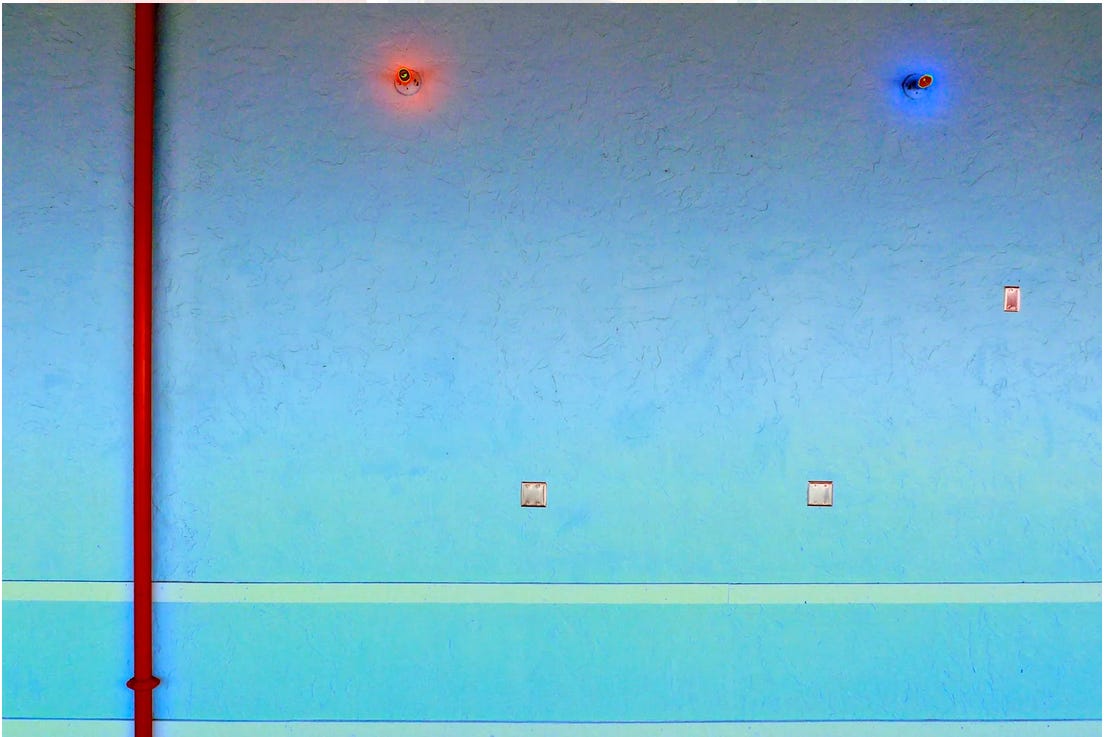
Bob Burgess, “Santa Monica” (Washington Printmakers Gallery)
NO PEOPLE APPEAR IN BOB BURGESS’S PICTURES, but should anyone amble in, she or he will have a place to sit. In “Encounters,” the photographer’s Washington Printmakers Gallery show, chairs serve as surrogates for humans. They populate elegantly composed pictures that are characterized by vivid colors, often discovered as large tracts or slabs of a single hue. In these photos, the world is often a found color-field painting.
The dominant color is often red, as in the case of the all-scarlet chair, table, and wall of “Bistro,” or the text-less crimson sign that foregrounds “Port Racine,” whose backdrop is a vivid azure sky. Even more painting-like is “Santa Monica,” whose gradated aqua expanse is punctuated by a vertical bar that appears to a metal drainpipe. Burgess is also drawn to the absence of hue, most wittily in “The Gallery,” which documents a white partition with no art hung on it, but with pale-blue light glowing coolly behind it.
The artist is not averse to scenes that tell a story. One picture observes a commercial building onto which some starstruck artist has rendered Mount Rushmore with an added fifth face -- not Trump, but Elvis. Another depicts a silvery truck that reflects the cloud-puffed sky that surrounds it, and into which it seems to be traveling. The sense of immersion is apt, for Burgess’s photos can be seen as plunges into pools of luxuriant color.
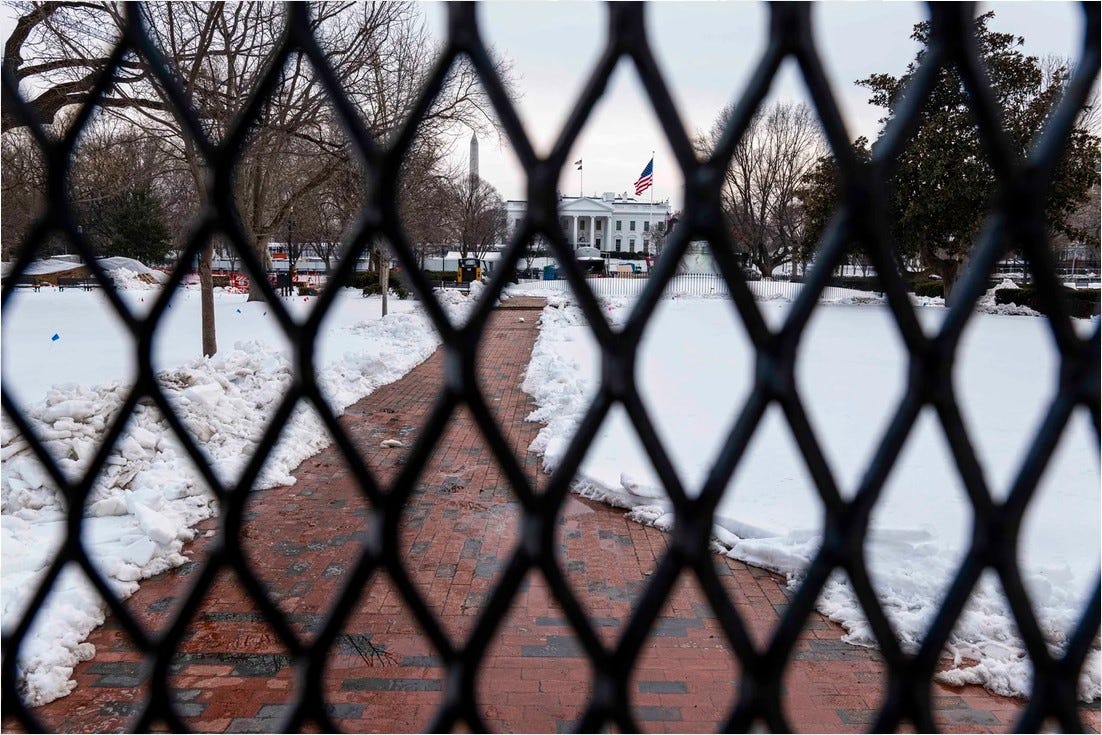
Van Pulley, “Of the People -- At a Distance” (Multiple Exposures Gallery)
FLAGS, SMALL TOWNS, AND WASHINGTON’S MONUMENTS are heavily featured in “America 250,” the semiquincentennial exhibition at Multiple Exposures Gallery. Juried by Andy Holtin, the show includes pictures by 11 of MEG’s 13 photographers. The selection includes views of the Mall and environs that gently tweak traditional postcard scenes: Soonin Ham spies flags in midair, fluttering improbably above clouds, and Stacy Smith Evans captures a dome -- the Capitol’s, presumably -- as a deformed reflection in water.
The most striking photos suggest that something’s off about the celebration. Van Pulley’s “Of the People -- At a Distance” gazes at Lafayette Square Park, a public space since 1804, through the lattice of a metal fence that prevents access. The U.S. flag in Sarah Hood Salomon’s “American Dreams” hangs in the doorway of a weathered storefront that appears to be abandoned. More whimsically, Evans finds another rustic shop facade where the crisis is only temporary: “Gone to Dentist / Return ASAP,” reads a hand-lettered sign that promises an imminent revival of normality.
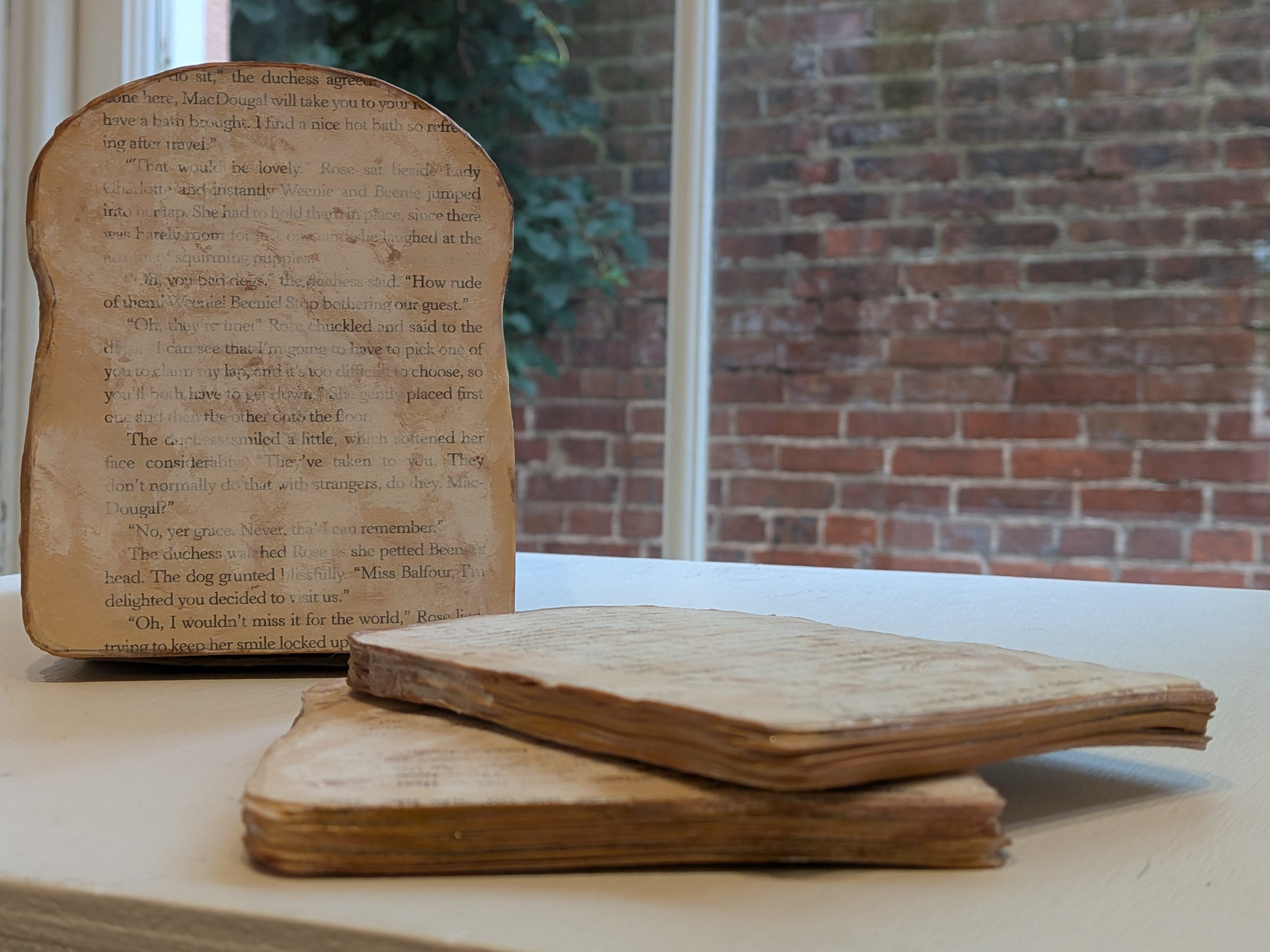
Joan Dreyer, “Reading Nutrition” (photo by Mark Jenkins)
CLOTH AND PAPER ARE THE PRINCIPAL MATERIALS employed by New Image Artists, a local group founded in 1980. The 11 current members are showing work in various media and at a range of scales in “Story Cloths and the Book.” Several of the most striking pieces in the Athenaeum show transmute books into eloquent but illegible objects.
Dominating the main gallery is Candace Edgerley’s “Winged Flight,” a large pair of white-tufted wings fixed on the wall near the top of the high-ceilinged room, as if ascending. Quilted in shades of black, gray, and bronze, Dominie Nash’s “Foliated Calligraphy” arrays abstracted leaves in a format reminiscent of a Japanese scroll. Linda Colsh’s “Elsewhere” is a mostly black quilt with repeated iterations of the same small figure in a long coat, interspersed with words such as “brouillard” (French for “fog”) and “miasma.” The piece seems to gaze into the past through the mists of time.
Colsh’s text is cryptic but, ironically, easier to read than that in several book-based pieces. Joan Dreyer’s playful “Reading Nutrition” pulps book pages into a sort of flour to yield a loaf of sliced bread, studded with phrases. B.J. Adams’s “Once Read, Not Forgotten” is a construction of 48 clumps of fanned pages, in alternating horizontal and vertical alignments. Saaraliisa Ylitalo’s “Disconnected” is a circle of tightly spaced pages, dyed blue at the top. Words yield to patterns, losing their meaning and yet still making visual sense.
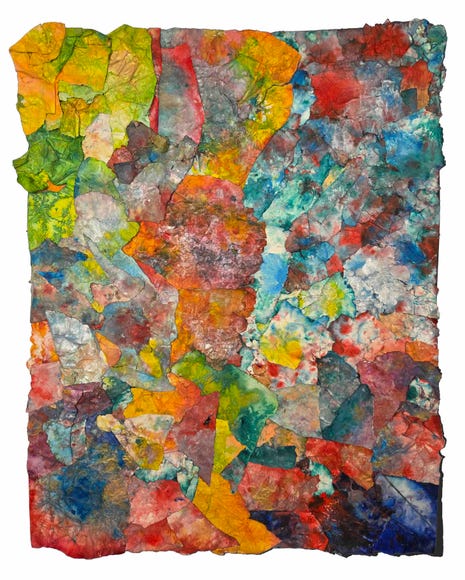
Wayson R. Jones, “A Mountain by Myself (After Gilliam)” (Hemphill Artworks)
TEXTURE HAS ALWAYS BEEN ESSENTIAL to Wayson R. Jones’s paintings, but somewhere along the way it got upstaged by color. Once a purveyor of impastoed monochromatic abstractions, the local artist now makes pictures that pop with ardent greens and oranges. His latest exhibition, “The Full Moon Is My Girlfriend,” is viewable only via Hemphill Artworks’s website, so the painter’s sculptural use of pumice gel is hard to appreciate. But the vivid acrylic hues transmit just fine across the web.
Jones’s compositions have also evolved. Formerly in the mode of 1960s color-field painting, they more recently trended toward abstracted landscapes. This new set of artworks marks another shift: The pictures seem to portray surreal imaginary creatures, as suggested by such titles as “God Lamprey” and “Pink-Hooded Figure, Facing Away.” The inspirations for the vaguely animal-like or humanoid forms include masks and African and Amerindian ritual figures, not everyday people. Rather than set out to portray such fanciful beings as “Yellow Bird of Existential Grief,” Jones allows them to emerge intuitively from experiments with color and shape.
Two of the pieces are the result of a different sort of experimentation. Made of brightly tinted shreds of paper rather than pumice and pigment, these collages are as colorful as the other pictures, but feel airier and appear more luminous. The title of “A Mountain by Myself (After Gilliam)” indicates a debt to Sam Gilliam, who’s best known for using the stained-paint technique of earlier Washington colorists while abandoning flatness for canvases that were creased and draped. Jones’s break with his previous style may not be quite so bold as Gilliam’s, but it does demonstrate the artist’s restlessly ongoing evolution.
Glitchscape
Through July 25 at Addison/Ripley Fine Art, 1670 Wisconsin Ave. NW. addisonripleyfineart.com. 202-338-5180.
Bob Burgess: Encounters
Through July 26 at Washington Printmakers Gallery, 1675 Wisconsin Ave NW. washingtonprintmakers.com. 202-669-1497.
America 250
Through July 26 at Multiple Exposures Gallery, Torpedo Factory, 105 N. Union St., Alexandria. multipleexposuresgallery.com; 703-683-2205.
Story Cloths and the Book: Work by New Image Artists
Through July 26 at the Athenaeum, 201 Prince St., Alexandria. nvfaa.org. 703-548-0035.
Wayson R. Jones: The Full Moon Is My Girlfriend
Through July 25 at Hemphill Artworks online. hemphillfinearts.com. 202-234-5601.