
Space Is the Place
Paul Myoda’s luminous nooks; Robin Croft’s metal absurdities; John Thomas Paradiso layers gay identity; Fred Zafran’s urban solitaire; Jessica Drenk reclaims the disposable; Willem de Looper evolves
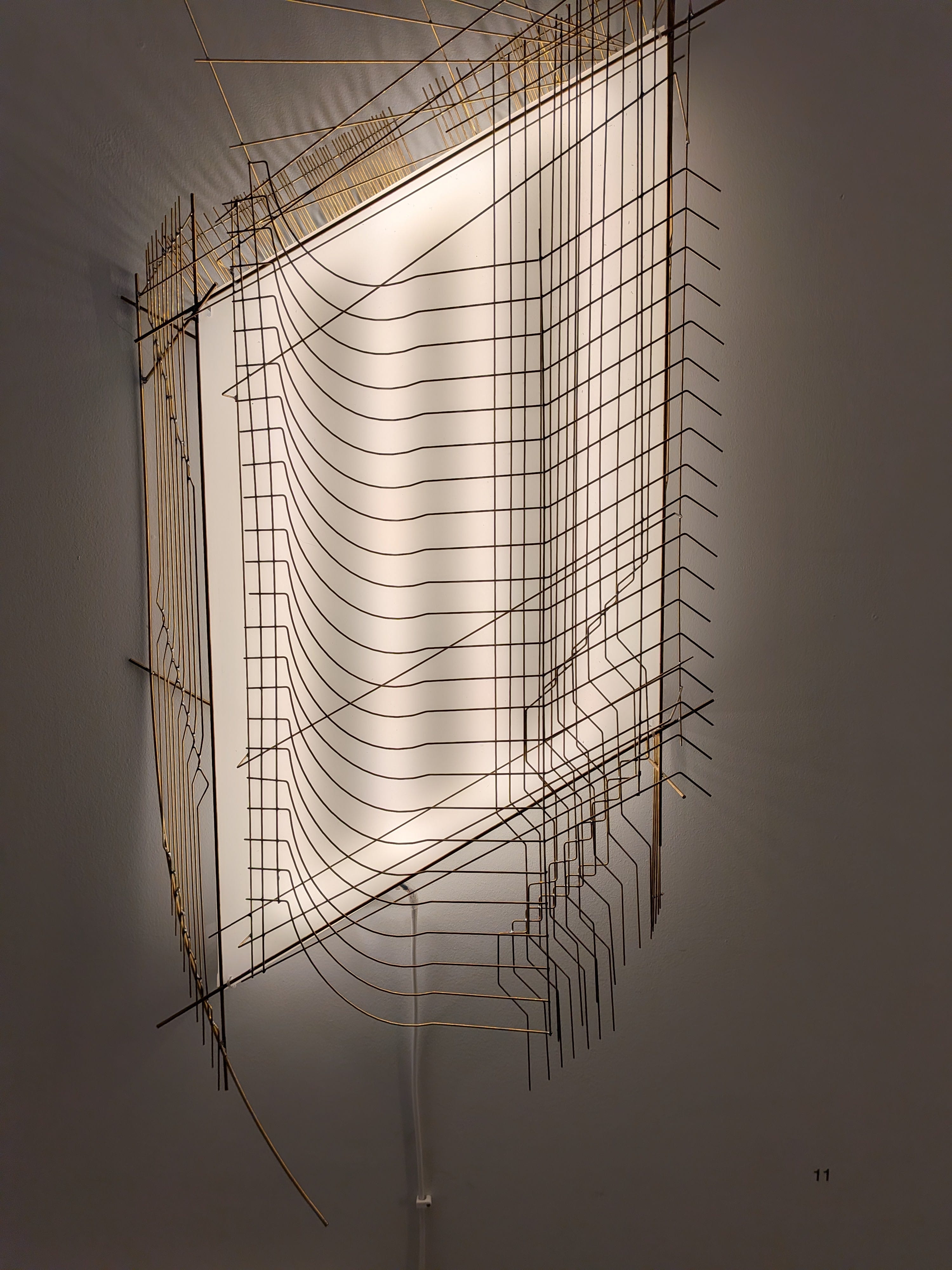
Paul Myoda “Poly-Perspective: Warped Plane” (photo by Mark Jenkins)
A FEATURE OF TRADITIONAL JAPANESE ROOMS, a tokonoma is a recessed area designed not for storage but for the display of artworks. Four of the sculptures in Paul Myoda’s “Poly-Perspectives,” all of which have the show’s name as their primary title, are subtitled “Tokonoma” (sometimes followed by a number). While the reference is not literal, this Spilt Gallery exhibition is indeed keyed to space, confined by arrays of metal rods but opened by light.
A U.S.-born artist of Japanese heritage, Myoda teaches at Brown University in Rhode Island. He makes sculptures that appear industrial, yet are inspired by nature as well as architecture and theoretical geometry. Mounted on poles or on the wall, the sleek copper-and-brass constructions usually incorporate LEDs that cast intricate shadows. The sculptures appear simultaneously hard and soft, solid and illusory.
Myoda teaches drawing as well as sculpture, and these pieces are, in a sense, both. The straight-lined poly-perspectives resemble mathematical illustrations or sketches of high-tech machines; these affinities are especially discernible in the four sculptures that don’t have built-in illumination. Yet ambient light endows even these four pieces with vast networks of shadows. By rendering his lattices with metal shafts in space rather than ink or pencil on paper, Myoda assures that they’ll be complicated by their environs.
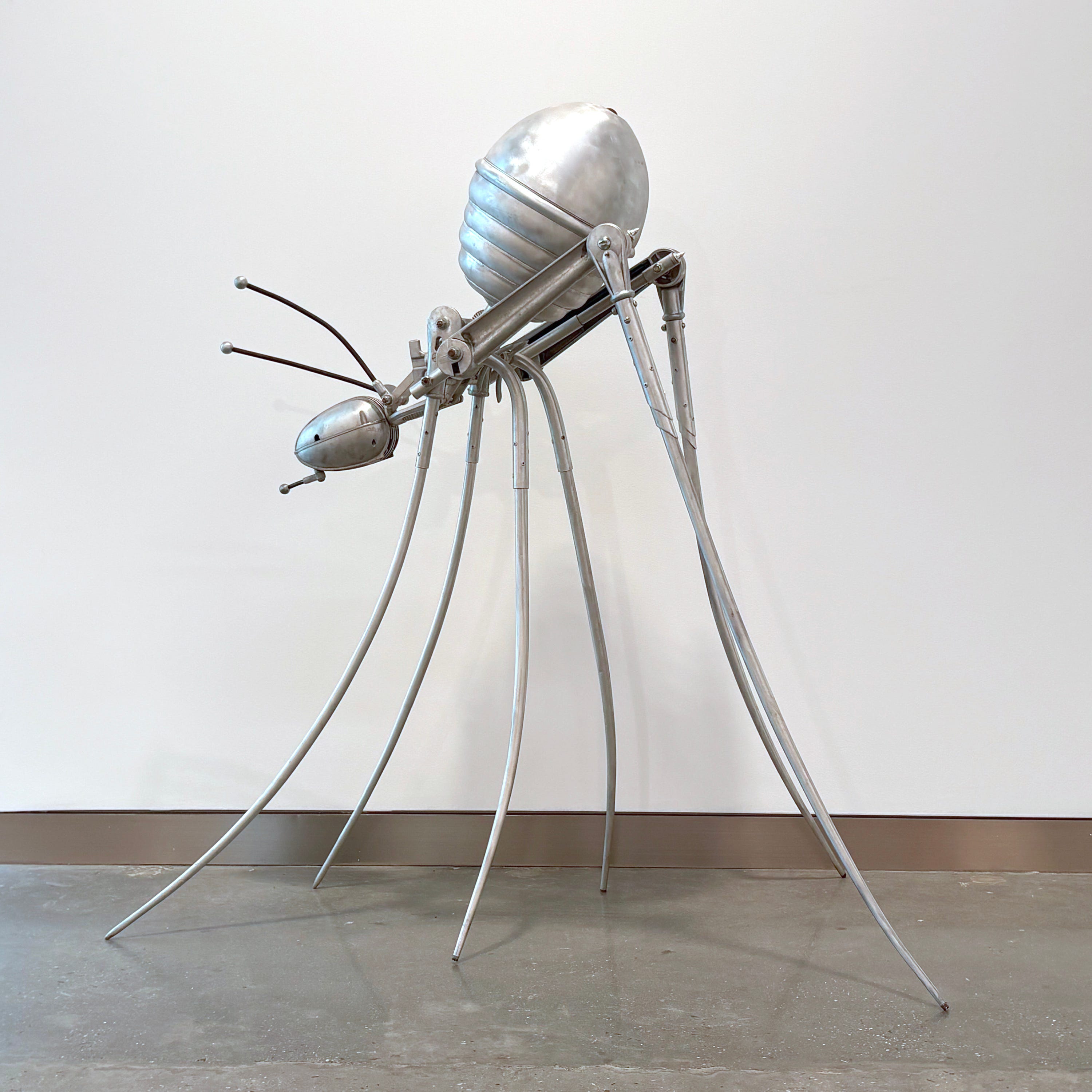
Robin Croft, “Anxious Insect (After Kafka)” (Fred Schnider Gallery of Art)
THE CENTERPIECE OF ROBIN CROFT’S “A Concise Retrospective” is a large creature, dubbed an “anxious insect,” made of readymade aluminum and steel parts. The sculpture is not as regular as one of Myoda’s metal frameworks, but it’s tidier than many of the entries in Croft’s Fred Schnider Gallery of Art show. The Northern Virginia artist sometimes takes a surrealist’s delight in juxtaposing random objects and ideas.
Thus “Fête de tête,” which balances a chalice and a teapot on an askew tray at the top of a seemingly rickety assemblage whose axis is a metal crutch. Like “Anxious Insect (After Kafka),” the sculpture is made entirely of silvery metal. But where one emulates an organic creature, the other is exuberantly unnatural.
This survey of Croft’s work from 1988 to 2022 includes drawings, rendered with ink and pencil. The pictures portray stylized humans, notably the bleeding body that stretches across three panels of circa-2020 societal chaos in “Reclining figure triptych.” Yet the drawings also depict tools and mechanisms, as if these are inseparable from their users and creators.
Transformation and motion are integral to the show, which features two sculptures on wheels. “Perpetual motion machine (Sisyphus machine)” is constructed in part of metal plates embellished with truncated numbers and is perched on a wooden chassis, ready to be tugged like a giant pull toy. Unfunctional yet imposing, the device has the strength of its own absurdity.
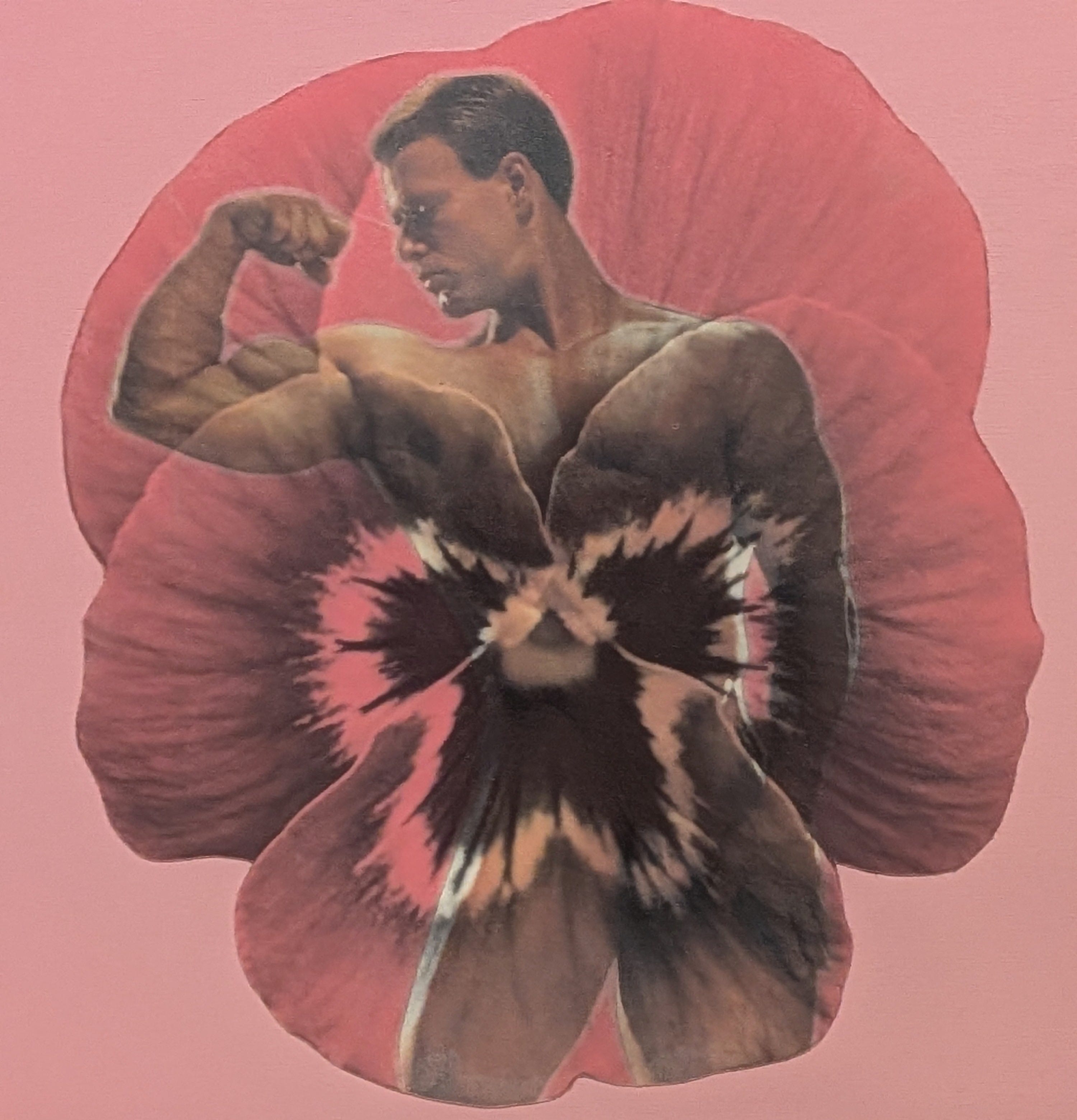
John Thomas Paradiso, “Bicep Pansy” (photo by Mark Jenkins)
ARCHETYPAL MALE AND STEREOTYPICAL FEMALE unite in the mixed-media assemblages of John Thomas Paradiso. The local artist (and Portico Gallery at Studio 3907 proprietor) is known for combining photography and embroidery to represent the complexity of gay-male culture. “Sexual Tensions: Nightmares and Daydreams,” his Artists & Makers show, includes examples of his recent output, which incorporates flowers, hyper-macho poses, and yellow caution tape. But the exhibition also reaches back almost four decades to showcase pieces that will likely be less familiar to D.C. area viewers.
The older work (some of which is sexually explicit) was made during the early days of the HIV/AIDS crisis and features what appears to be autobiographical content. “Medicine Cabinet” is filled with pill bottles, many of them sporting the artist’s face. There’s also an ominous vibe to “The Hunt,” a wall sculpture with a wooden cross-piece that’s bedpost on one end, rifle butt on the other -- although that butt could just be a playful reference to a part of the male anatomy also featured in the hybrid construction.
The more recent items are more directly celebratory. The artist submerges photos of nude men under crocheted doilies and overlays muscle-flaunting guys on pansies, a flower whose name was once used as an anti-gay slur. The individual components range from offhand to carefully crafted, but all are put together meticulously. Paradiso’s layered collages may wink impishly at the viewer, but they’re fabricated with utmost seriousness.
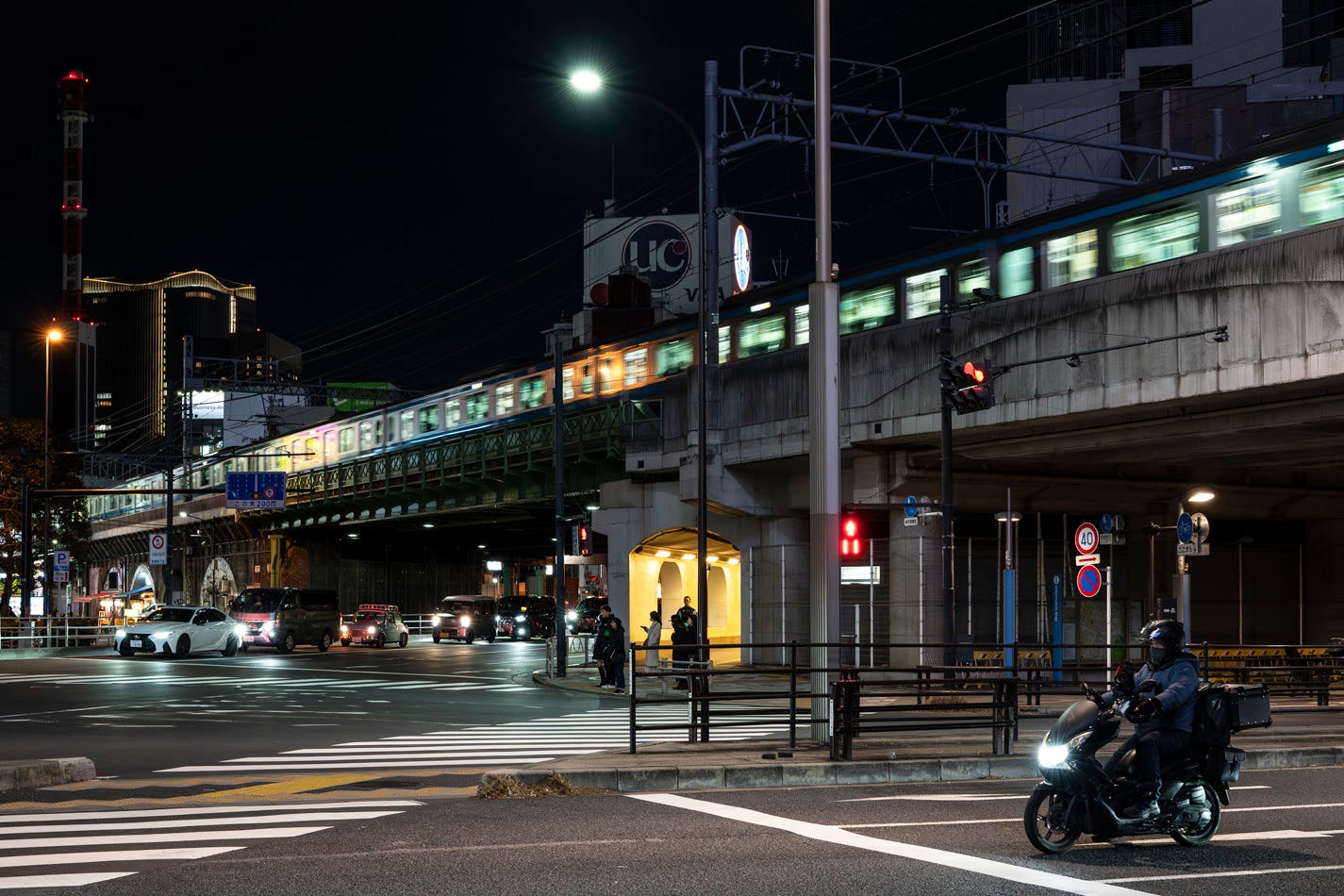
Fred Zafran, “Just Passing Through_04” (Multiple Exposures Gallery)
ONE PHOTOGRAPH IN FRED ZAFRAN’S Multiple Exposures exhibition spies a directional sign for Hama-rikyu Gardens, a Tokyo park whose origin dates to the 17th century. But the Northern Virginia artist doesn’t head there, or to any other site that evokes Japan’s traditional culture. Many of the pictures instead focus on features that could be in London, New York City, or Dubai -- generic urbanism for the rootless global nomad. The show’s title is “Just Passing Through,” and Zafran further seeks to conjure a feeling of transitoriness by photographing through windows or screens to convey the vantage of someone who’s outside looking in.
Several photos depict train stations or railroad overpasses, and the signage is, of course, partly in Japanese. Zafran also offers glimpses of such characteristically Japanese sights as a bank of drink vending machines and a lineup of bicycles beneath a bridge’s metallic span. But the pictures depict just two upscale areas of central Tokyo, near the harbor, where most of the buildings are recent and in the sleek, bland international style.
Made during the winter of 2024, and often at night, these photographs depict a city that’s bustling but bundled up -- even the locals are transient, headed for well-heated refuges. The chill seems metaphorical as well as palpable, as if the whole city is giving visitors the cold shoulder. Yet Tokyo is a city of light, and that profuse illumination -- soft or harsh, direct or refracted -- provides a sense of enchantment. Zafran is just passing through, but it appears he’d like to linger.
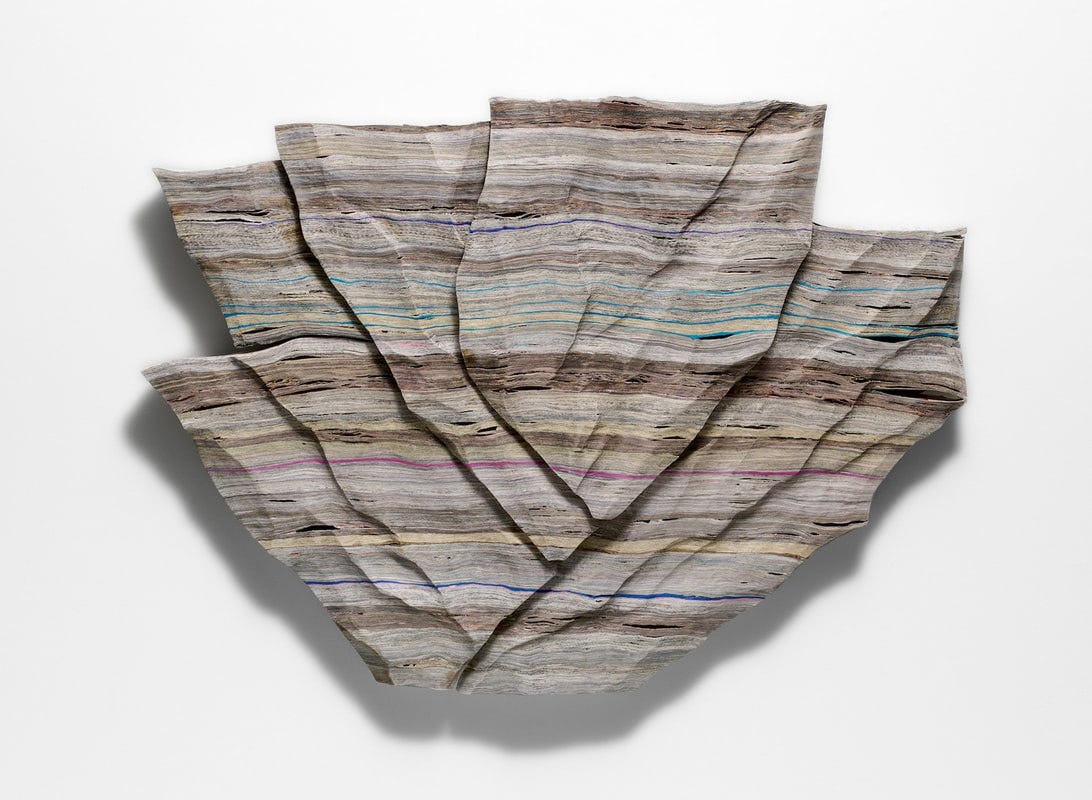
Jessica Drenk, “Aggregate Stone 5” (Adah Rose Gallery)
THE DISPOSABLE BECOMES MONUMENTAL, seemingly, in Jessica Drenk’s recent sculptures, exhibited alongside some older work at Adah Rose Gallery. The show, “that is a made place, created by light,” features several wall pieces that appear to be excavated chunks of stone -- jagged, creased, and striated. The sculptures are actually made of junk mail that’s been pressed together and then carved and sanded. The upstate New York artist transmutes mass-produced trash into objects that pay homage, playfully yet respectfully, to the natural world.
Drenk prefers basic ingredients that are modest, commonplace, and manufactured. In one of the older pieces, she abrades multiple lengths of white PVC pipe into a sort of tectonic map of an imaginary hillscape. In another, she turns old books into what appears to be a ringed slice of a tree, symbolically rewinding the volumes into their original substance. A 2025 creation revisits the artist’s earlier transformations of clumps of tightly bunched pencils into hollow, shell-like forms.
The artist is mostly concerned with material and metamorphosis, but one recent sculpture introduces another factor. “Compression 14” consists of slabs of abandoned books, pressed together into a series of undulating valleys and peaks, all contained by a rectangular wooden frame. Because the pages are arrayed at different depths, stray bits of text are legible. The result is mostly ribbons of squashed pulp, but also contains glimpses of ideas.
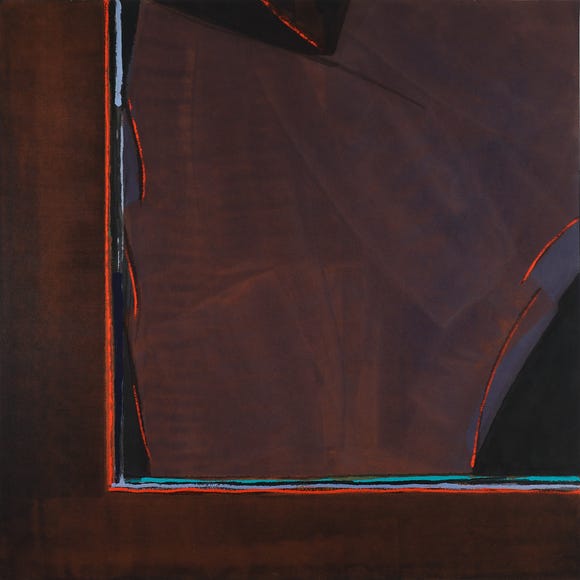
Willem de Looper, “Untitled (Window Series)” (Hemphill Artworks)
MADE OVER 22 YEARS, THE 13 PAINTINGS in “Evolution of an Artist” show Willem De Looper’s continuing fascination with swirling color. The Dutch-born abstractionist, who ascended from a guard to chief curator at the Phillips Collection, was a Washington colorist, if not exactly a member of any school. He adapted the technique of Morris Louis and Kenneth Noland, whose diluted acrylic pigments seeped into untreated canvas.
The formal problem de Looper ponders in these untitled all-over pictures, on exhibit at Hemphill Artworks’s website only, is the transition from one hue to the next. The earliest painting, from 1966, overlays streams of translucent colors, each rivulet well defined yet blending into others in places. The second one, made a year later, sets off brightly hued petals with black outlines in the manner of a stained-glass window.
After that, de Looper’s style becomes softer and more fluid, a look achieved by pouring successive gushes of paint. Some of the later pictures do include lines of various sorts, from the curving horizontal bands of a mostly blue 1980 painting to the short green stitches and the sketchy frame, respectively, of ones made in 1983 and 1987. With the latter work, the most recent in this selection, de Looper returns -- by accident, most likely -- to the strategy of that stained-glass-like 1967 painting. Rather than fill the canvas with bold color, he fixes vivid details within a near-black expanse. The effect is electric: The hot reds and intense blues flash like neon in the darkness.
Paul Myoda: Poly-Perspectives
Through June 27 at Spilt Gallery, 2529 P St. NW. spiltdc.com.
Robin Croft: A Concise Retrospective
Through June 28 at Fred Schnider Gallery of Art, 888 N. Quincy St., Arlington. fredschnidergalleryofart.com. 301-852-8042.
Fred Zafran: Just Passing Through
Through June 28 at Multiple Exposures Gallery, Torpedo Factory, 105 N. Union St., Alexandria. multipleexposuresgallery.com. 703-683-2205.
John Thomas Paradiso: Sexual Tensions: Nightmares and Daydreams
Through June 24 at Artists & Makers, 11810 Parklawn Dr., Rockville. artistsandmakersstudios.com. 240-437-9573.
Jessica Drenk: that is a made place, created by light
Through June 28 at Adah Rose Gallery, 3766 Howard Ave., Kensington. adahrosegallery.com. 301-922-0162.
Willem De Looper: Evolution of an Artist
Through June 27 at Hemphill Artworks online. hemphillfinearts.com. 202-234-5601.