
Soft Feelings
Nathan Mullins and Marsha Goldberg’s blurred lines, Pat Goslee’s flowery instincts, Beverly Logan’s repurposed houses, & Andrea Kraus’s suicidal closeups
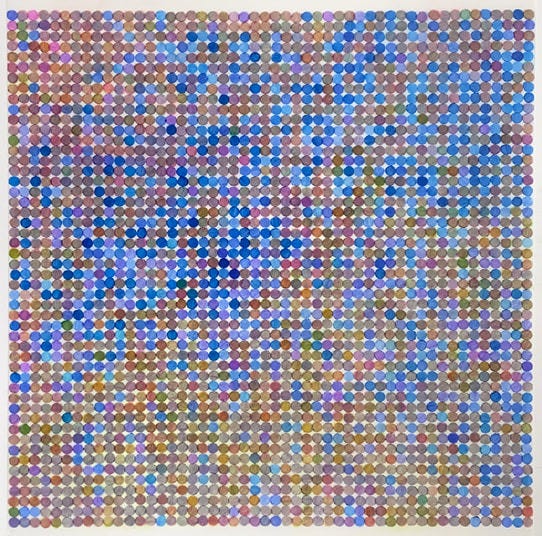
Marsha Goldberg, “Campo XLV” (Adah Rose Gallery)
THE WORLD IS SOFT, STILL, AND A LITTLE BLURRY in the paintings of Nathan Mullins and Marsha Goldberg, currently co-billed in Adah Rose Gallery’s “A Small Moment of Amazement.” Mullins is a representational but impressionistic oil painter whose recent works include numerous still lifes of books grouped by topic or author. His other pictures, all small and hushed, depict domestic scenes populated by cats and women who are reading, sleeping, or talking.
The last is the occasion for one of the Mississippi artist’s gentle formal experiments: four paintings of the same pair of conversationalists at the same small-town location, but at different times of day. The quartet demonstrates Mullins’s careful rendering of light and shadow, but also his bent for distilling real-world objects to their geometric fundamentals. Buildings and books become rectangles, simple and direct yet far from hard-edged in the artist’s cottony style.
Disruptive events, when they occur, are merely suggested. “Sunburn” ponders the partly red back of a partly naked woman, whose discomfort is apparently not severe: a cat curls up on her covered legs. The artist also offers a diptych that is, playfully, vertical rather than horizontal. The action, such as it is, of “K Revises the Novel” is wholly in the lower panel; above are just shelves, plants, and the top of a lamp-shade. The top half reveals the part of Mullins’s domain that is nothing but color and shape.
That’s where Mullins’s approach overlaps that of Goldberg, whose pictures are purely abstract but equally attuned to illumination and elemental form. The New Jersey artist paints fields of closely abutting dots whose colors are complexly layered and edges are softly defined. She applies acrylic ink on synthetic Yupo paper, whose non-absorbent surface allows the pigment to pool and meld. The small circles are positioned regularly, but rendered freehand and with several coats in different but complementary hues. The process yields dots that appear to glisten and twinkle, and sometimes seemingly to undulate across the compositions.
The artist’s recent works include several in the “Campo” series, inspired by the light of Venice. (”Campo” is Italian for “field,” and is also applied to urban squares.) These are rectangular and covered with dots that subtly shift color. Other paintings use blocs of small, similarly-hued circles to define two or more eccentric shapes that are placed in opposition to each other. The sense of contrast and motion is stronger in these pictures, but all of them pulse and glimmer. The multiple levels of color in each dot generate a force that crackles outward, energizing the entire field.
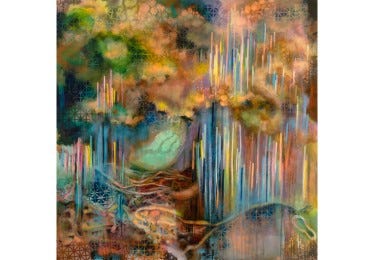
Pat Goslee, “Sensing Rain” (Popcorn Gallery)
PAT GOSLEE IS AN ABSTRACTIONIST, but she sometimes incorporates recognizable images into her richly tangled paintings. Those visual allusions have changed over time, and so have the prevailing color schemes. Or at least that’s the case with the recent pictures in “As Syllable from Sound,” the D.C. artist’s show at Glen Echo Park’s Popcorn Gallery. The representational glimmers, which in the past could suggest viscera, are currently trending toward the floral. And many of these paintings are keyed to the contrast between pinks and greens, hues that suggest gardens.
Little if any of this is intentional, according to the artist’s statement. She constructs her dense compositions “instinctively,” she writes, “placing pattern atop pattern.” There’s a liquid quality to some of these pictures -- one includes a spilled-coffee stain -- that occasionally recalls Maggie Michael’s sloshed-color style. But there are also repeated decorative elements produced by stenciling, which yields small squares, ribbon-like vertical lines, and lacy filigree. The last may be the result of actual lace, since Goslee employs secondhand fabrics as one of her form-generating devices. A sense of remaking or reclaiming animates these pictures, some of which are on canvases made from recycled plastic bottles.
The show’s centerpiece is a large triptych whose soft shapes and blurry gestures coalesce into something epic. Tellingly, the painting is called “Muscle Memory.” That title suggests that the act of making such an artwork -- layering, constructing, establishing rhythms of soft and hard, free and stenciled -- is what defines it. The artist herself may ultimately see rain, flowers, and other phenomena in the finished picture. But serendipity, not overall design, is what summons such associations.
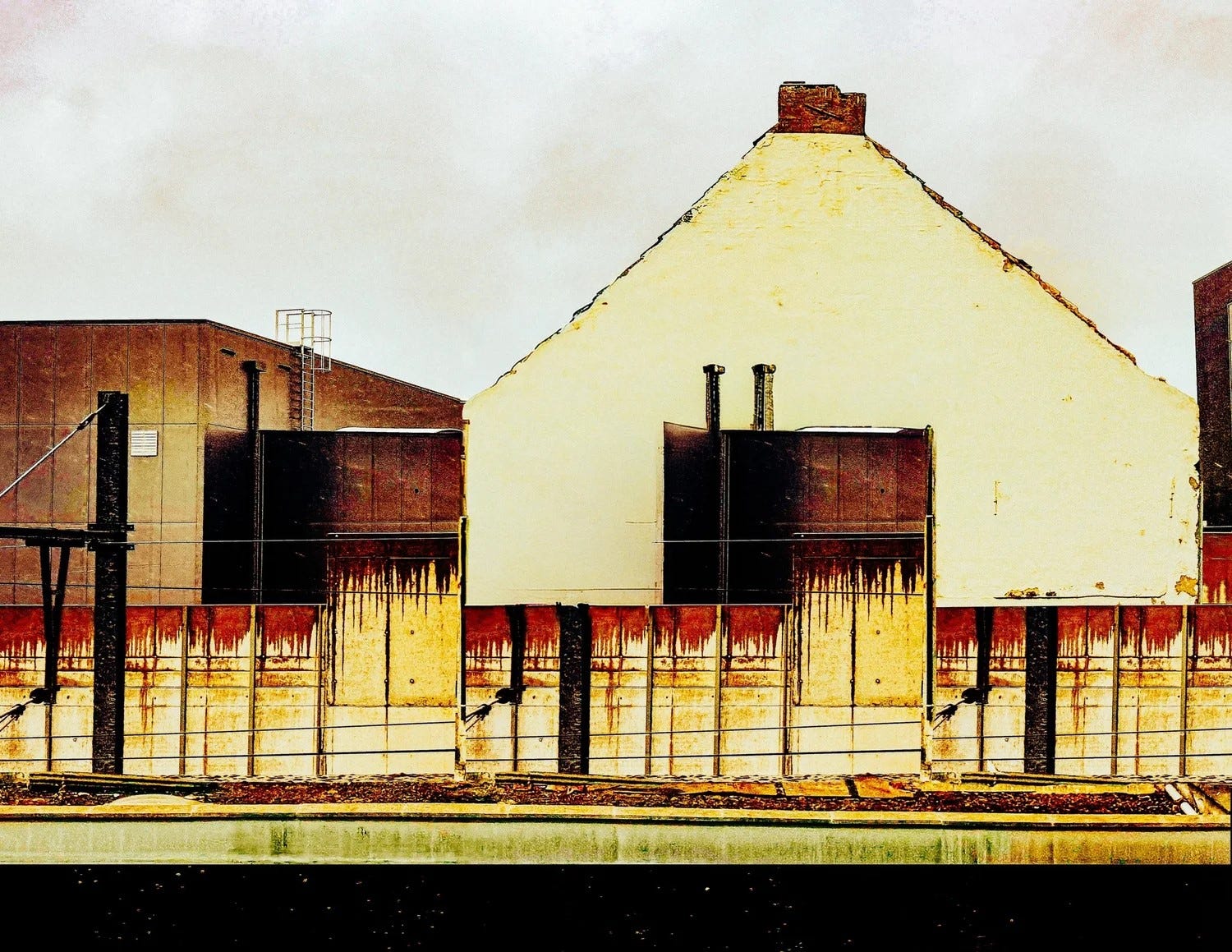
Beverly Logan, “Blank Building” (Studio Gallery)
THE SIMPLEST OF BUILDINGS BECOME PORTALS into alternate universes in Beverly Logan’s photo-collages, each centered on a house, barn, or elementary industrial structure. These everyday edifices give a sense of ordinariness to the pictures in “Everything Is in Order,” the local artist’s Studio Gallery show. But Logan gently subverts her collages’s naturalism with bright colors and unexpected details. Not everything is orderly in pictures that place buildings in water, towering over roads, or floating in a cloud bank.
Logan takes a newly streamlined approach in this show, curated by Adah Rose Gallery’s namesake, Adah Rose Bitterbaum. Most of the imagery appears commonplace, and the transformations are often executed simply with color shifts. In “Greenhouse,” the title structure seems to be siphoning its strong hue from the adjacent grass, which has turned orange as a result. Red or orange buildings clash vibrantly with electric-blue skies, and puffy white clouds bid to shroud everything. Indeed, “White House with Window” appears to have been rendered as flat as a sheet of paper, to serve as a stage set for the blue-and-white firmament behind, around, and within it. Solid as they may seem, the structures in Logan’s alchemical collages are no more substantial than water vapor.
“Suicide printing” is the attention-getting term Andrea Kraus uses to describe the process by which she made the linocuts in “Layer Perfect,” also at Studio (and also curated by Bitterbaum). More commonly termed “reduction printing,” the technique involves applying one color of ink and then recarving the same matrix for each subsequent impression. (This is “suicide” because the earlier versions of the block can’t be brought back to life.) The local artist uses the strategy to produce pictures in which vivid and evocatively smeary colors are contained, sometimes just barely, by bold black forms.
These prints mostly explore Asian motifs, usually in tight closeups that banish the wider world. Parasols, marionettes, and swimming koi are presented from an immersive, nose-against-the-glass perspective. Sometimes Kraus takes a few steps back, notably for two fanciful pictures in which a woman defies real-world scale by reclining under a bonsai tree. This figure can be seen as a stand-in for the spectator. She’s been allowed to infiltrate an emblematic Asian scene, much the way Kraus invites the viewer’s eye to enter her iconic vignettes.
Nathan Mullins & Marsha Goldberg: A Small Moment of Amazement
Through Feb. 20 at Adah Rose Gallery, 3766 Howard Ave., Kensington. adahrosegallery.com. (301) 922-0162.
Pat Goslee: As Syllable from Sound
Through Feb. 15 at Popcorn Gallery, Glen Echo Park, 7300 MacArthur Blvd., Glen Echo. glenechopark.org/partnershipgalleries. 301-634-2222.
Beverly Logan: Everything Is in Order
Andrea Kraus: Layer Perfect
Through Feb. 21 at Studio Gallery, 2108 R St. NW. studiogallerydc.com. 202- 232-8734