
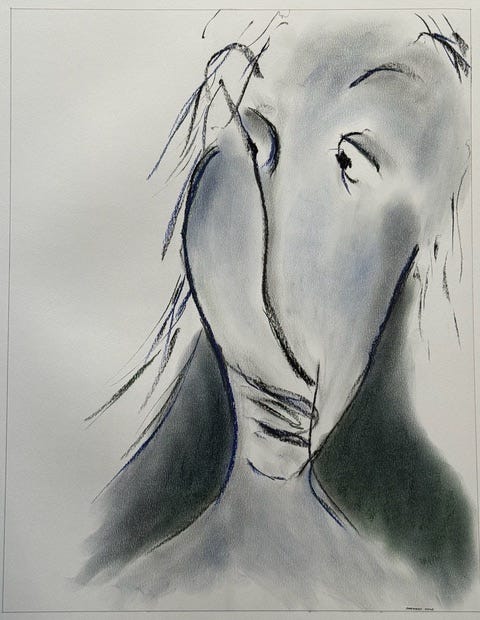
Geoff Desobry, “The Escapee” (Waverly Street Gallery)
GEOFF DESOBRY’S EXPRESSIONIST SKETCHES of faces are first impressions, but deepened by second thoughts. The 16 drawings in “Untamed Spirits,” the local artist’s Waverly Street Gallery show, center on a few angular lines. These convey the basic elements of a human visage: eyes, a nose, only sometimes a mouth. The quick figurative strokes are in black, and often accented by touches of blue and green. Yet the strongest contrast to the improvised gestures is provided by soft, mostly gray tones that conjure shadows, whether on the face or behind it.
The goal is represent people who “thrive connected to wildness,” according to the artist’s statement. The pictures’s titles range from “Determination,” the only picture with a fully dark background, to “The Prisoner,” an eyeless visage that’s the most abstracted of the renderings. In both cases, the primary lines appear light and even ephemeral, yet are weighted by smudgy shadowing that give depth and substance to cheeks, eye sockets, and other contours that elude direct light. The spirits may be wild, but darkness anchors them in place.
Desobry’s drawings are neatly complemented by several Cristian Ianculescu sculptures, also of faces. Some of these also have a sketchy quality, even though they’re rendered in marble or alabaster. The one most akin to the pastel pictures is “The Argument Within,” which boxes a face into the tight confines of a vertical bar. (A possible alternate title? “The Prisoner.”)
In this array, Ianculescu’s style ranges more widely than Desobry’s. “What Remains” is the most naturalistic, and “Janus in Suspension” the most mythological. The Roman god’s countenances aren’t on opposite sides of his hand but instead at some distance from each other, linked by tendrils of carved-marble hair. It seems appropriate that the wildest of the local sculptor’s offerings depicts more than one face.
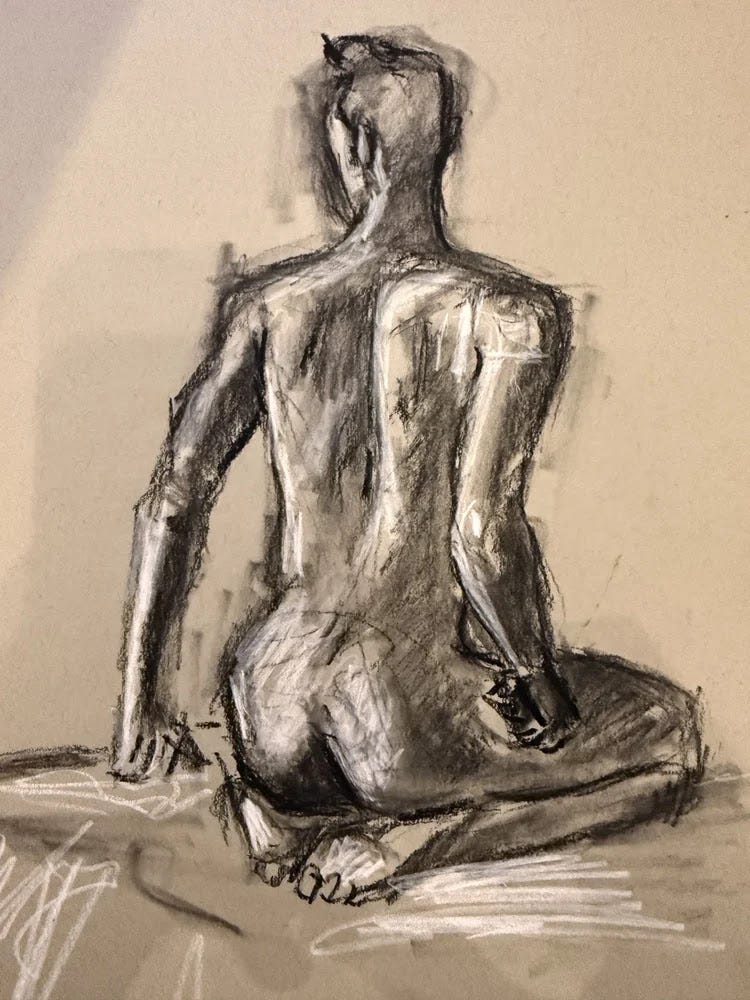
Gregory Newcomb, untitled (Foundry Gallery)
THE PICTURES IN FOUNDRY GALLERY’S CURRENT SHOW are mostly sketches of mostly naked humans, captured during the venue’s weekly figure-drawing sessions. But a few of the 15 artists depart significantly from the premise of “The Sketches: A Figure Drawing Exhibit.” Alan Hirsch’s entries are digitally altered photographs in which flesh is distorted and body parts sometimes oddly doubled. Travis Clark’s comic-book-like renderings of female nudes are fully realized, without a hint of sketchiness.
Even among the artists who take a more traditional approach, there’s plenty of variation. Elegantly finishing pencil drawings with watercolor, Stefano Scafetta often depicts models who are clothed. Matt Malone’s raw style recalls pre-Cubist Picasso, notably in a picture of four overlapped reclining bodies. Both Xiaowei Song and Gregory Newcomb stress animal-like in rear views of lithe figures. Annika Bjorkholm neatly abstracts figures she outlines in white on tan paper.
Colored paper also features in the superb pictures of Luis Zanforin, who draws with the assurance of a Renaissance master. Made with chalk and charcoal, usually on dark gray sheets, the artist’s pictures are beautifully modeled and shaded to convey mass and contour. These are sketches, but endowed with such cunning detail that they appear intensely physical.
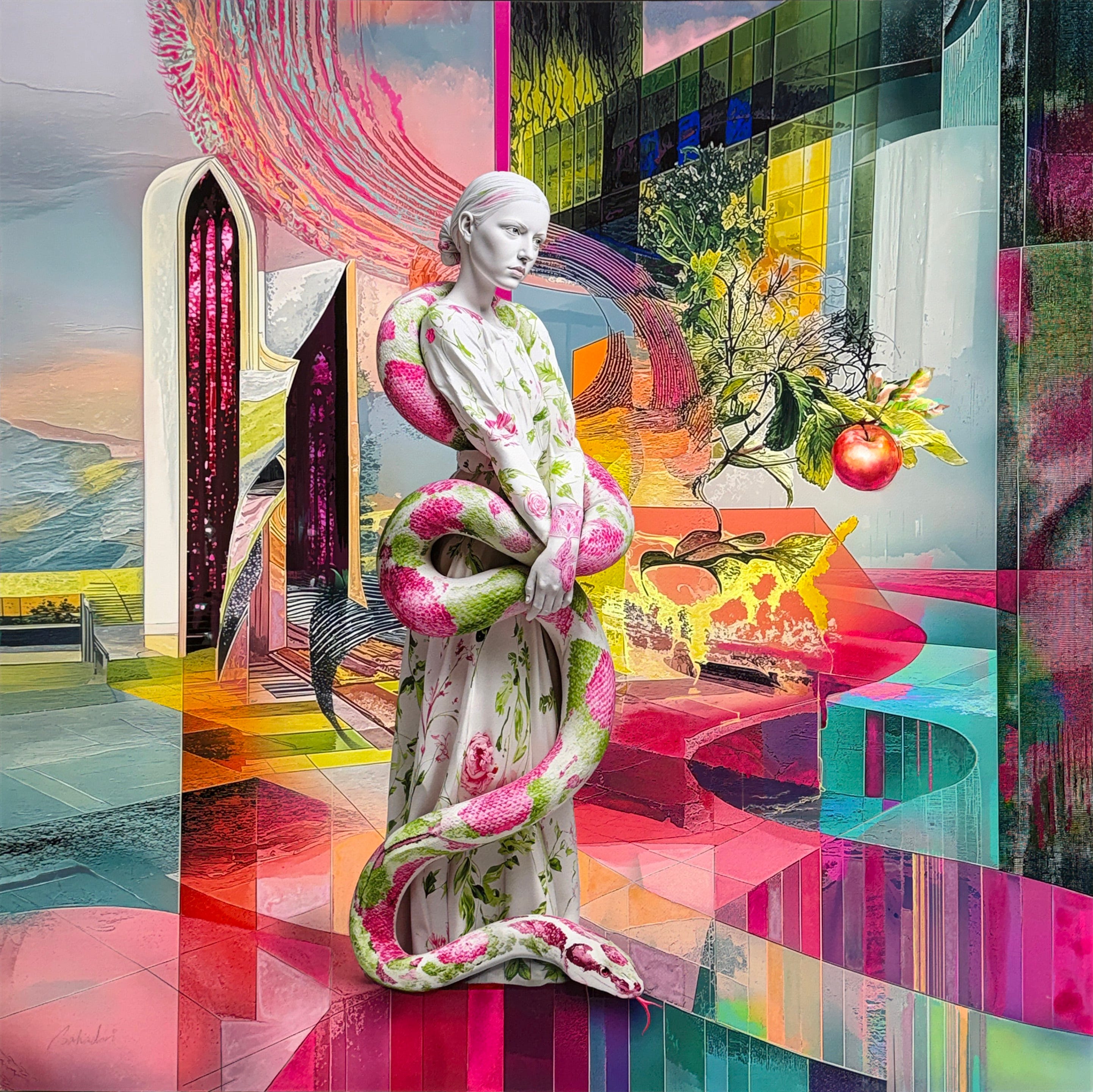
Abol Bahadori, “Temple of Eden” (courtesy of the artist)
A FUGUE OF VISUAL COUNTERPOINTS, Abol Bahadori’s mixed-media pictures are simultaneously mythical and realistic, technocratic and human, neoclassical and psychedelic, solid and wispy. “Hybrid Baroque,” The title of the Northern Virginia artist’s IA&A at Hillyer show, captures only some of those dualities.
It might seem that Bahadori’s artworks begin with their settings, precisely rendered architectural fantasies stuffed with arches, columns, and staircases. These stage sets appear to Greco-Roman in inspiration, and contribute to the pictures’s strong sense of depth. Within the appealingly anachronistic environs, the artist places bodies in motion -- crouching, curling, or perhaps flying. Several of the figures in this series sport a set of wings, whether angelic or insect-like. Other mythological references include the book of Genesis, whose tale of Eve, serpent, and apple is relocated to architecturally eclectic quarters in “Temple of Eden.”
Bahadori identifies as one of his precursors “Eastern miniatures,” by which he presumably means Persian and Mughal-period Indian book illustrations. Where those ornate pictures were rich with gold and other mineral hues, the artist’s work features artificial-looking modern colors, notably day-glo pinks and oranges. Bahadori’s fantastic collage-print-paintings draw from many cultures, their many elements ready to be unified by the glow of ultraviolet light.
Also at IA&A are shows by textile artist Esha Sadr and watercolorist Natasha Sachdeva. Sadr’s “Absence of Us” employs repurposed fabric, usually clumped on rectangular canvases, “to embody absence, fragility, and transformation,” according to her statement. On one wall is the D.C.-based weaver’s collaged reinterpretation of the U.S. flag, with yellow flowers substituting for stars. On the other is a large installation of hanging garments that frame a short video about the situation of women in her native Iran. Every piece of clothing could be a missing person.
The women in Natasha Sachdeva’s paintings are not nude, but there’s a lot of pink-brown flesh on display in her “will this entanglement ever resolve?” The New Delhi artist’s subjects, clad unglamorously in functional white underwear, contemplate their plus-sized bodies while often clutching small circular objects akin to the mirrors that hang in an adjacent installation. Sachdeva experienced sudden weight gain because of a specific medical condition, but most people, it seems, are self-conscious about their appearance. The show features a station where visitors can leave comments about bodies, and many have.
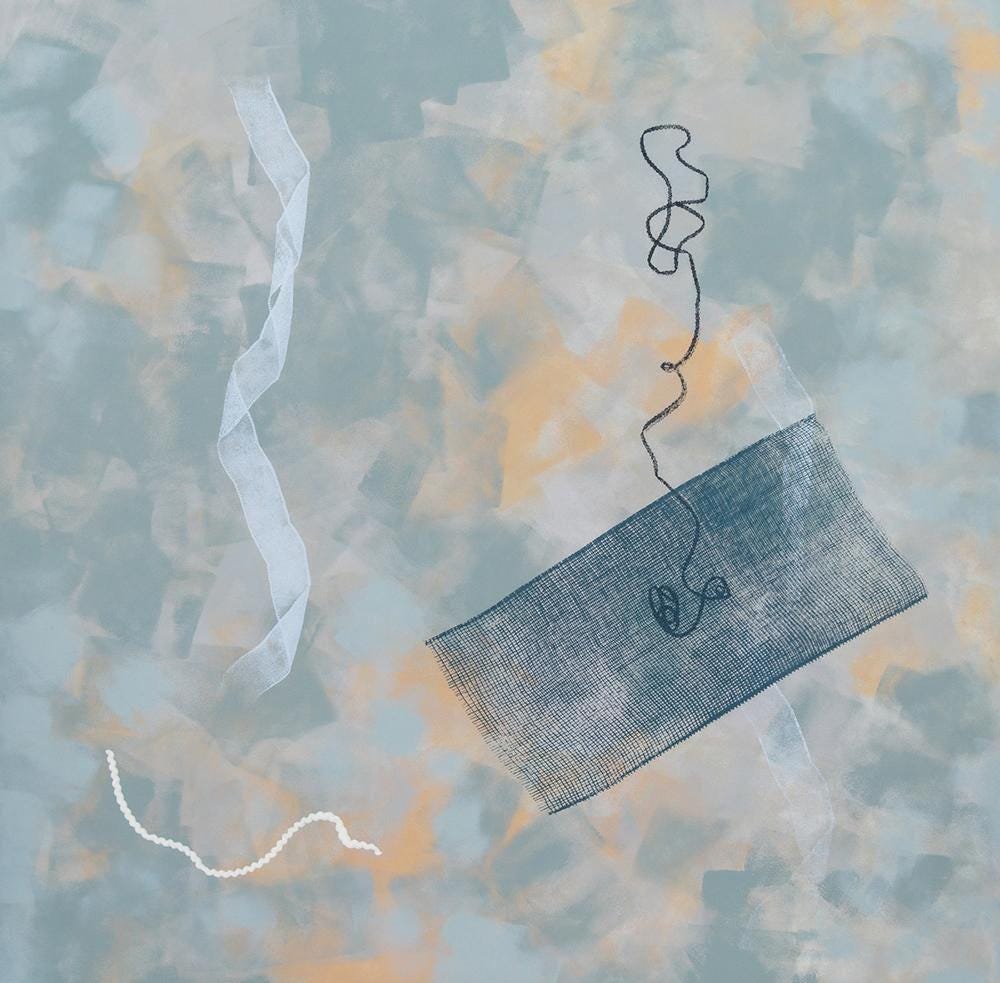
Clare Winslow, “Everything that Rises” (Washington Printmakers Gallery)
IN THE WINDOW OF WASHINGTON PRINTMAKERS GALLERY, Clare Winslow has hung the remnants of two decades of printing, used objects the artist terms “an archive made visible.” The installation, “Through,” doesn’t relate exactly to Winslow’s show, “What Passes Between,” but there is a sense of suspended forms in the local artist’s images. Her screenprints array fabric-like matrices, whether grids or ribbons, over mottled grounds. Precise textures neatly contrast spacious expanses.
The selection features two large works, “Everything that Rises” and “Blue Hour Drift,” that combine printmaking with color-field painting. Patterned blocks and cascading strips appear to float over aqueous backdrops made with softly dappled acrylic paint. The illusion of depth is powerful, although Winslow achieves a similar effect in a series of painting-prints that are much smaller, and thus less immersive.
These eight extraordinary pictures, all extremely horizontal, subtly vary the vocabulary of the larger ones. Hard-edged geometric shapes, mostly circles but sometimes hexagons, skip across the compositions. Lace, loose weaves, and a twisting set of links join the serpentine ribbons, and a silhouetted blue bird flutters on a gray field. If “Through” displays the individual devices that underlie this work, these eight prints demonstrate how deftly Winslow can put things together.
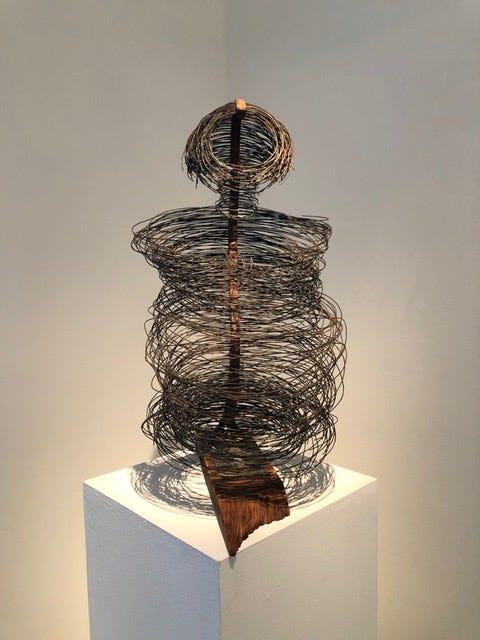
Kirsty Little, “Gaia” (WOW 11)
APPROPRIATELY FOR A SHOP-WINDOW EXHIBITION, “WOW 11 -- We Are All Human” includes several works, such as Carol Rubin’s abstracted paintings, that can be read as crowd scenes. But the 19-artist show in the 5550 block of Wisconsin Avenue also features numerous images of solitariness. It is, of course, possible to be detached in a crowd, as seen in Susan L. Sanders’s black-and-white photographs of people alone in public spaces.
The show’s second photographer is Jeff Moscow, whose vignettes of everyday life -- also black-and-white -- date to the 1970s. This gives them a timeworn vibe akin to the feel of Bruce Abrams’s expressionist paintings of people in bars, many of them smoking. The boldly hued pictures look like things retrieved from a time capsule, although perhaps they were just inspired by Mad Men.
Other photo-derived pieces include an enigmatic Ann Stoddard video in which each quadrant of the screen is occupied by a silhouetted figure; Tom Greaves’s striking collages of girls and women, their visages shattered into shards and overlaid with aggressively doodled lines; and Adeoluwa Jones’s elegantly layered collages, one of which replaces a Black boy’s eyes with the Japanese characters for “namelessness,” inscribed in eye-catching orange.
Among the three-dimensional entries are David Prete’s almost-neoclassical busts, whose stately solidity is undermined by honeycombed sections; Esperanza Alzona’s cast-metal sculptures that distill humans to such body parts as a torso or a partial face gripped by a single hand; and Sharapat Kessler’s large multi-piece composition, which suggests a calligraphic gesture written in black shapes. Kirsty Little, who organizes these “WOW” (”windows on Wisconsin”) shows, offers a female figure defined with bent wires that bristle from a curving spine. This, too, is a solitary entity, but it’s titled “Gaia,” after the Greek goddess who personifies the Earth. She may stand alone, but she contains multitudes.
Geoff Desobry & Cristian Ianculescu: Untamed Spirits
Through March 28 at Waverly Street Gallery, 4600 East-West Highway, Bethesda. waverlystreetgallery.com. 301-951-9441.
The Sketches: A Figure Drawing Exhibit
Through March 29 at Foundry Gallery, 2118 8th St. NW. foundrygallery.org. 202- 232-0203.
Abol Bahadori: Hybrid Baroque
Esha Sadr: Absence of Us
Natasha Sachdeva: will this entanglement ever resolve?
Through March 29 at IA&A at Hillyer 9 Hillyer Court NW. athillyer.org. 202-338-0680.
Clare Winslow: What Passes Between
Through March 29 at Washington Printmakers Gallery, 1675 Wisconsin Ave NW. washingtonprintmakers.com. 202-669-1497.
WOW 11 -- We Are All Human
Through April 4 at 5500-5510 Wisconsin Ave., Chevy Chase. Info: kirstylittle9@gmail.com.