
Premium Grayed
William Kentridge’s monochromatic riches. Also: six artists mend the body; Hamiltonian fellows layer the world; Trisha Gupta investigates a crime site; and Karin Edgett takes a macro view of blooms
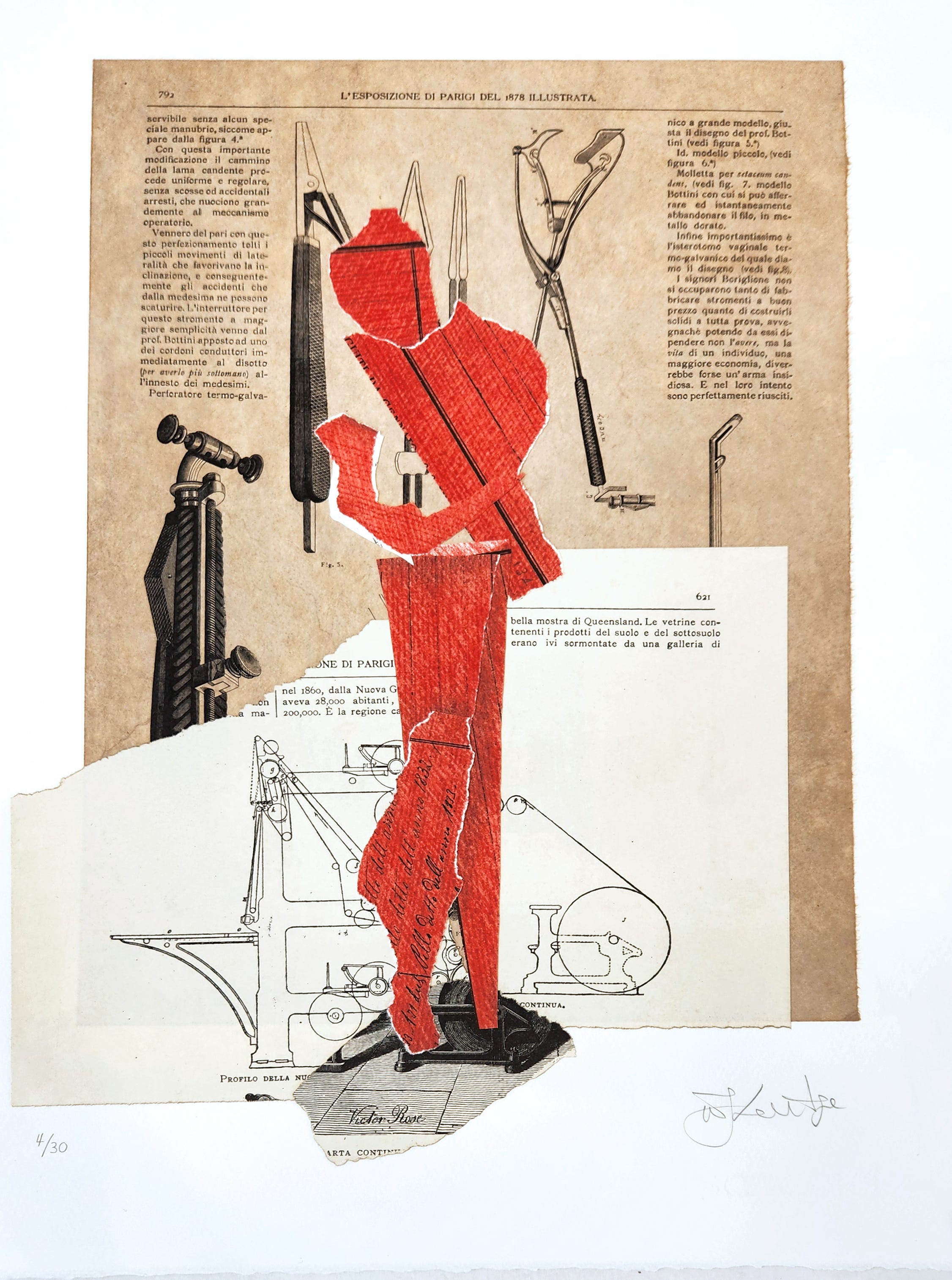
William Kentridge, “Questa Importante Modificazione” (Gallery Neptune & Brown)
A VAGUELY HUMAN FIGURE MADE OF SCARLET SCRAPS centers “Questa Importante Modificazione,” a collage-print that’s one of the attention-getting pieces in William Kentridge’s “Vertical Thinking.” While that red is the only bright color in the Gallery Neptune & Brown show, luxuriant hues are hardly lacking in this selection of prints, drawings, and collages from 1993 to 2024. The veteran South African artist is a master of grays. Such prints as the three-panel “Medicine Chest” supply a rainbow of middle tones, seemingly layered like pencil marks.
Regular visitors to Neptune & Brown, which often exhibits Kentridge’s work, will recognize familiar motifs. The artist likes angular metal coffeepots so much that he sometimes substitutes them for people’s heads. (He also may streamline heads merely to gargantuan noses.) He’s long riffed on proto-Dadaist Alfred Jarry’s 1896 play, Ubu Roi, which flavors “Dada Picnic,” a parade of people whose figures demonstrate varying degrees of abstraction. His homeland’s fraught history is layered into the mix of “Landscape,” one of his many drawings executed on 1913 Rand Mines ledger sheets.
Although nearly all these pictures are black-and-white, their styles are diverse. Such hand-colored prints as “LULU (Portrait of a Lady Looking Down)” are high-contrast, softened by light-gray shadows. Much more detailed, “The General” is a stark lampoon of evil authority inspired both by early 20th-century European caricaturists and the brutality of apartheid’s enforcers. The solid black forms in “Chairs from Zeno II” are silhouetted like shadow puppets, while the ones in “Planes from Zeno II” are distant and suspended among wispy scratches. (”Zeno” is a reference to a play based on Italo Svevo’s 1923 novel, Confessions of Zeno.)
Kentridge’s pictures refer not only to theater but also to short animated films he’s made with such collaborators as Deborah Bell (one of whose large drawings is included in this show). But his prints and drawings are not subsidiary to his work in other media. They stand alone, exquisitely detailed and sumptuously monochromatic.
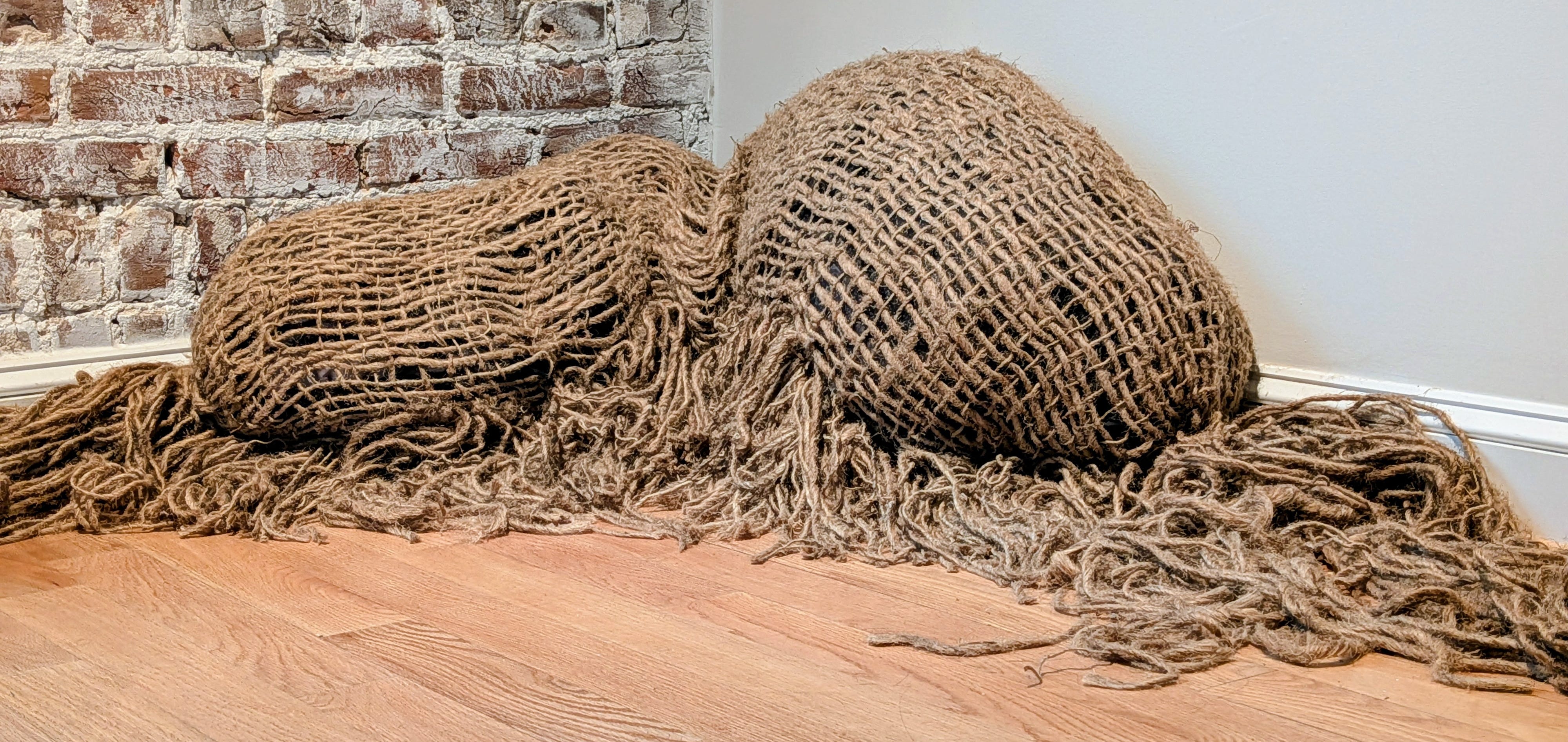
Milan Warner, “If I lay here long enough” (photo by Mark Jenkins)
REMNANTS OF FABRIC ARE RARELY VALUED, but in the case of “We Mend in the End Times” they represent things that are precious and even essential: human skin and physiques. The first hint of this is a slumped shape in one corner of D.C. Arts Center’s main gallery. Milan Warner’s “If I lay here long enough,” made of jute netting, suggests a body bag. It appears ready to be loaded into a Vietnam-era chopper or -- containing the live form of the future Count of Monte Christo -- tossed into the Mediterranean.
The show features the work of six artists, including curators Izy Carney and Lucas J Rougeux. The latter’s contributions are textile landscapes dotted with blood-like red circles. These speak to both political and domestic violence, evoking wounds as well as poppies -- symbols of sleep, peace, and remembrance of war victims. Rougeux’s ragged artworks also seem to express the artist’s personal vulnerability.
While most of the pieces don’t literally resemble bodies, several do invoke the human form. Among Fatima Janneh’s cyanotype-printed T-shirts are two that have been sewn together, implying Siamese twins or other, less corporeal types of symbiosis. Grace David’s “I Want My Body to Vibrate” is two large swoops of pieced-together black material, festooned with hundreds of safety pins and conjuring spiraling motion.
As might be expected, quilting is a motif. Eliza Clifford’s “Looking” is built of interlocking vertical and horizontal bands of wool and cotton, while Carney’s “Oscillation” uses a series of fabric panels to ponder the high-tech business of what the artist terms “AI-powered surveillance.” Fittingly, the show also offers fabric and tools so that visitors can contribute to a community quilt: Many hands can construct a common entity.
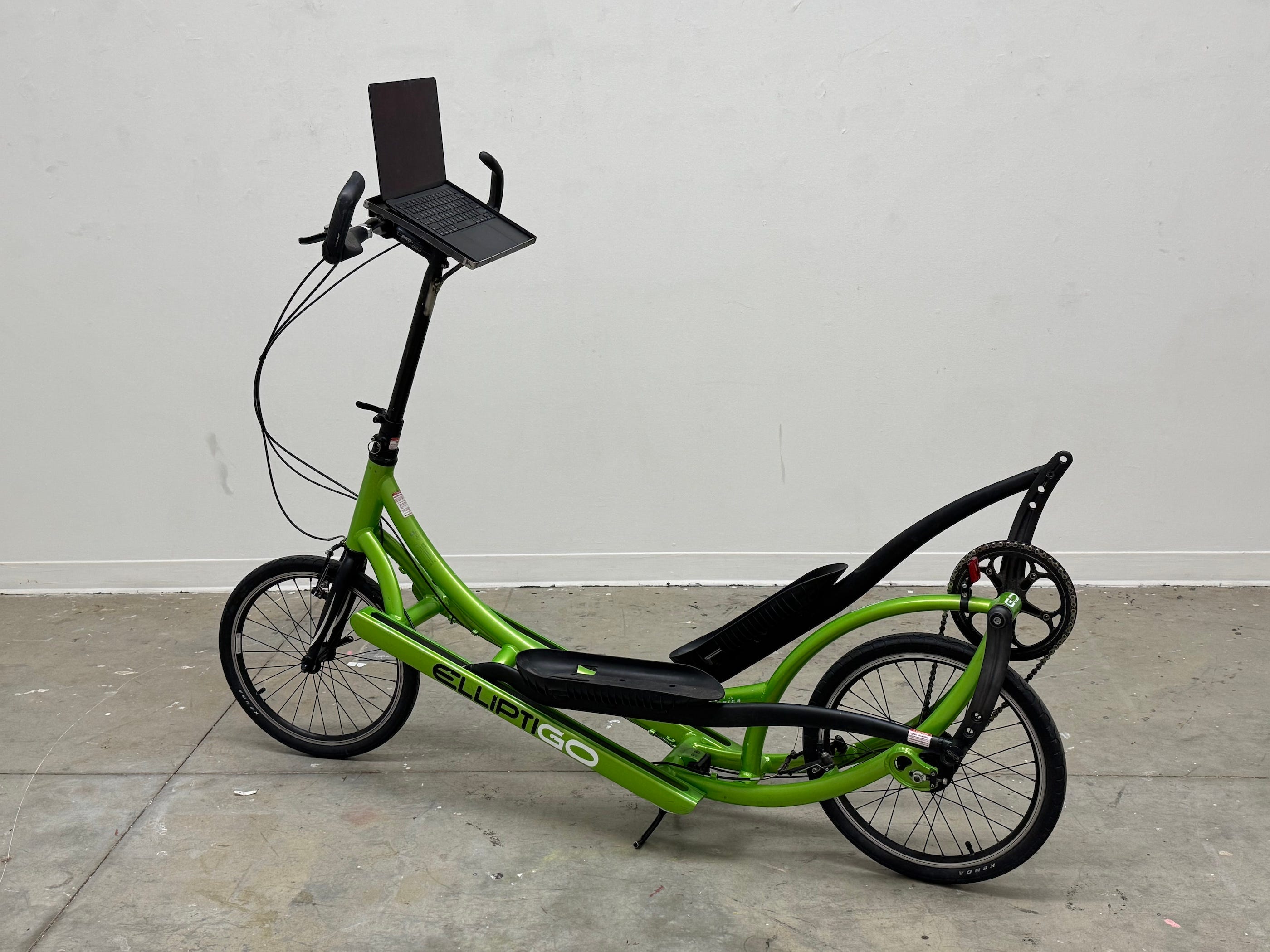
Mallory Kimmel, “Mobile Work Station I” (Hamiltonian Artists)
LAYERS OF IMAGES CONFLICT AND COMPLICATE within many of the pieces in “new. now. 26,” Hamiltonian Artworks’s annual showcase of its current fellows. Most of the five artists produce mixed-media work whose overlapping elements conjure flickers of meaning and shivers of alienation. Inkjet prints, photo transfers, and topographic maps are among the tiers overlaid by Diego Borgsdorf Fuenzalida, Chidinma Dureke, and Tara Youngborg.
Fuenzalida was born in California, but his multi-fabric, photo-printed artworks evoke the history and current situation of Chile, his ancestral homeland. One is aptly titled “Huellas (Traces).” Dureke’s photo-collages are highly personal meditations of her Nigerian-American heritage, but incorporate words and likenesses that are accessible to all viewers. Youngborg combines maps and other data into cyanotypes and a video that serve as symbolic landscapes of places as they exist today and are remembered.
No less complex but visually starker are Behrouz Vatankhah’s sculptural paintings, one of which is backlit by LEDs. The Tehran-born artist’s work is abstract, yet seeks to convey what a gallery note calls “personal experiences of anxiety, displacement, and cultural transition.” More directly autobiographical, and appealingly rueful, is Mallory Kimmel’s bound book of partly redacted rejection letters. The artist doesn’t think of herself only, though. “Mobile Work Station I,” a laptop mounted on an elliptical bicycle, is a sardonic monument to the Internet-age rat race.
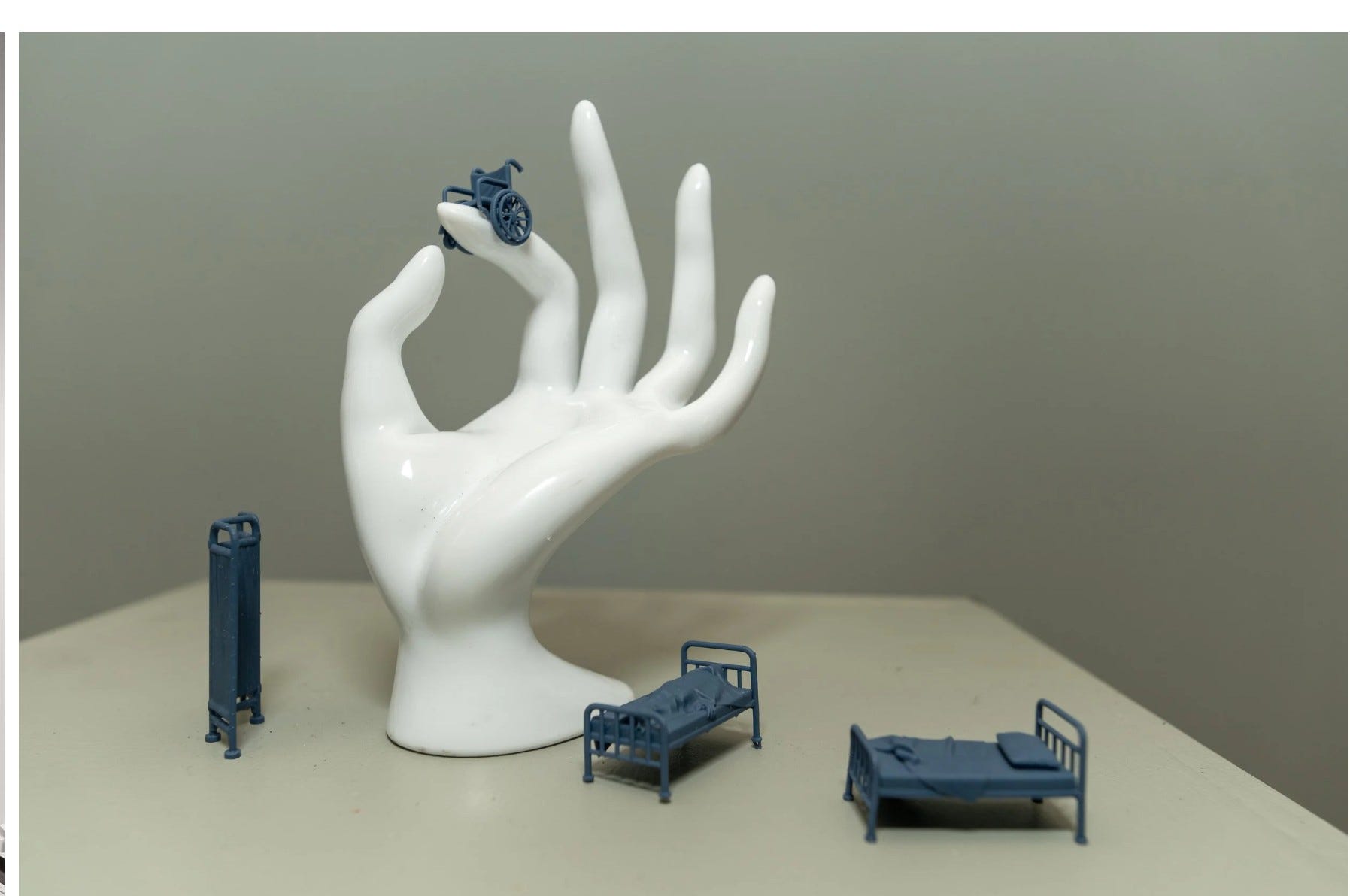
Trisha Gupta, “Forest Haven Asylum” (VisArts)
A SHAMEFUL LEGACY OF NEGLECT is the difficult subject of Trisha Gupta’s “Haven,” an array of photos, drawings, and artifacts at VisArts. The D.C.-based Gupta, who describes herself as “a neurodivergent artist and medical professional,” has been investigating the buildings and grounds of Forest Haven Asylum, a defunct facility in suburban Maryland for people with intellectual disabilities. Notorious for physical and sexual abuse and hundreds of unexplained deaths, Forest Haven was closed by a judge’s order in 1991.
Gupta returned from her forays with both images and relics. A rusted basketball hoop presides over the show, mounted above sets of small artifacts embedded in resin, as if they were fossils preserved in amber. The artist made with drawings of the buildings and their environs on a 26-foot-long scroll, partially draped on the floor to make it suitably intrusive. A “Then and Now” installation overlaps two sets of photos: recent color views of abandoned rooms below earlier black-and-white pictures --- printed on transparent plastic -- of patients seemingly ignored by staff. (The source of the archival photos is not identified.)
“Haven” can experienced as a memorial to the victims of the bygone institution, nearly 400 of whom were buried in a mass grave. But the artist also means to sound a note of entirely contemporary caution. “Researching this asylum,” writes Gupta on her website, “is an effort to elucidate the continued damage of similar institutions today.”
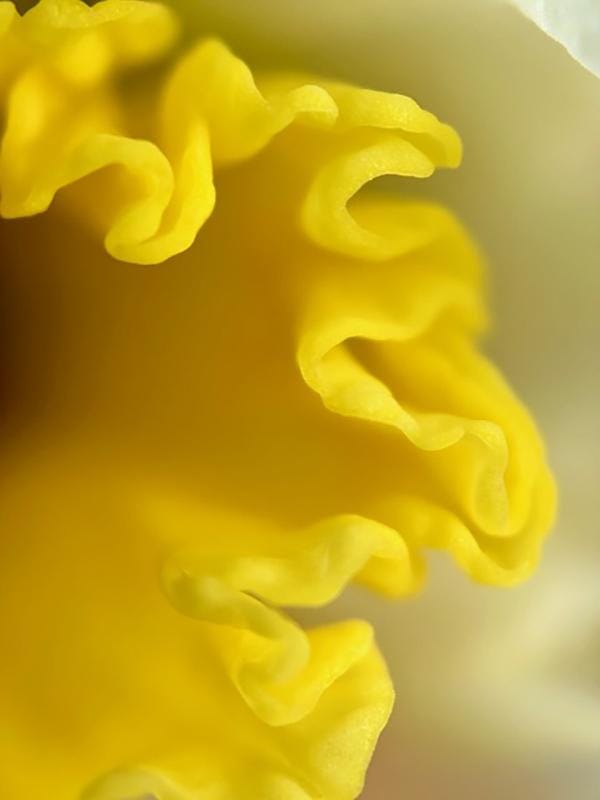
Karin Edgett, “Spring Light Wave of Daffodil” (Ashe & Norton)
PRINTED DIGITALLY ON METALLIC PAPER OR METAL PLATES, ‘s macro photographs of flowers have a machine-like quality. The petals and pistils depicted in “Woke Botanicals” glisten like well-oiled mechanisms, and the silhouetted tendrils at the center of “Chicory Aura” even somewhat resemble electrical plugs. The closeup images, on display in Ashe & Norton’s small shop-window space, are also exercises in vivid color, almost unnatural in their boldness.
As the show’s title indicates, the artist sees her work differently. The pictures “reveal auras and fresh vibrations of energy and consciousness,” says her statement. Indeed, the text continues, the flowers embody “SuperConsciousness.” But perhaps either interpretation points to the same conclusion: that Edgett’s flowers are tiny clusters of power.
William Kentridge: Vertical Thinking
Through March 21 at Gallery Neptune & Brown, 1530 14th St. NW. galleryneptunebrown.com. 202-986-1200.
We Mend in the End Times
Through March 13 at D.C. Arts Center, 2438 18th St. NW. dcartscenter.org. 202- 462-7833.
new. now. 26
Through March 14 at Hamiltonian Artists, 1353 U St. NW. hamiltonianartists.org. 202-332-1116.
Trisha Gupta: Haven
Through March 15 at Kaplan Gallery, VisArts, 155 Gibbs St., Rockville. www.visartscenter.org. 301-315-8200.
Karin Edgett: Woke Botanicals
Through March 16 at Ashe & Norton, 2440 Wisconsin Ave. NW, #A. ashe.norton@gmail.com.