
Photo Finishes
Mixed media art with a “PhotoGenesis.” Also: “Why Paint?” ask a dozen painters, Dorothy Fratt abstractions, Tinam Valk dreamscapes, Korean folk tales old and new
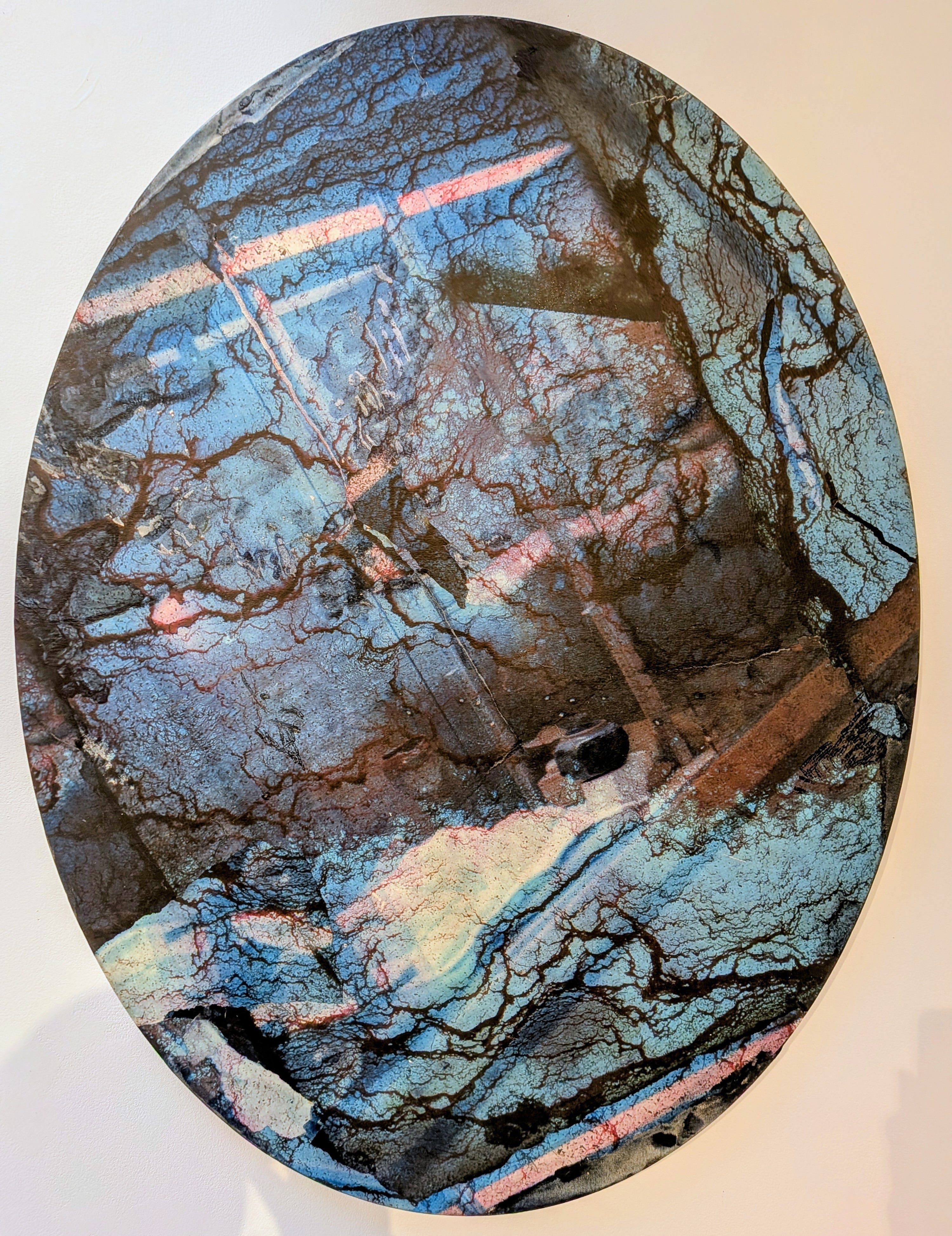
Don Kimes, “Blue Falling” (photo by Mark Jenkins)
PHOTOGRAPHY OR VIDEO MERELY BEGAN the processes that produced the work in “PhotoGenesis 2,” an impressively diverse exhibition at the McLean Project for the Arts. Among the show’s 20 Washington-region artists, selected by curators Nancy Sausser and Jen Lillis, are just a few who don’t incorporate their photographic images into mixed-media work. And even those contributors denature or deconstruct their source material in provocative ways.
Chris Combs fragments video of nature in two high-tech pieces, notably “S(p)lash,” a skinny and obliquely mounted LED panel that displays assorted views of swelling water. The same subject gets a starker treatment in a work by David Carlson (better known as an abstract painter). His “Messages” is a high-contrast black-and-white closeup of the Connecticut River, distilled to white ripples inside a black circle.
A similar format frames a much more intricate image in Don Kimes’s exquisite “Blue Falling,” a mixed-media oval picture. This richly layered, predominantly blue piece appears to overlay images of the natural and built worlds, glimmering with reflected pink and white light. There may be a house within the artwork’s depths, linking it to David Douglas’s atmospheric treated photo of a large American home, glimpsed through a painterly haze of hue and mist.
The videos include Maryam Rassapour’s pair of short animated collages and Dawn Whitmore’s study of dancing figures distorted so that they often have two sets of feet. The effect is as eerie as it is graceful.
Several participants, including Joseph Cortina and Sarah Salomon, carve photographs into shards and reassemble them as striking sculptures. Linda Plaisted’s elegant photo-collages are pierced with holes, embellished with gold leaf, and cloistered inside black boxes. Alexandra Silverthorne does subtler damage to her photos of forested scenes in New Orleans and D.C.; she soaks them in water from the local river to warp them gently.
Zofie King is also a collagist, but cyanotypes of architectural interiors are minor elements in her beautifully drawn and painted supernatural visions. Like Catherine Day, who prints her photographic closeups on antique fabric, King transforms real-world images into something beguilingly unattainable.
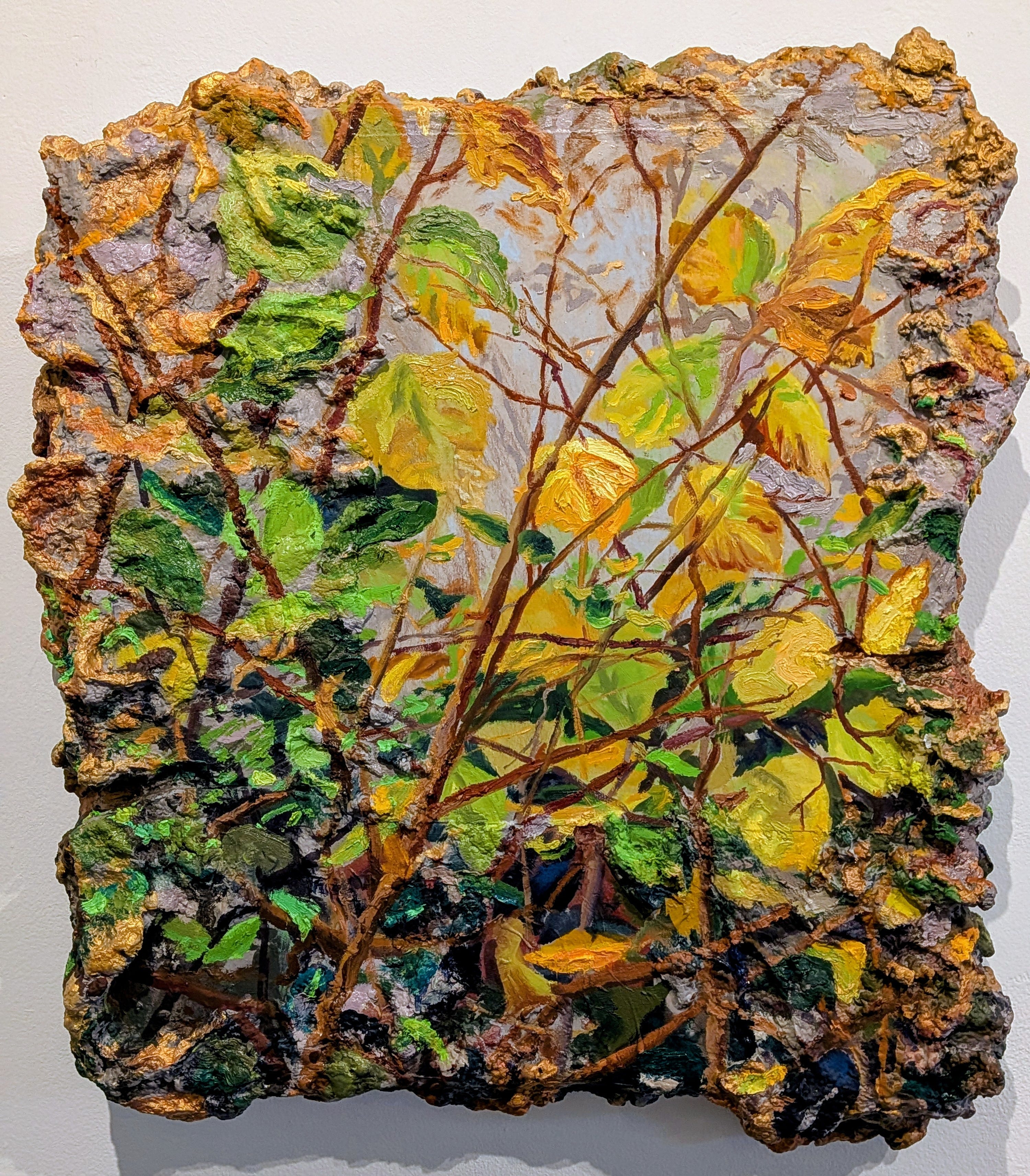
Lindsay Mueller, “Drawing Debris” (photo by Mark Jenkins)
FEW DIRECT ACKNOWLEDGEMENTS OF PHOTOGRAPHY occur in “Why Paint? II,” a 12-artist show at Washington Studio School. But some influence is evident, notably among the contributors who offer multiple views of the same person or scene. They jump-cut reality as if their paintbrushes were equipped with motor drives.
Marina Ross, who sometimes works from stills from The Wizard of Oz, channels personal grief into a series of yellow-heavy oils of a woman’s face. Scott Hutchison painted 26 small closeups of a shirtless man’s head and shoulders, each apparently from a different vantage. (Only six are on display; the others are supposed to be visible on a video screen that was not in operation during my visit.) Olivia Isabel Rosato, who is also a photographer, painted the same underpass twice, alternately in light or darkness.
The exhibition, curated by Reem Bassous and Jan Dickey, features artists from Chicago and New York City as well as D.C. The last group consists of Hutchison, traditionalist-futurist Elaine Qiu, expressionist Eric Uhlir, and nature artist Lindsay Mueller, whose intimate landscapes are made on chunky, rough-edged slabs of paper and paper clay, Mueller’s sculptural style is akin to that of Xiaohan Jiang, whose “Shared Smoke” is painted on felt that swirls up and away from the panel on which it’s mounted.
Jiang’s picture is one of the looser ones in an array that’s all, arguably, representational. (Noelle Africh’s black-on-black “Face Value” is hard to read, but its title hints that it depicts a human visage.) The diverse selection includes Baoying Huang’s deadpan-realist still life of a potted plant and two renderings of scenes that appear unstable. Anna Gregor’s “After Botticelli V” might portray a painter’s studio, but the image is slippery and intriguingly tentative. A similar vibe characterizes Qiu’s black-and-white “Hindsight #12,” which suggests an interior space. Both are the work of artists who discover their subjects as much with the hand as the eye.
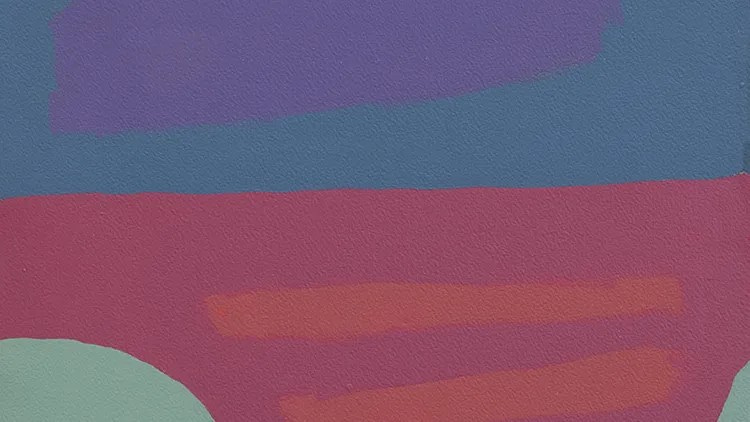
Dorothy Fratt, “Gulf of California” (detail) (PFA Gallery)
THE TITLE OF PFA GALLERY’S SECOND DOROTHY FRATT SHOW is accurate so far as it goes. Bold reds and cool greens are among the principal attractions of “Explorations of Color,” a selection of acrylic paintings on paper made between 1973 and 2001. But Fratt (1923-2017) was equally concerned with form, carefully placing blocks, bars, and other simple shapes mostly on monochromatic fields. The artist’s pictures can resemble streamlined landscapes, an affinity she acknowledged with scenic titles such as “Gulf of California” and “Quiet Estuary.”
A native Washingtonian, Fratt began her art career in her hometown, but relocated to Arizona in 1958, just as D.C’s Morris Louis and Kenneth Noland were establishing themselves as color field painters. Her style developed differently, with more sense of solidity and without the white space common in the paintings of her almost-peers back in Washington. Fratt’s pictures are usually characterized by a dominant hue that holds together elements in various colors, only some of which provide strong tonal opposition.
This show’s paintings include “Blue Jacob’s Ladder,” which fixes a vivid orange rectangle -- centered between purple and green ones -- in an expanse of contrasting blue. Equally striking is “Three Visitors,” which positions bars of purple and two shades inside a black box that’s floated above a pale-blue field in a manner that suggests Mark Rothko’s compositions.
The selection also includes seven pictures (six of them studies) in which the primary dialogue is between close shades of red: Scarlet backdrops diverge only slightly in hue from a rock-like slab or a jagged squiggle that hints at a mountain range. It’s possible to see these artworks as distilled scenes of desert sunsets, or just as formal experiments. Either way, the imagery is as delicate as the colors are forceful.
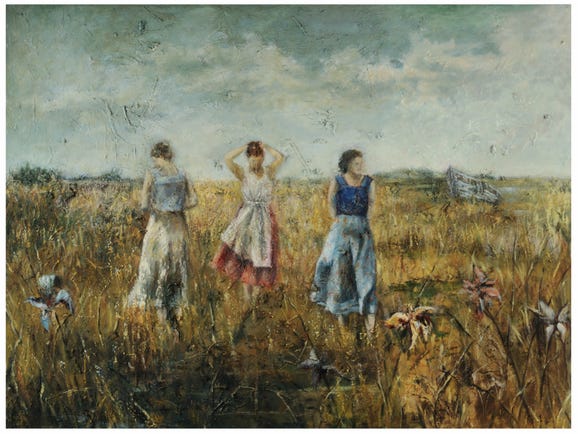
Tinam Valk, “Women in a Field” (Portico Gallery)
DEPTH IS LITERAL AS WELL AS METAPHORICAL in Tinam Valk’s paintings, which are made on craggy surfaces built up with soil, leaves, modeling paste, and underpainting. Her imagery is based partly on old photographs, hinting at personal memories, but is executed with reverie-evoking softness and features surreal touches. The absurdist elements are mostly related to animals in “Figures & More,” the suburban Maryland artist’s show of recent work at Portico Gallery at Studio 3807.
Valk grew up in Europe, and the people in her pictures often look as if they’ve been summoned from that continent a few generations ago. Among the most traditional of the paintings is “Women in a Field,” whose trio of rustics and impressionistic style conjure a late-19th-century feel. Yet many of the pictures incorporate African or Asian fauna, sometimes as the principal focus. A tiger lurks behind a man in vintage suit in “Tempo Dulu II,” and a gorilla wearing a baby bonnet sits across a stream -- water often features in Valk’s compositions -- from a woman in an old-timey dress in “The Dream.” Several pictures foreground animals, and a few banish humans altogether.
Do these furry or feathered creatures represent danger to the nearby people? Or are they objects of fascination and even emulation? The artist suggests the latter by including paintings of mummers -- costumed paraders -- who wear animal-head masks. Donning a rabbit’s head or a deer’s antlers is a way of escaping the ordinariness of human existence, and perhaps of acquiring a sort of instinctual wisdom. In Valk’s gently hallucinatory pictures, the mummers aren’t merely experiencing a dream. They, like the artist herself, are willing themselves into a fantastical state.
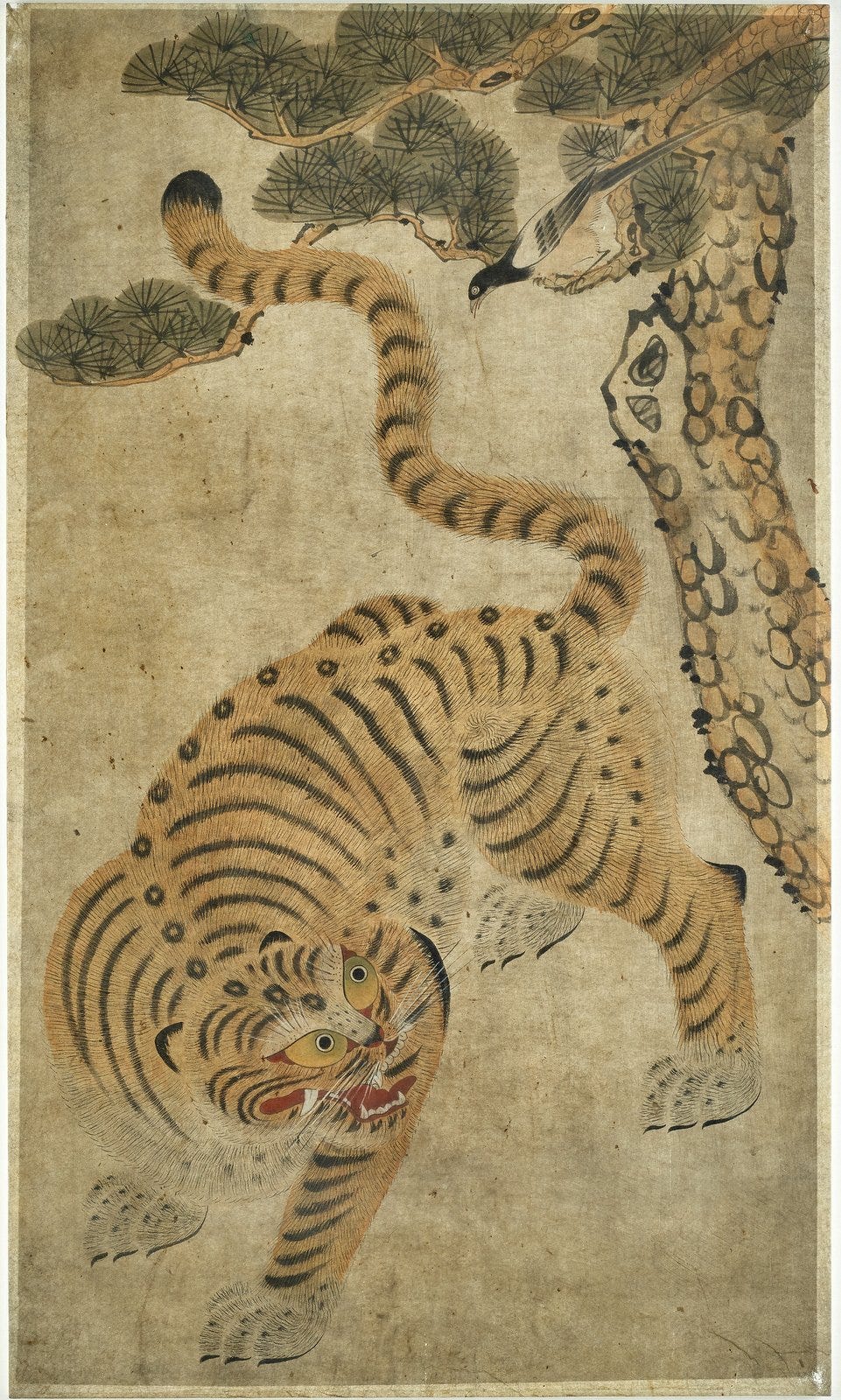
“Tiger and Magpie” (unidentified artist) (Korean Cultural Center)
THE LINK BETWEEN EAST ASIAN ART AND AMERICAN CARTOONS is only about a century old, but a loose affinity can be traced at least to the 18th century. That’s when the earliest pieces in “Charm of Seoul, Minwha: Wishes in Korean Folk Painting” were made. Elegant, centuries-old renderings of tigers, fish, and other animals are among the highlights of this Korean Cultural Center show. But nearby are playful works that reference U.S. cartoons and comic books, as well as a room-filling CGI forest scene centered on a stylized waterfall and populated by silhouetted creatures of land and sky.
One gallery holds mostly older works in the minhwa style, including delicate porcelain flasks and a painting of a scholar’s cabinet that recalls the one that introduced the National Museum of Asian Art’s “Korean Treasures” exhibition (which closed Feb. 1). A recurring character is a tiger whose sinuous form dominates a vertical painting, and is often accompanied by a magpie. (The significance of this pairing reportedly changed over time.) But this room also holds a video animation of a four-part screen painting, combining traditional and contemporary formats.
More technological fun awaits in the third gallery, where placing one of four vases on one of three stands activates an animation of a blossoming plant. Most of the room’s other works are recent paintings by artists who graft American icons onto Korean motifs. A series by KyungJu Kim pairs cute animals with superhero symbols, so that a cute baby tiger perches next to Iron Man’s helmet. Somi Moon makes pop-art updates of pictures of shrines and scholarly libraries, in the process introducing such cultural interlopers as Tom and Jerry. If the cat and mouse are not exactly a tiger and a magpie, they embody a similarly irreverent spirit.
PhotoGenesis 2
Through Feb. 24 at McLean Project for the Arts, 1234 Ingleside Ave., McLean. mpaart.org. 703-790-1953.
Why Paint? II
Through Feb. 27 at Washington Studio School, 2129 S St. NW. washingtonstudioschool.org. 202-234-3030.
Dorothy Fratt: Explorations in Color
Through Feb. 28 at PFA Gallery, 1932 9th St. NW (entrance at 1917 9 1/2 St. NW). pazofineart.com. 571-315-5279.
Tinam Valk: Figures & More
Through Feb. 28 at Portico Gallery at Studio 3807, 3807 Rhode Island Ave., Brentwood. portico3807.com. 202-487-8458.
Charm of Seoul, Minhwa: Wishes in Korean Folk Painting
Through Feb. 20 at the Korean Cultural Center, 2370 Massachusetts Ave. NW. washingtondc.korean-culture.org/en. 202-939-5688.