
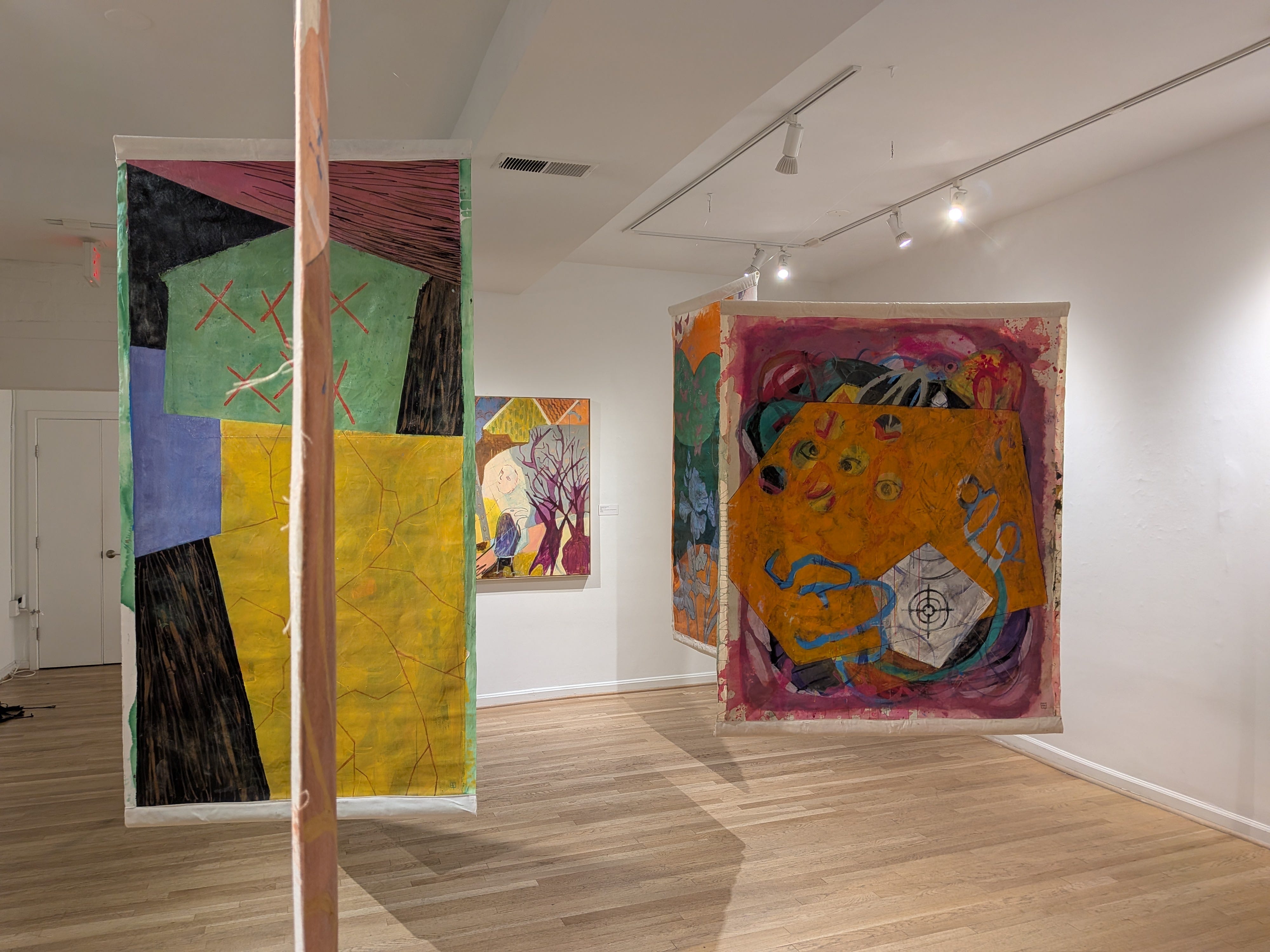
Elizabeth Casqueiro, “Counterspace” (installation view) (photo by Mark Jenkins)
A SENSE OF PLACE -- OR, MORE EXACTLY, DUAL PLACES -- links two of the artists who are showing this month at IA&A at Hillyer. D.C. painter Elizabeth Casqueiro is known for semi-representational montages that depict buildings and vegetation but also include abstract gestures. Sunanda Khajuria is an Indian artist who divides her time between her homeland and China, and incorporates motifs from both countries into paintings that feature hard-edged images and bold colors.
Casqueiro’s “Counterspace” includes two of her customary paintings, but consists mostly of six banners that hang from the ceiling to interfere with a visitor’s straightforward route through the room. One side of the banner depicts a local landmark that would be recognizable without such titles as “Airport” -- Eero Saarinen’s Dulles, of course -- “Pentagon,” and “Basilica.” The other side combines arrays of plants, flowers, and fruit mixed with decorative patterning. Other motifs include eyes and the U.S. flag.
Essentially, the Portugal-born artist has separated the ingredients of her usual style and divided them between two planes. But from a vantage point within the dangling paintings, both natural and manmade realms are potentially visible, if not simultaneously on the same banner. Responding to the same impulse that inspired Cubism, Casqueiro seeks to show the viewer everything all at once. To wander through “Counterspace” is to get a whiff of omniscience.
The pictures in Khajuria’s “Beyond Borders: Who I Am Between Houses” are much crisper and more open than Casqueiro’s. The Indian artist outlines her hybrid subjects precisely and places them discretely on blank fields of light, neutral hues. Among the Chinese components are cranes, which symbolize longevity and even immortality; and two of the paintings are on Chinese-style scrolls. More suggestive of India are the vivid colors, which include green and fuchsia skin tones. These meditations on change, home, memory, and migration may represent ruptured personalities, but visually they’re neatly unified.
Even tidier are the wall sculptures in Iranian-born Florida artist Mona Bozorgi’s “Threading the Gaze,” which place gauzy photographs within meticulous wooden frames. The pictures are mostly selfies taken by women during Iran’s Women, Life, Freedom protests and printed on silk. Bozorgi then removes some of the threads from the material to make the image softer and more vulnerable. The frames are complex -- one is a six-sided star and another bends around the corner where two walls meet -- if ambiguous in significance. The way the wooden slats hold the gossamer pictures in place suggests that they’re protective. But they can also be seen as embodying the structures that confine Iranian women in subordinate status.
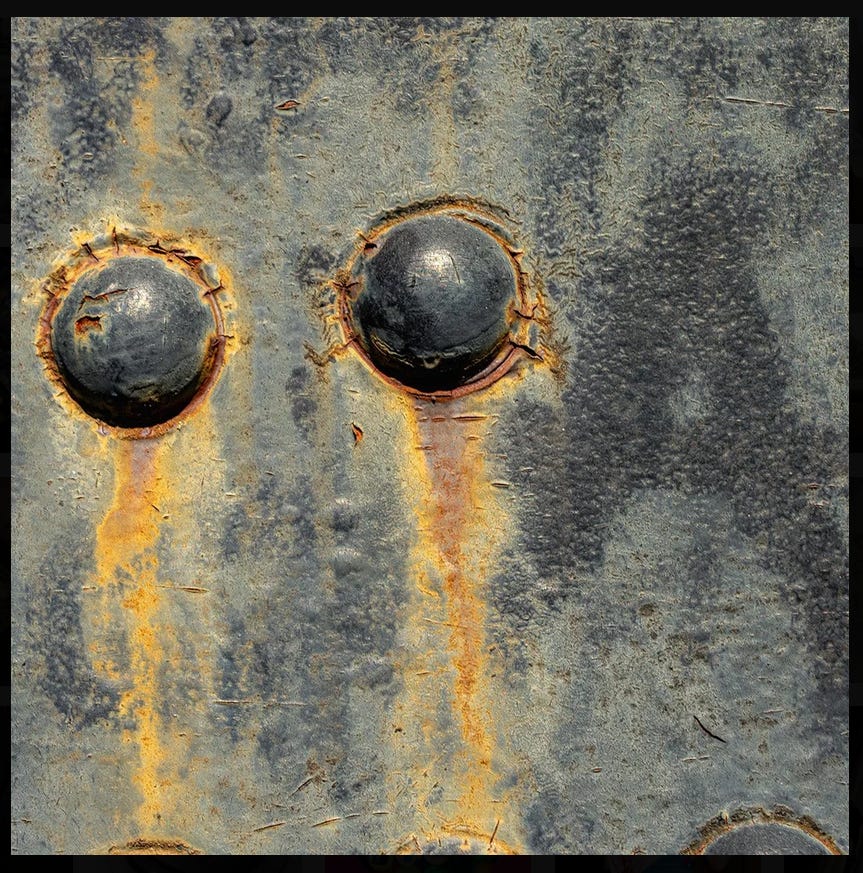
Sandy LeBrun-Evans, “Crying Eyes” (Multiple Exposures Gallery)
A VISUAL VARIATION ON “EXQUISITE CORPSE,” the Dadaist word game, Multiple Exposures Gallery’s latest round of “Progression” strings together 48 photographs, slightly less than half of them black-and-white, by means of pictorial or thematic resemblance. Sixteen photographers, including all 14 current gallery members, contributed extraordinary images that range from narrative vignettes to found abstraction.
The segues often turn on similar shapes, textures, or compositions, but can also involve parallel elements of shadow, mist, or reflection. One notable sequence cycles playfully from fire to air, moving from Francine B Livaditis’s closeup of flickering sacramental candles to Maureen Minehan’s picture of steam swirling upward from a silhouetted chimney to Guillermo Olaizola’s vista of a large cloudbank that appears to be glued to the Matterhorn.
People rarely appear, and when they do are subsidiary to their environments -- or even entirely obscured by them, as in the case of Maureen Minehan’s telling picture of a girl who cloaks her face behind a Disney-princess kite. Battered surfaces, often industrial, are common, notably in Sandy LeBrun-Evans’s harshly lovely shot of two eye-like metal orbs that appear to weep rust. These circular forms enter the continuum, like a musical refrain, three images after Alan Sislen’s evocative photo of electrical gauges, also round, metallic, and scourged by time.
One picture is a visual rhyme in itself: Sarah Hood Salomon observes a tree, nestled against a building, whose trunk curves in seeming imitation of the three flights of fire-escape stairs adjacent to it. Sometimes a single glance provides all the progression a photographer needs.
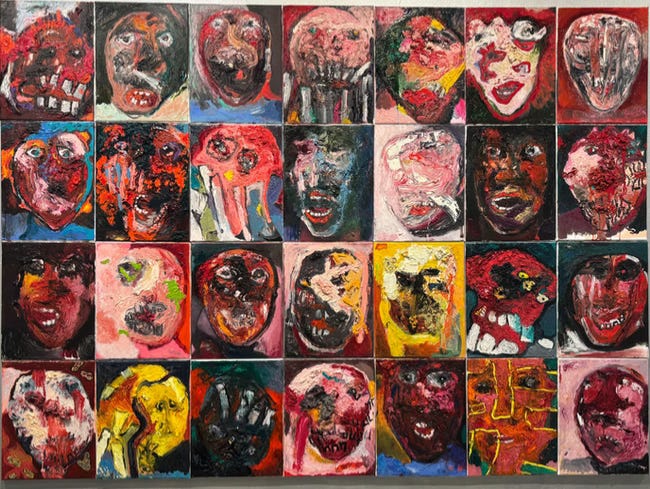
Misuzu Fukeda, “Head” (Washington Studio School)
THE MAJORITY OF THE PICTURES in Washington Studio School’s current show are gentle, semi-realistic paintings of clouds, some of which incorporate scraps of kimonos. They look like details from old Japanese scrolls, but the exhibition’s title points to a different sort of history. “Hiroshima Revisited” pairs the work of two artists linked to the monstrous 1945 A-bombing.
Glover is the L.A.-based granddaughter of a Hiroshima man who was spared because he was out of town on the day of the bombardment. The other artist, Misuzu Fukeda, is a Hiroshima-bombing survivor who lives in Hawaii. Her paintings are, understandably, much harsher than Glover’s. Only two Fukeda works are included in the show, but both are multi-panel compositions that gain power from their repeated motifs.
All but one of Glover’s pictures depict skies tinged by orangish light; in another context, they would evoke sunrises or sunsets rather than a massive explosion and resulting conflagration. Fukeda’s raw, heavily impastoed paintings are more direct: One is a set of decayed fruits and vegetables, and the other a series of burned, mangled, and skeletal heads. The first depicts natural wasting; the second portrays deterioration that’s entirely unnatural. What happened at Hiroshima and Nagasaki, these pictures attest, was literally perverse.
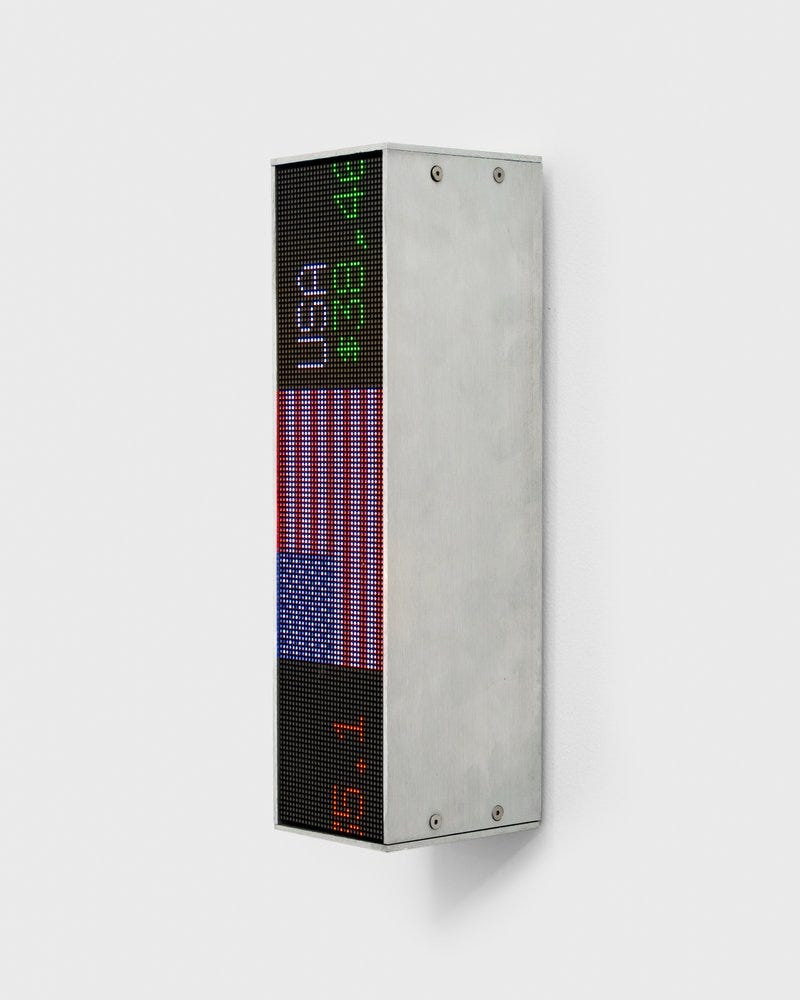
Ignacio Gatica, “Preface to an Automated Stratosphere (USA)” (Von Ammon Co.)
VON AMMON CO. NO LONGER HAS A GROTTO-LIKE SPACE, yet there are stalactites poking from the ceiling as part of the gallery’s fifth annual multi-artist summer show, “Focus Group 5.” Liz Croft’s ceramic spikes are simple and white, as befits the white-box venue. But Tony Matelli’s bronze flower statues, which appear to grow from the shiny black floor, are painted in realistic colors, offering a rare nod to naturalism in a gallery that tends toward the stark, garish, and artificial.
Among the many twists on American icons are Jacob Kassay’s crisp collages of U.S. flags in unorthodox arrangements; Danny McDonald’s incongruous assemblage, which slumps a nutty Uncle Sam action figure atop an antique glass globe stand; and several pieces by Banks Violette, including drawn-on black-and-white photos of an upside-down Empire State Building and another U.S. flag, also upside down and rendered in silver metal bars and white neon tubes. Banks also offers two cryptic graphite drawings of cracked surfaces.
The term “focus group” comes, of course, from marketing and advertising. Von Ammon often offers for sale art that’s deeply skeptical about the business of selling. Capitalism manifests here in the forms of Sylvie Fleury’s set of shopping bags, one white and one black, and Ignacio Gatica’s aluminum-framed dot-matrix display of World Bank financial info. The latter artwork features yet another U.S. flag, pulsing blithely as the bond market begins to show cracks in the American prospect.
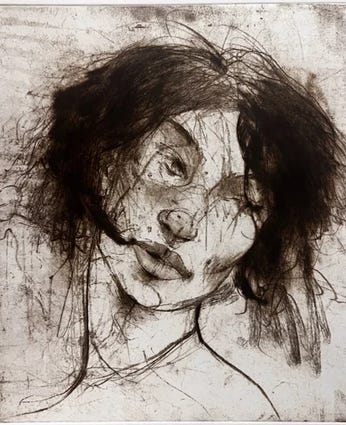
Jake Muirhead, “Persona” (Washington Printmakers Gallery)
EXQUISITE CRAFT AND STYLISTIC DIVERSITY CHARACTERIZE the 2026 Peggy Doole National Small Works Exhibition, an annual show at Washington Printmakers Gallery. Writing about this selection is a bit odd for me, since I’m the one who juried it. But these prints and photographs shouldn’t be overlooked.
Among the noteworthy traditional prints are Jake Muirhead’s “Persona,” a wispy etching and drypoint of an imaginary beauty; Holly Berry’s “Point of View,” a bold woodcut of a river that’s carved a rustic landscape; Emmakate Sprenkle’s “Beetle,” a lino print of a green insect set off by bright orange and yellow touches; Joanna Kidd’s “No! Crow,” which positions a silhouetted blackbird atop an overlapped chorus of letterpress “no’s”; Sherrie York’s “Stillness,” a snow scene highlighted with light-blue drifts; and Sachin Pannuri’s “Banned in the U.S.A,” an etching and aquatint that uses watery, earthy colors to depict a woman amid books.
Of the prints that employ digital technology, the standouts include Laura Bloomenstein’s “Mahjong Chair,” printed on a field of actual game tiles; Craig Subler’s “No Return,” in which transparent plastic bottles almost merge into their backdrops; and Robert Hunter’s “Anselm’s Crow V-1,” which centers on another silhouetted black bird, this time on a subtly textured backdrop rendered in gray and blue.
The photographs range from Jim Allen’s “Remains 7/8,” which treats a closeup of animal bones as a silvery memento mori; Sallie Lowenstein’s “The Reader,” which observes a little girl in a large chair; Anne McMahon’s “Looking Out,” in which an earth-toned structure is set off by a ribbon of blue sea; and Terry Thiele’s “Titmouse,” whose subject perches within a green-patinaed metallic circle. For a show that the curator -- inadvertently -- filled with images of birds, this titmouse obligingly framed itself for an ideal composition.
Elizabeth Casqueiro: Counterspace
Sunanda Khajuria: Beyond Borders: Who I Am Between Houses
Mona Bozorgi: Threading the Gaze
Through Aug. 30 at IA&A at Hillyer, 9 Hillyer Court NW. athillyer.org. 202-338-0680.
Progression
Through Aug. 30 at Multiple Exposures Gallery, Torpedo Factory, 105 N. Union St., Alexandria. multipleexposuresgallery.com. 703-683-2205.
Yumiko Glover and Misuzu Fukeda: Hiroshima Revisited
Through Aug. 31 at Washington Studio School, 2129 S St. NW. washingtonstudioschool.org. 202-234-3030.
Focus Group 5
Through Aug. 31 at Von Ammon Co, 3210 Grace St. NW. vonammon.co.
2026 Peggy Doole National Small Works Exhibition
Through Aug. 30 at Washington Printmakers Gallery, 1675 Wisconsin Ave NW. washingtonprintmakers.com. 202-669-1497.