
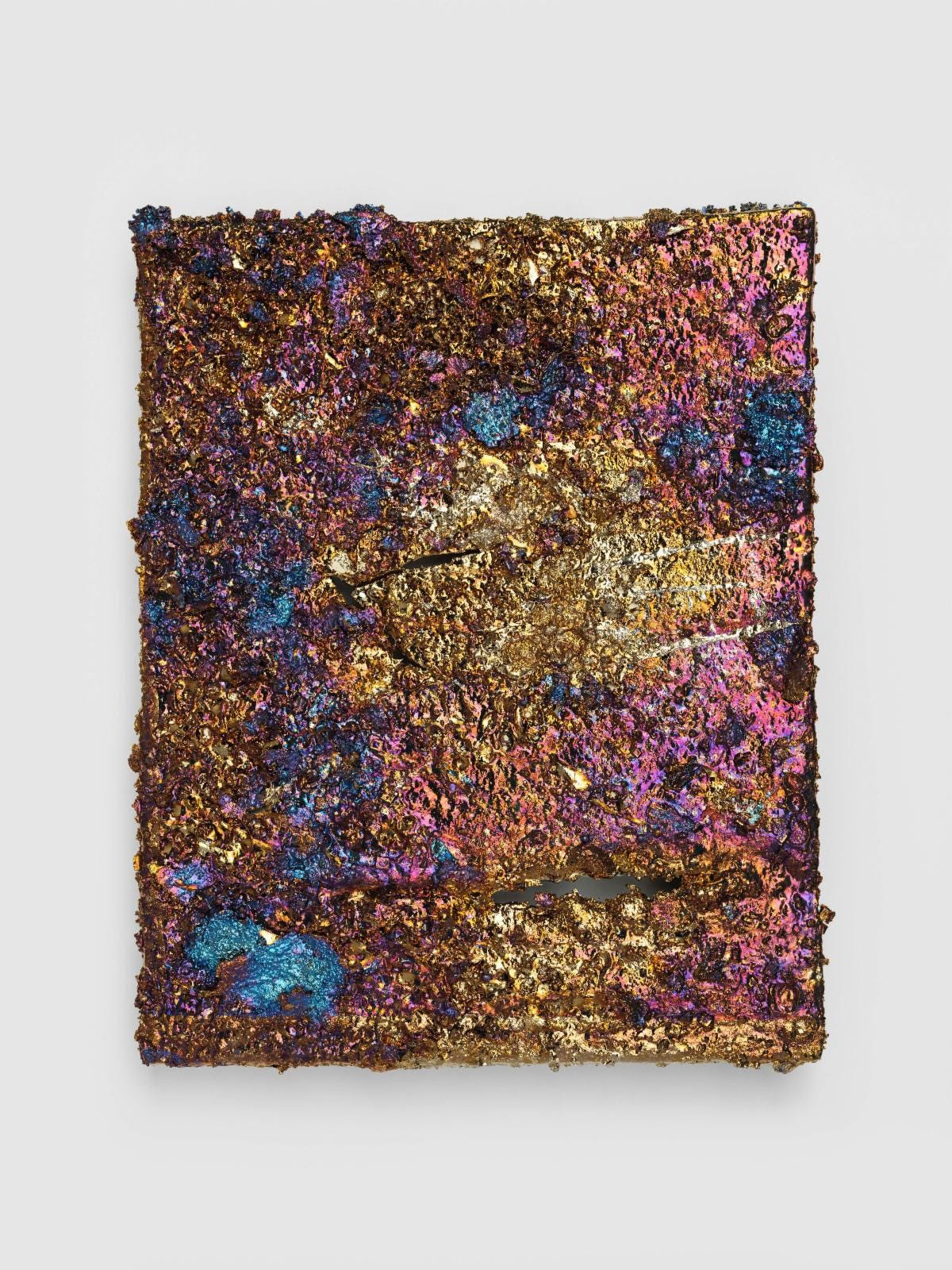
Catharine Czudej, “Hippie Puke” (Von Ammon Co.)
THE STARK WHITE WALLS OF VON AMMON CO. have been covered in gray carpet for the current show, but that’s not to make the experience more homey. Instead, the carpeting is part of what the gallery’s statement calls “an act of resistance.” Catharine Czudej’s “Wake Me up Inside” turns toward the material world in a virtual age, seeking respite in “the stuff of meatspace.”
As is characteristic of Von Ammon artists, the South-Africa-born New Yorker critiques the cultural dominance of commercialism and the “dehumanizing technologies” unleashed by the Internet. Most of the pieces in this show are titled “Hippie Puke” -- can’t get much more corporeal than vomit -- and are made of bismuth and ceramic.
The artworks are all basically rectangular and essentially sculptural paintings. They can be seen as 3D color-field abstractions, yet are characterized as much by texture as hue. The mainly gold-and-blue mixes of metal and ceramic have a jewel-like glitter, but in form are brazenly imperfect: The surfaces are craggy, pockmarked, and gashed, with gaps often large enough that the carpet behind the works is clearly visible.
Visually, the crux of the “Hippie Puke” pieces is the tension between shimmering beauty and disturbing damage. (The show also includes three checkerboard collages, two of which incorporate T-shirts with squares cut from the fabric.) According to the gallery statement, Czudej is not interested primarily in the finished objects: “The artist’s faith lies in the process itself.” Perhaps that’s the appeal of the many cuts and scars. They offer a sense of struggle and tentativeness. The materials have cooled and hardened, but into shapes that are a permanent reminder of their fashioning. They appear both unfinished and forever unfixable.
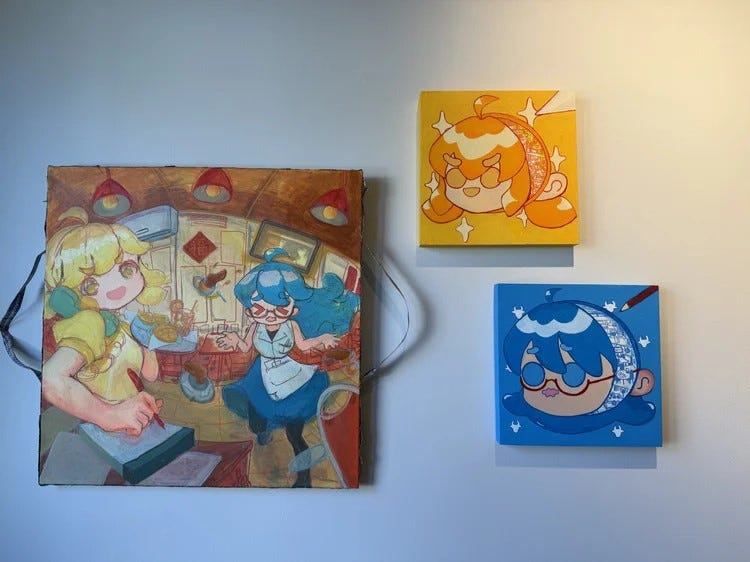
Amity Chan, “Welcome to the New World” (D.C. Arts Center)
HOME IS A DISTANT AND PERHAPS IRREDEEMABLE PLACE in some of the most poignant pieces collected for “Closer beyond; further within.” Curated by Milan Warner, the show presents work by members of the D.C. Arts Center’s Sparkplug Artists Collective, a one-year program for local artists seeking to advance professional careers. Among the current crew are emigres from Palestine, Lebanon, and Hong Kong.
Of the 11 contributors, the one whose approach is closest to Czudej’s is L.A. Crawford, who covers a wall with squares of dried multi-layered latex paint -- the pigment often used to cover the interior walls of houses. The blocks of white ad off-white are creased, cracked, and occasionally shattered. The gallery statement says these artifacts evoke “the tempo of a pre-digital childhood,” but they also conjure the fragility of home and family.
The brittle paint squares fit well with the work of Rachael Bohlander, who paints on canvases that she then folds and rumples eccentrically. The artist calls these pieces autobiographical and says that they reflect the fact that “home is within me.”
The imagery is more traditional, if the media often unconventional, in the work of six contributors. Izy Carney ponders the role of protest in textile and collage pieces. Amber Cooper makes collages that recall Black history and invokes the ritual value of household objects. Allison Crouch invokes her “lesbian’s masculinity” in tattoo-style pictures, many of which feature a blue panther. Hannah Longbottom Estrada demands the abolition of ICE in as sloganeering weaving that turns out to be a painting. With painterly realism, Malik Greene portrays dolls and figurines as a means of conveying “the Black experience.” The most whimsical of the participants, Jeff Soifer makes black-and-white etchings of animals and toys in blithe entanglement.
Both of Palestinian heritage, Fadia Jawdat and Ahmad Kadi offer potent, affecting visions of desolation. Kadi’s painting of a figure silhouetted in front of a crimson inferno is stark and direct. Literally more complex, Jawdat’s 3D collage-painting was inspired by the “genocide and destruction in Gaza.” It highlights a cutout cardboard dove held above the carnage by chicken wire, although whether the bird is free or trapped is left for individual interpretation.
The imagery appears more auspicious in the paintings of Amity Chan, which draw from East Asian comics and cartoons. Smiling big-eyed girls offer traditional Hong Kong treats in dream-like scenarios that envision everyday life as a form of subversion. For Chan, her former cherished home is a place that exists in only two places: the past, and the imagination.
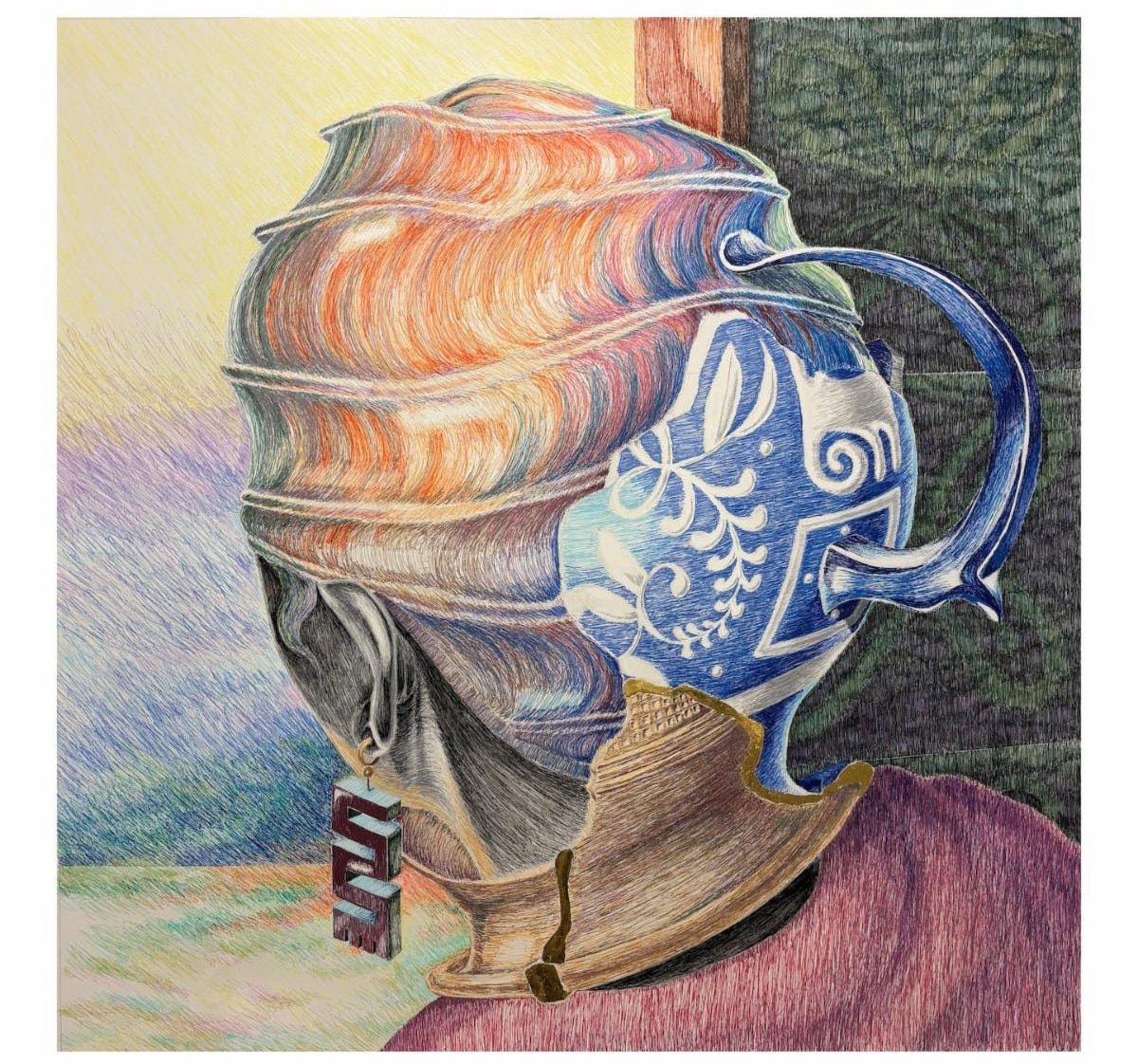
Michael Andrew Booker, “Out on the Veranda” (Morton Fine Art)
IF MICHAEL ANDREW BOOKER’S PICTURES ARE SHORT STORIES, as he labels them, they’re post-modernist parables that withhold as much as they reveal. The Maryland artist’s Morton Fine Art show, “Forward,” consists of large drawings made with colored fineliner pens, sometimes supplemented by watercolor or gold leaf. Most of the pictures, all from 2025, portray a single Black person with his or her head turned away from the viewer, so the subject’s facial expression is hidden. Booker sometimes enlists local artists as models, only to obscure their identities.
The images are mostly naturalistic, but with surreal touches: One person wears a turban topped with potted plant, and another’s head is clad in reflective squares so that it resembles a disco ball. One head is partly encased in two fragments of pottery, with the vessels’s jagged edges outlined in gold. This evokes kintsugi, the Japanese practice of repairing ceramics using lacquer mixed with gold. The process both repairs and exalts broken pots and bowls, and can be seen as a metaphor for living with or recovering from psychic injury. His pictures are “about transition, growth, and the resilience required to leave something behind.
Booker appears drawn to glossy surfaces, whether those porcelain- and mirror-enveloped heads or a shiny green-and-gold puffer parka. These exteriors are rendered with thousands of pen marks, densely but carefully arrayed. Interestingly, the last piece in the show is a diptych in an airier style. Two people, one in each panel, gaze toward what appears to be a tropical sea. The drawings are heavily worked, in the artist’s usual mode, but are lighter in hue and include curving clouds defined by their lack of pigment. This two-piece drawing may just be an experiment, but it seems to represent Booker’s effort to leave something behind.
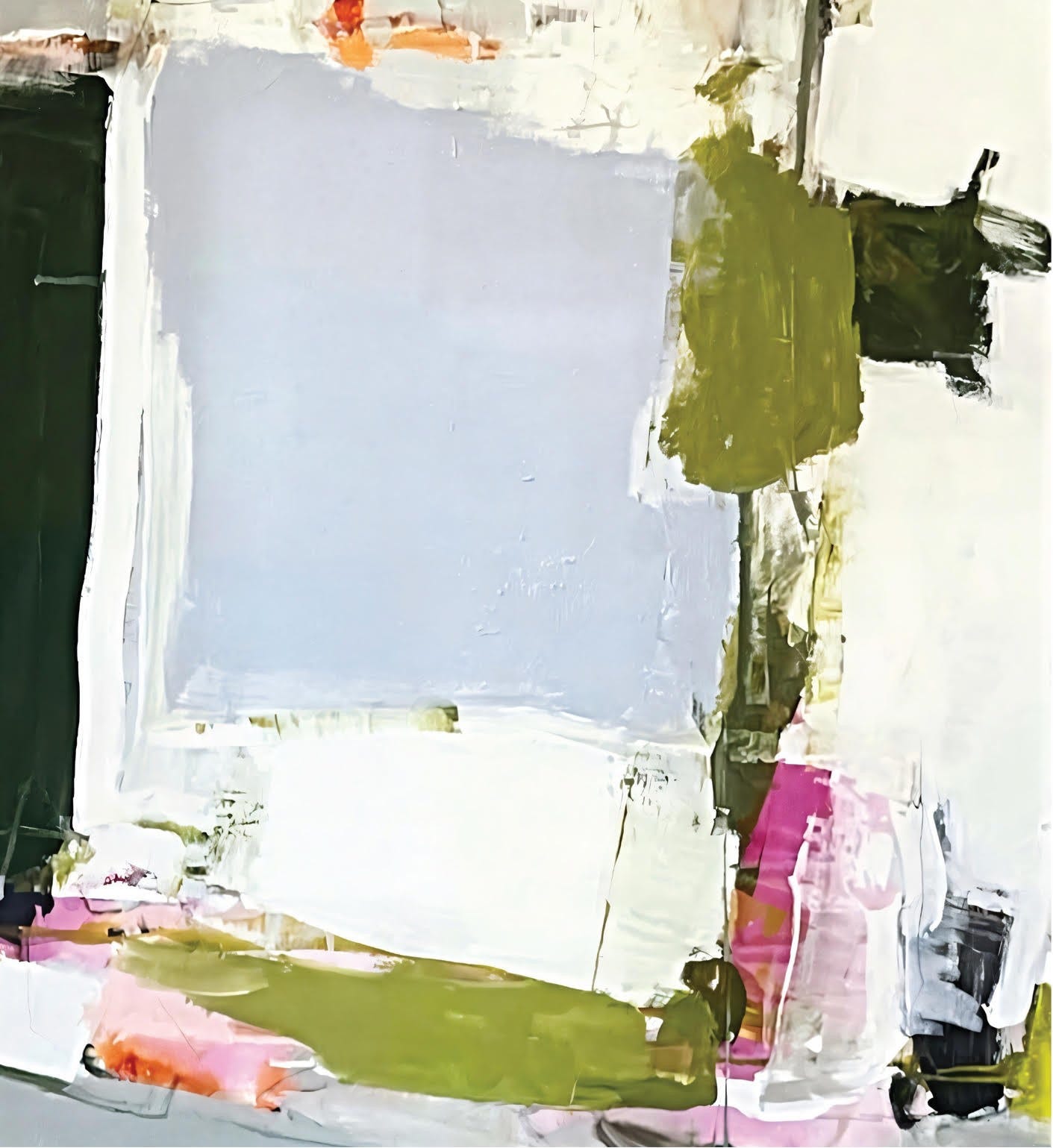
Laura Caliguiri, “Marsh Edge” (detail) (The Athenaeum)
THERE AREN’T A LOT OF PARALLEL LINES in “Parallel Lines: A Second Act in Color,” the duo show at the Athenaeum. But Laura Caliguiri and Leslie Thornton, who are longtime friends and regular collaborators, have such complementary styles that one’s output is not easily distinguished from the other’s. Both women favor open compositions and muted palettes that feature lots of white and off-white. The results suggest sun-washed California art, so it’s fitting that one precedent for the artists’s work is the landscape-rooted abstraction of Richard Diebenkorn.
That affinity is evident in the pictures that are a bit more geometrical, although in a manner that’s more intuitive than mathematical. The color fields are soft, blotchy, and ragged-edged, punctuated by meandering lines rendered with paint or pencil. Among the paintings that flirt with representation, perhaps the most notable is Thornton’s “Blowin’ in the Wind,” which conjures a shrub or tree out of a flurry of overlapping gray, green, and white brushstrokes. More typical, though, are topographical improvisations whose smears and blocks of color contain only the vaguest hint of pastures, mountains, and skies. The only territory these pictures map is their own.
Catharine Czudej: Wake Me up Inside
Through Dec. 13 at Von Ammon Co., 3330 Cady’s Alley NW. vonammon.net. 202-893-9797.
Closer beyond; further within
Through Dec. 14 at D.C. Arts Center, 2438 18th St. NW. dcartscenter.org. 202- 462-7833.
Michael Andrew Booker: Forward
Through Dec. 13 at Morton Fine Art, 52 O St. NW, #302. mortonfineart.com. 202-628-2787. Open by appointment.
Laura Caliguiri & Leslie Thornton: Parallel Lines: A Second Act in Color
Through Dec. 14 at the Athenaeum, 201 Prince St., Alexandria. nvfaa.org. 703-548-0035.