
Life Lines
Isabel Manalo paints past lament. Also: Maggie Siner’s after-party vignettes, U St. memories and regrets, Jun Yun & Ju Yun’s very different approaches
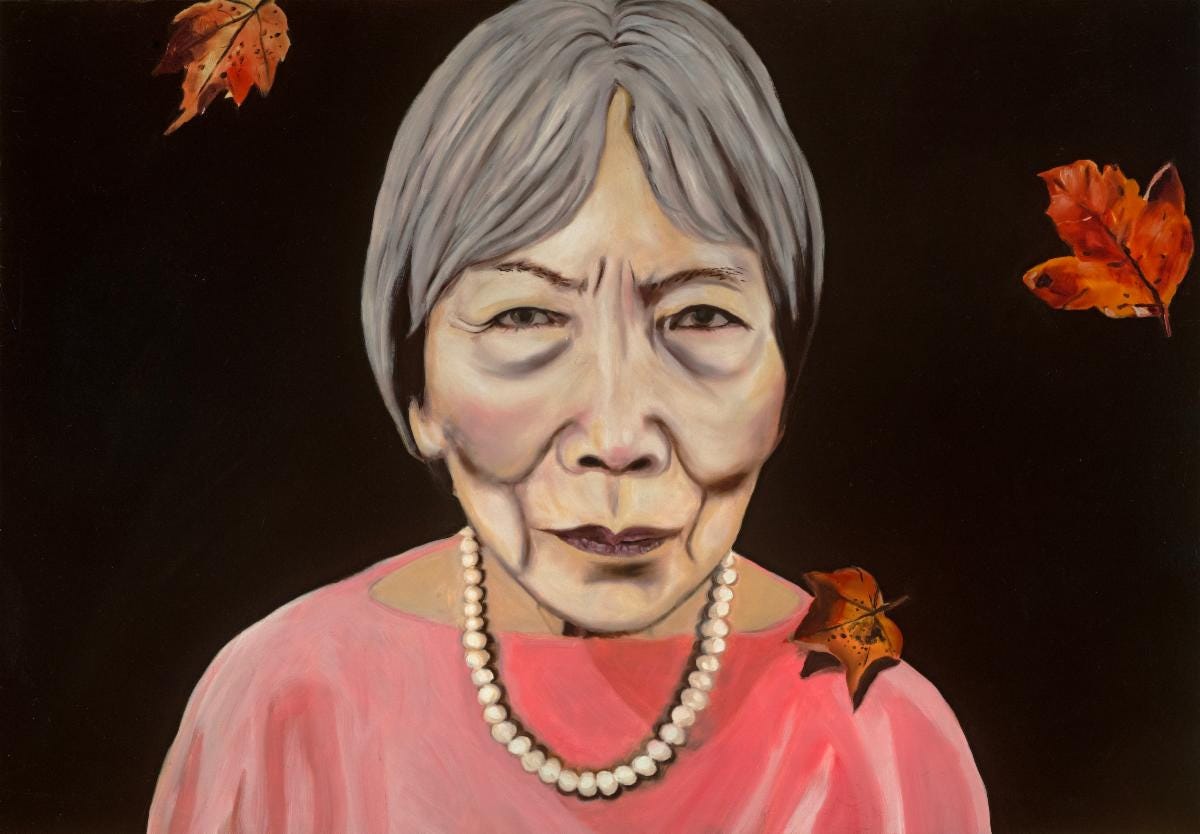
Isabel Manalo, “Lament” (Addison/Ripley Fine Art)
FAMILY CONNECTIONS WERE INTEGRAL to Isabel Manalo’s previous Addison/Ripley Fine Art show, “To Grow a Life.” It included a memorial portrait of the suburban-Maryland artist’s late father, but was mostly inspired by Manalo’s teenage daughters, and thus flowered with paintings of lush blooms. The artist’s current exhibition is titled “Lament,” after a portrait of her mother, who has dementia. The picture’s subject gazes directly at the spectator, and appears elegant and dignified. But she’s placed not among the tropical flora of her Philippines origins, but with three falling red-brown leaves that represent the end of the life cycle.
Almost half these pictures are black-and-white drawings, many small but including a large pencil rendering of mother and daughter that’s detailed and evocative. The two women are side by side, both looking leftward as if into the past. There’s also another powerful painting of Manalo’s mother, her cheekbones underscored with shadows as black as the somber background.
The mood of such pictures infuses the entire show, yet many of the lamentations are not for Manalo’s mother but for women in general. The artist depicts stylized near-nude figures, bound with ropes to represent their struggle for autonomy. Some of the subjects are twinned and tied together symmetrically, or arranged into insect- or crustacean-like hybrids with multiple sets of limbs. “Boundless” portrays a woman in a yoga pose, her thighs divided into blocky red shapes that resemble cuts of meat. (Perhaps that’s not the intended implication, but the painting recalls one by Anna U Davis that explicitly presents women as objects for psychic butchery.)
Bright colors enliven a few of the paintings, but the palette is mostly subdued, with orangish flesh tones contrasted by backdrops of mottled tan, black, or dark green. Yet the artist dapples the women’s skin with luminous highlights, and softens the outlined forms with areas of gently modeled color. Into pictures that ponder strife and decline, Manalo injects lush life.
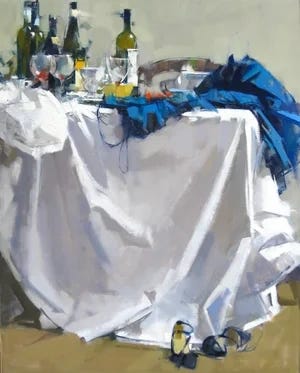
Maggie Siner, “After, Blue Dress” (Calloway Fine Art and Consulting)
LIGHT, SHADOW, AND DISARRAY ARE THE ESSENTIAL INGREDIENTS of Maggie Siner’s elegant oil paintings, which are mostly landscapes and still lifes. The semi-local artist, who spends much of her time in Venice, makes impressionistic pictures of scenes she semi-renders perfectly. For the second January in a row, Calloway Fine Art and Consulting is presenting a “pop-up” of recent Siner canvases, most of them small and all of them utterly assured.
One of the painter’s motifs is the aftermath -- serene and domestic, yet with an intimation of chaos. These qualities are embodied in “After, Blue Dress,” in which the titular garment is piled on a table covered with a rumpled white linen tablecloth, a Siner trademark. A pair of women’s shoes on the floor is further testimony to a bygone presence, and the dress shares the table with glasses and wine bottles, all of them likely empty. Intriguingly, the show’s only picture that contains a person depicts a woman wearing a blue dress and curled up atop a table -- possibly the same dress and the same table, and certainly the same after-the-ball vibe.
Most often it’s unworn clothing, hanging loose and extravagantly creased, that stands in for people. That men and women exist is also conceded by what’s left from meals and parties, whether the remains are empty bottles or the green melon rinds whose orange interiors set off the blue bowl that shares a table with them. In other paintings, the foodstuffs are uneaten and arrayed dramatically among dishes and, of course, mussed table cloths. On a larger scale, the existence of humanity is illustrated by cities, towns, and farmhouses, although these are seen at a distance and usually upstaged by such foregrounded environments as bodies of water or fields of lavender.
The lavender is depicted primarily as sheets of that color, and is among the most abstract elements in these pictures. Also strikingly minimal are two snow scenes -- that is, aftermaths of snowfalls -- distilled to little more than slashes of blue on white. Siner constructs evocative little tales from seemingly offhand gestures, and sometimes those gestures are almost the whole story.
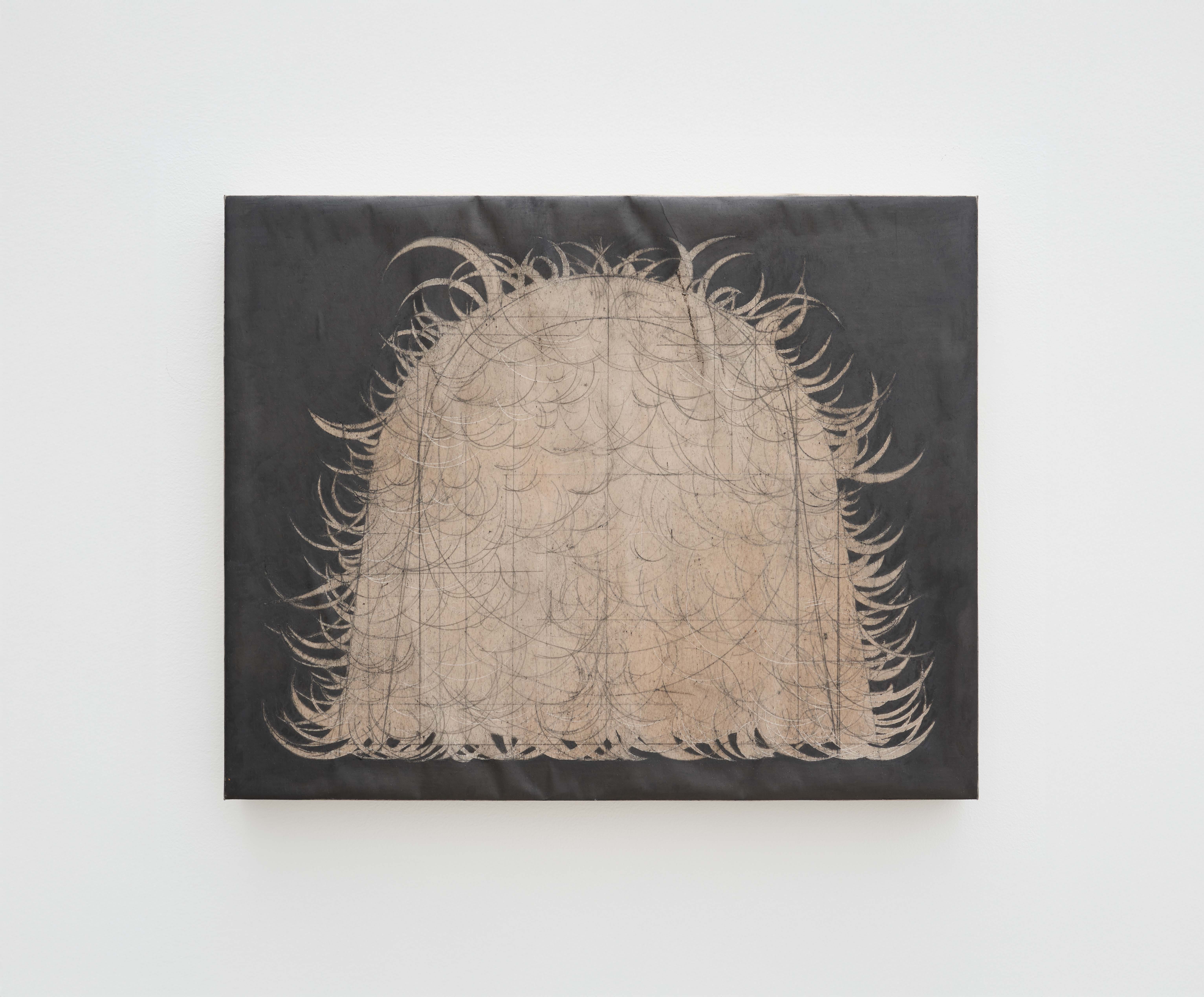
Kai Jenrette, “No Title” (Hamiltonian Artworks)
U STREET IN ITS “BLACK BROADWAY” ERA is treated both historically and symbolically in “Mic Check,” an eight-person show at U St.’s Hamiltonian Artists. Curated by Anisa Olufemi, the exhibition mixes the work of local participants (including Jermaine “jET” Carter, currently a Hamiltonian Artists fellow) with that of New York and Los Angeles residents.
Some of the pieces include vintage photographic images, such as the Howard Theater sign Carter incorporates into a mosaic of tightly fitted honeycombed wooden tiles, or the drag performers Alanna Fields memorializes on fan-shaped wall sculptures. Also photographic are two half-hour videos: Cameron A. Granger’s “pseudo-documentary” that ponders the disappearance of cultural memories and Darol Olu Kae’s impressionistic portrait of a long-lived L.A. experimental jazz group.
Kamari Carter turns more directly political with such pieces as “Patriot Act,” a trio of sound-emitting megaphones painted, respectively, red, white, and blue. Other contributors render music and street life abstractly, whether as swirling ribbons of black in Lindsay Adams’s mixed-media drawing or as primary-color blocks in Imar Lyman’s 1960s-style acrylic painting. Especially intriguing are two dense pencil drawings made by Kai Jenrette on waxed newsprint. These shadowy pictures may not have anything to say about U St. in particular, but they do hauntingly conjure absence and loss.
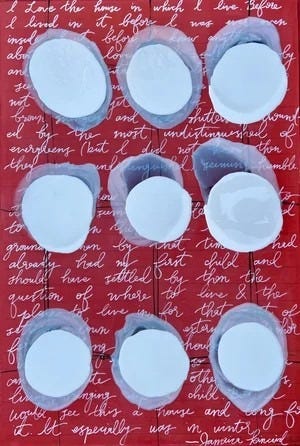
June Yun, “Memory Book” (June Yun)
JUNE YUN COMBINES COMMERCIAL ILLUSTRATION with color-field painting in the eight mixed-media pictures in “The Dreaming Garden.” On exhibit in the cafe of the Tysons Neiman Marcus department store, the brightly colored works are unified by a shared motif of gridded dots. Those dots vary, however, not just in color and size but also in texture. The circles are usually crisp, but in striking “Memory Book” they’re big white blobs -- thick, irregular, and shadowed -- atop handwritten white script on a deep red background.
Flowers, textiles, chairs, and a woman graced by butterflies are among the subjects of these paintings, most of which are dominated by a single color. The primary hues are often synced with a different shade of the same one, but are occasionally contrasted by gold or silver leaf, suggesting abundance. If that’s appropriate for an upscale store, there’s a subversive twist to the Alexandria-based artist’s style. Her hard-edged images and tidy dots are disrupted here and there, as if to demonstrate an anarchic streak. Yun’s strong graphic sense sometimes yields to improvisation, satisfyingly messy and unexpected.
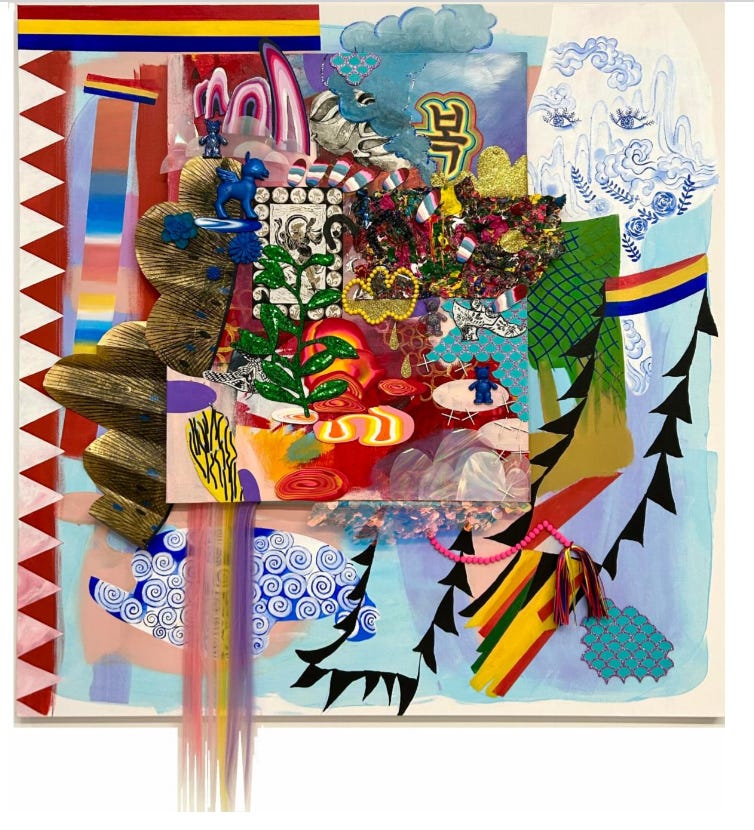
Ju Yun, “What I Leave Behind” (Ju Yun)
THE DISORDER IS MORE CONSPICUOUS in Ju Yun’s mixed-media artworks, Rauschenberg-like combines whose ingredients literally pop off the surface. The title of the local artist’s VisArts show, “What I Leave Behind,” could be a reference to her South Korean origins. Such pieces as “Memory of the Festival” and the title work are stuffed with Korean text and folkloric objects that evoke that heritage. But they also encompass American pop culture, represented by shoes, toys, smiley faces, and comic-book sound effects.
It seems significant that the show’s title is in the present tense. Whatever cultural longing the Northern Virginia artist means to express, her painting-sculptures are direct and immediate. The pieces are shiny with paint and plastic, and thrust emphatically at the viewer via molded clay forms and found objects. There’s no way these bustling culture-clash parables could recede into quaintness or nostalgia.
Isabel Manalo: Lament
Through Jan. 17 at Addison/Ripley Fine Art, 1670 Wisconsin Ave. NW. addisonripleyfineart.com. 202-338-5180.
Maggie Siner Pop-Up Show 2026
Through Jan. 25 at Calloway Fine Art and Consulting, 1643 Wisconsin Ave. NW. callowayart.com. 202-965-4601.
Mic Check
Through Jan. 17 at Hamiltonian Artists, 1353 U St. NW. hamiltonianartists.org. (202) 332-1116.
June Yun: The Dreaming Garden
Though Jan. 21 at Neiman Marcus Cafe, first floor, Tysons Galleria, 2255 International Drive, Tysons.
Ju Yun: What I Leave Behind
Through Jan. 18 at VisArts, 155 Gibbs St., Rockville. www.visartscenter.org. 301-315-8200.