
Lands, Scapes
World views, actual and imagined, by Hedieh Javanshir Ilchi, William Demaria, Multiple Exposures photographers, and botanical artists. Also: ceramics from Greenbelt
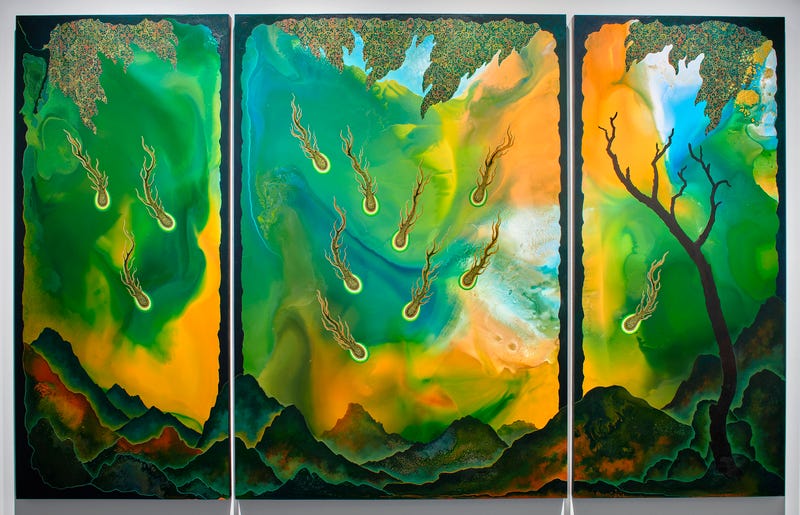
Hedieh Javanshir Ilchi, “This time merciful nature saved us from ourselves” (photo by Ulf Wallin/Museum of Contemporary Art Arlington)
ABSTRACTIONS THAT SPIRAL INTO LANDSCAPES and much more, Hedieh Javanshir Ilchi’s mixed-media paintings have been widely exhibited in the Washington area. But the museum of Contemporary Art Arlington’s retrospective reveals something new, in part by showing us things that are older. Striking pictures made in 2008-2009, vividly and unexpectedly evoking the Iran-Iraq War, begin the artist’s “Here the waving flag. Here the other world.” (The artist is known for long titles, often derived from poetry.) In these paintings, explosions and photo-derived images of urban buildings are juxtaposed with areas of fluid color.
Organized by MOCA’s Blair Murphy, the exhibition is an unusual one for the venue, which customarily doesn’t allot so much space to a single artist. Ilchi was a good choice for more extensive treatment, and not just because she’s long been associated with MOCA and its predecessor, the Arlington Arts Center (where she had a studio for six years beginning in 2012). The 30 works on display give a good account of both the growth and the continuity in Ilchi’s style.
Born in Iran in 1981, Ilchi moved to the Washington area to marry when she was 18. As it happens, the artist’s technique echoes that of innnovative Washington colorist Morris Louis. But where Louis poured pigment onto untreated canvas that absorbed it, Ilchi flows paint onto nonporous material, usually Mylar or dibond. This allows the pigments to swirl freely, intermingle unpredictably, and dry more slowly, ultimately yielding brighter colors. The interplay of such vivid hues is the principal attraction of some Ilchi paintings.
However compelling the abstract liquid patterning, the artist always adds other elements, usually from three categories: small human figures, Iranian decorative motifs, and landscapes, the latter sometimes so elaborate as to dominate the composition. These ingredients usually contrast each other, but sometimes merge. In the earlier pictures, women’s tresses twirl long and free -- forbidden, of course, under Iran’s strict Islamic regime -- until they nearly become one with the rivulets of aleatory paint. In later paintings such as “This time merciful nature saved us from ourselves,” tree branches play a similar role, twisting to mirror the sinuous play of the poured pigment.
The appearance of traditional Persian design elements, often embellished tiles or golden portals, can appear incongruous. But such motifs are becoming more common, and the show’s most recent work is an upright 3D painting on individual panels, which combines decorative gold filigree with free-form blues. It stands near another sculptural work, from 2016, that’s a heap of disassembled tiles. The latter is an interesting experiment whose implicit violence links to the war imagery of the artist’s early work. Most often, though, the disparate parts of Ilchi’s art represent not conflict but an attempt to reach a synthesis that’s as universal as it is personal.
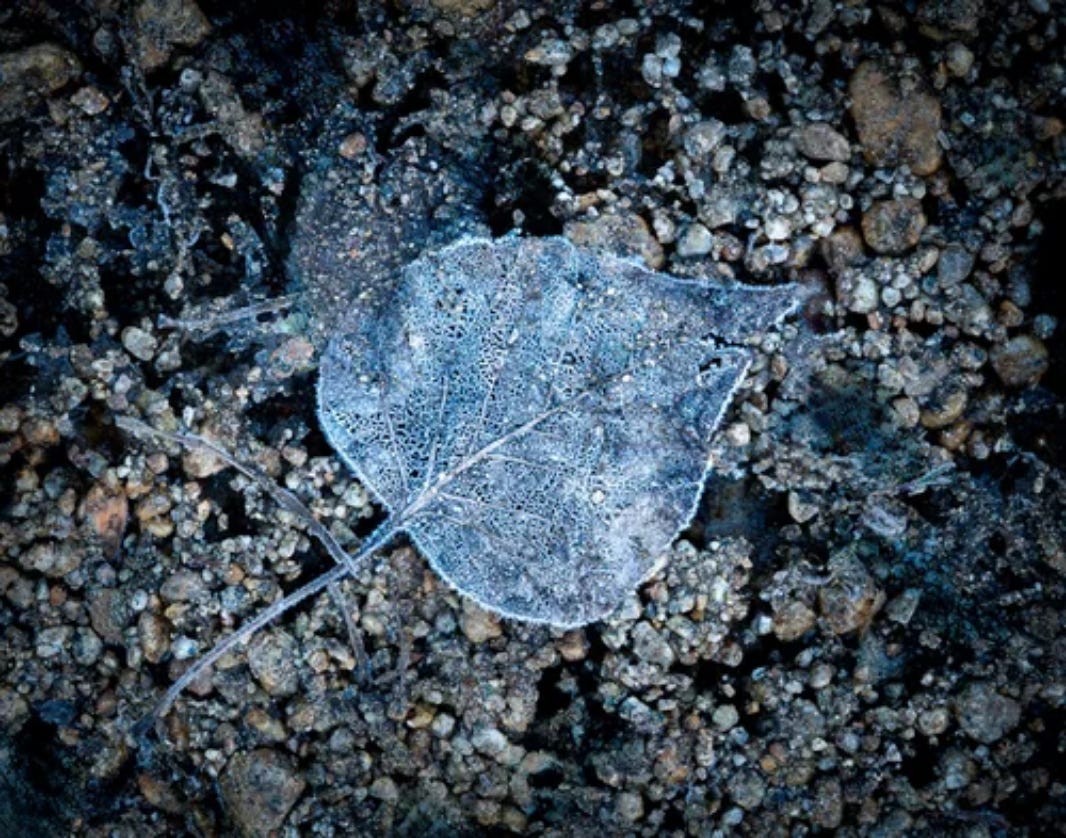
Guillermo Olaizola, “Transience” (Multiple Exposures Gallery)
MIST AND VAPOR FEATURE PROMINENTLY -- or as prominently as such substances can feature -- in Multiple Exposures Gallery’s “Ephemeral.” Juried by Touchstone Gallery Executive Director Abbey Alison McClain, the exhibition offers one or two photographs by each of the gallery’s 13 members. Most of the pictures are nature scenes, often closeups, whose subjects appear fragile and softly defined. Exemplary of the selection are Guillermo Olaizola’s blue-heavy photo of a single, nearly transparent leaf and Irina Lawton’s of a “broken” bridge, its gap-toothed span set off by satiny clouds and sun-dappled water.
Not all the pictures are so gauzy. Fred Zafran offers two that depict solid structures, one an exterior and the other interior. But both compositions focus on shadow and light, the most mutable aspects of the otherwise substantial scenes. Another piquant contrast to the overall tone comes from Russell Barajas’s witty study of flood-damaged old records, objects that are doubly impermanent. The discs, which include one by Pat Boone, would have little resale value even if they hadn’t been deformed by water.
Among the transient phenomena memorialized here are vapor trails (by Tom Sliter), dandelions (by Barajas and Maureen Minehan), and reflections in windows (by Soomin Ham and David Myers). Several participants photographed denuded trees in gray mists, but Sarah Hood Salomon went further by scratching swirling lines into her image of a single tree. To express fully the vulnerability of our forests, her picture had to be put to the blade.
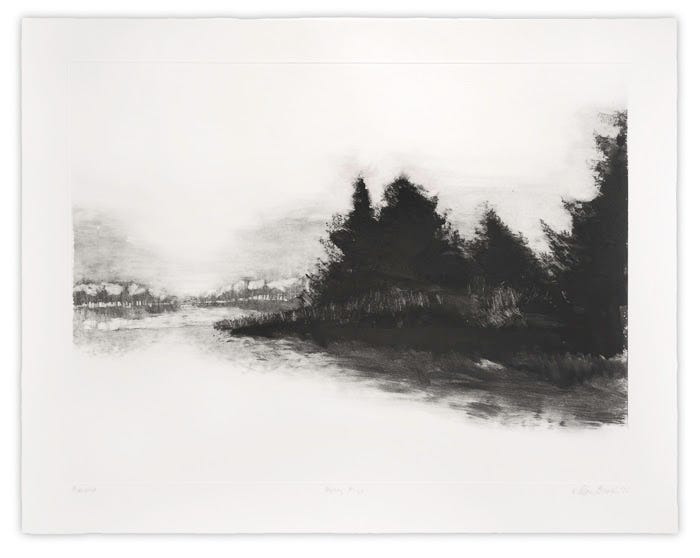
William Demaria, “Morning Mist” (Washington Printmakers Gallery)
ROCKY VIGNETTES EMERGE FROM WHITENESS in William Demaria’s recent intaglio prints, now on exhibit at Washington Printmakers Gallery. The show’s title, “Moments/Memories,” suggests that the partial images are meant to hover on the paper the way half-remembered instants float in the brain. But the icy blank expanses have another significance to the Baltimore artist: They recall the glaciers that carved many of the Earth’s contours.
The show’s introductory text notes that these slow-traveling ice walls were “as tall as skyscrapers,” a link that may explain the selection’s one outlier: a partly green-tinted urban scene that contains highrise buildings. The other pictures are all black-and-white landscapes rendered with a mix of fine lines and wash-like black and gray gestures. Some of the vistas, reportedly, depict Chinese scenery. If so, it’s apt that the printmaker’s technique evokes the softness and fluidity of traditional Chinese ink paintings.
Demaria’s precision is evident in such prints as “Ghost River,” in which a downed tree trunk parallels the oblique course of a stream. The water is represented simply by white paper, but that emptiness appears to glisten between the dark forms of bank and shadow that define the creek. As this picture demonstrates, the artist’s printmaking skills are equaled by his compositional flair. Highlighted natural forms, notably the rugged tops of mountain, cut dynamically across the paper like jagged lines. It turns that glaciers, as least as their handiwork is distilled by Demaria, really knew how to draw.
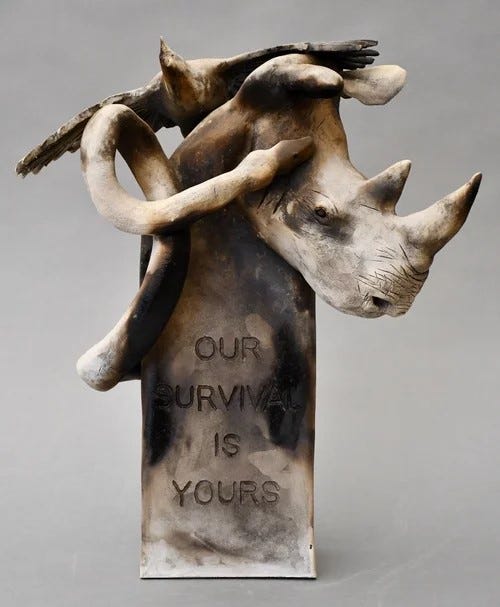
Chris Corson, “Our Survival Is Yours” (Studio Gallery)
AN IMPRESSIVE SURVEY OF AN OUTSTANDING PROGRAM, “Spirit of Community: Ceramics in Greenbelt, MD” presents 43 pieces by 33 artists associated with the New Deal-founded town’s ceramics group. The selection was curated by Mary Welch Higgins, and the show was organized by Christopher Corson. The latter is a member of Studio Gallery, which hosts the show, and he made one of the highlights, “Our Survival Is Yours.” This pit-fired monument to endangered nature entwines the heads of several animals atop a stele engraved with the piece’s title.
Corson’s shrine represents the more thematically ambitious side of the selection, which is heavy on such traditional ceramic objects as bowls, jars, vases, plates, and flasks. These entries are uniformly well crafted, and are not necessarily traditional in form and embellishment. Karen Arrington’s salt shaker takes the form of a shimmering pear, while bowls by Amy Karlsson and Xiaodan Yan feature, respectively, an undulating profile and a metallic-rainbow interior. Julie Boynton’s elegant “Carved Bottle” has incised circular patterns that recall the cord-made marks of ancient Japanese Jomon pottery.
Arrington reaches to North Africa for her ceramic doumbek, a goblet-shaped ceramic drum with a goat-skin drumhead. Meshian Lehmann echoes the nature theme of Corson’s contribution with “The Great Leviathan,” a miniature whale whose bubble glaze resembles the mottled skin of an actual cetacean. Of the many pieces made of multiple parts, perhaps the most intriguing is Diane Elliott’s “Love Your Crown,” an assemblage of broken crockery that also incorporates stone, bone, and small shells. Craggy and yet graceful, the piece makes destruction an integral part of creation.
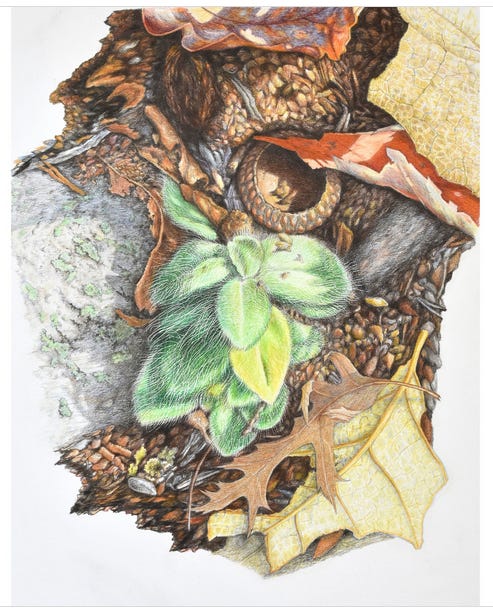
Elena Maza-Borkland,”North Mountain Patch” (The Athenaeum)
THE NATURAL WORLD CATALOGED as a series of crisp closeups, “A Winter’s Walk” focuses with exquisite precision on berries, leaves, cones, pods, and branches. This Athenaeum show presents the work of 17 members of the Botanical Art Society of the National Capital Region, all of them highly skilled in their chosen media: watercolor, pencil, and colored pencil.
None of the artists excels far above the others in technique, but a few pictures do stand out for other reasons. Margaret Farr’s “Multiflora Rose” benefits from a dramatic black backdrop. An unusually complex composition, Elena Maza-Borkland’s “North Mountain Patch” is a microcosm of dry, brown, and mostly inert objects grouped around a few lush and fuzzy green sprigs. Even more wintry is Ann Lesciotto’s “Redbud Branch,” whose leaves and pods are all in shades of brown. All three artists render their subjects with such vitality that their pictures remind the viewer that winter will soon yield to spring.
Hedieh Javanshir Ilchi: Here the waving flag. Here the other world.
Through Jan. 25 at the Museum of Contemporary Art Arlington, 3550 Wilson Blvd., Arlington. 703-248-6800.
Ephemeral
Through Jan. 25 at Multiple Exposures Gallery, Torpedo Factory, 105 N. Union St., Alexandria. multipleexposuresgallery.com. 703-683-2205.
William Demaria: Moments/Memories
Through Jan. 25 at Washington Printmakers Gallery, 1675 Wisconsin Ave NW. washingtonprintmakers.com. 202-669-1497.
Spirit of Community: Ceramics in Greenbelt, MD
Through Jan. 24 at Studio Gallery, 2108 R St. NW. studiogallerydc.com. 202-232-8734
A Winter’s Walk
Through Jan. 25 at the Athenaeum, 201 Prince St., Alexandria. nvfaa.org. 703-548-0035.