
Into an Instant
Photographer Vincent Ricardel seizes moments, while Multiple Exposures members find frames within frames. Also: painter Christopher Baer’s home truths & sculptor Carolina Carubin’s organic structures
Note: Gmail diverted notifications of the previous issue, “Into the Woods,” to users’s spam folders. If you didn’t receive notice of the issue and would like to see it, please visit discerningeye.substack.com/p/into-the-woods.
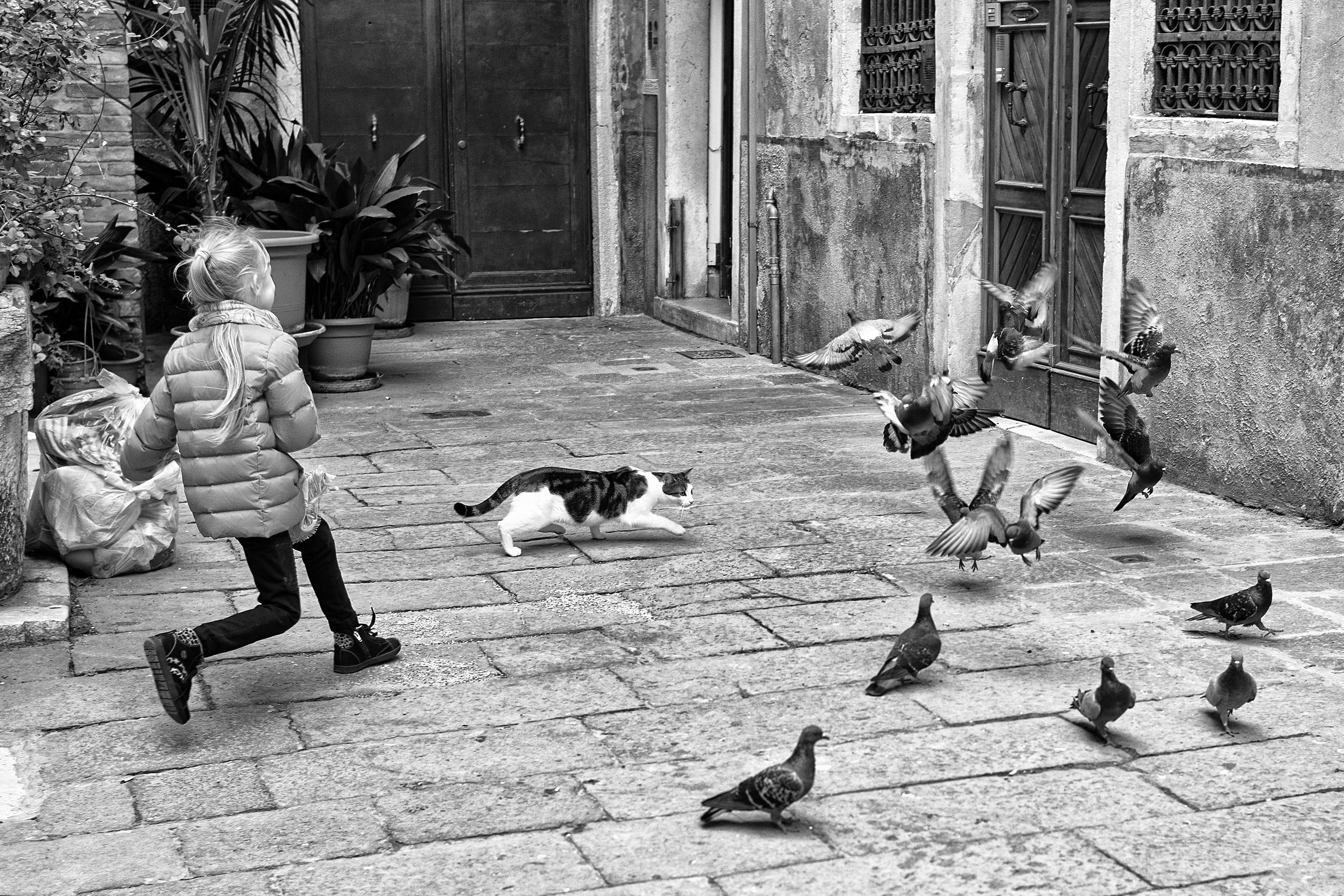
Vincent Ricardel, “The Chase, Venice, Italy” (Gallery Neptune & Brown)
THERE SEEM TO BE AT LEAST TWO VINCENT RICARDELS, to judge by his show at Gallery Neptune and Brown, “Chasing Light.” One of them gazes down toward the ground, or up to the sky, to spy disembodied feet and legs or a girl who chases a cat who’s scattering a flock of pigeons. The other makes views of water so immersive that they nearly swallow the viewer. The former photos are in black-and-white, as are almost all these pictures. The latter are in dye-sublimation color, for which Ricardel demonstrates an exquisite if only occasional flair.
The photographer, who divides his time between south Florida and northern Virginia, trains his lenses on Europe and Asia, as well as the United States. Two of the three water pictures were made on the seashore in Hawaii or on Long Island. The third, a fantasia of reflected green and purple and shimmering white highlights, is a closeup of the water in the moat that surrounds the Imperial Place in Tokyo. It’s a highly specific location, identified in the photo’s title but rendered unrecognizably abstracted.
Further demonstrating his versatility, Ricardel offers a platinum contact print of a slumping bloom he terms a “sleeping tulip” and a sheet of blurred closeups of a woman’s face that looks like nine frames from a 1920s German expressionist film. But most of his pictures are examples of street photography that rely on unexpected events and serendipitous lighting. Whether it’s the girl, cat, and birds or a ballerina’s pas a deux with her own shadow, Ricardel captures the everyday at the exact moment it becomes remarkable.
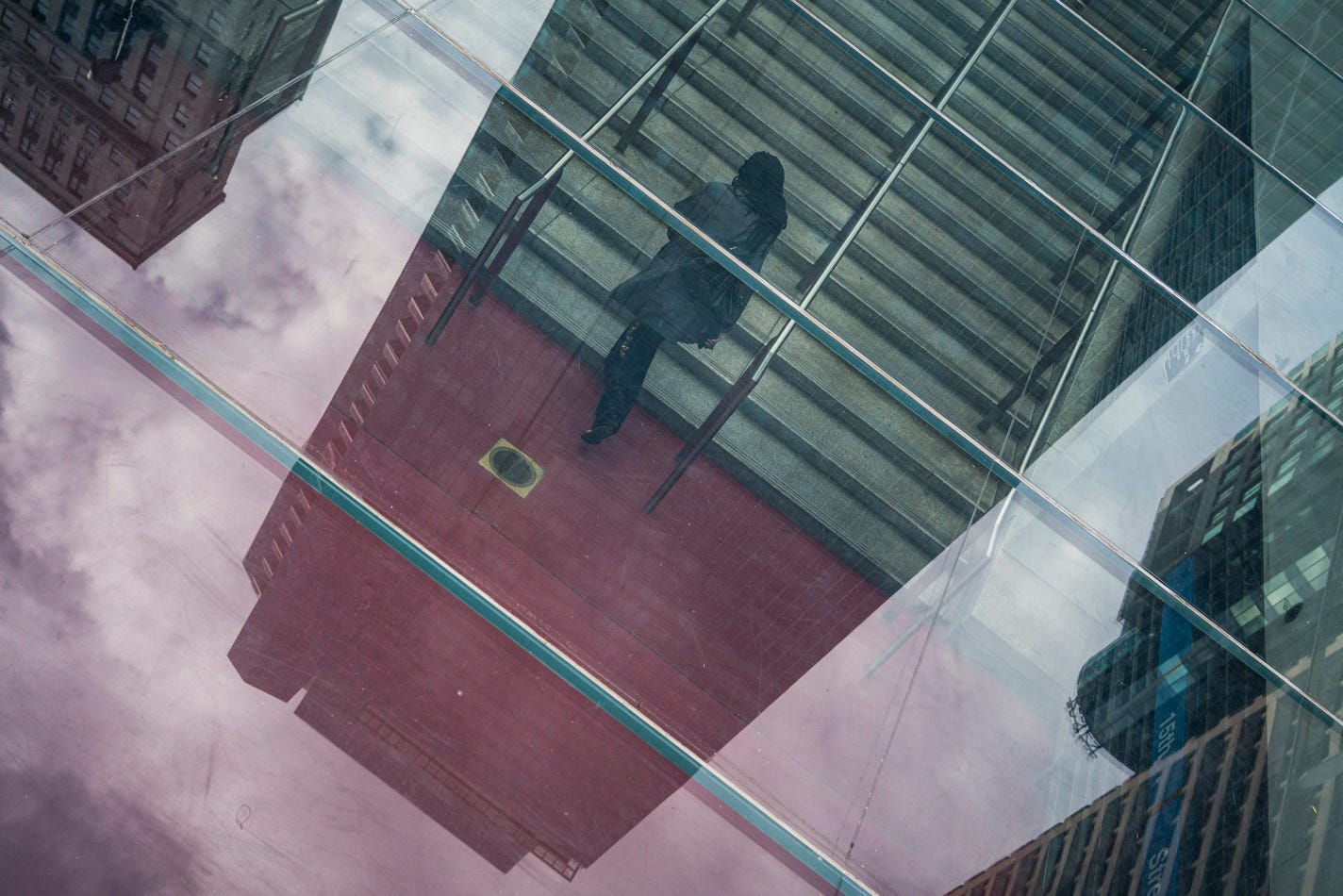
Fred Zafran, “Stairway Out” (Multiple Exposures Gallery)
GAZING INTO OR THROUGH are the strategies that link the entries in “Pediment of Experience,” a show of 20 photographs by 10 members of Multiple Exposures Gallery. The pictures were juried by Tim Carpenter, whose statement explains that he sought examples of the “active frame” -- not the perimeters imposed by the photo lens but real-world boundaries that confine part or all of the composition.
Nearly all the pictures are in black-and-white, which accentuates one sort of border: the line between light and darkness. In Van Pulley’s “Off Broadway,” light streams down one side of a dusky urban passageway, silhouetting a lone pedestrian. Eric Johnson’s “Fish Market at Night” peruses an area of bustling activity defined by both physical barriers and surrounding blackness. Russell Barajas’s “Clearing Out His Study” depicts a shadowy room, empty except for a desk and chair, that’s energized by hot light through vertical banks of windows.
Similarly enclosed spaces are documented by Sarah Hood Salomon’s two pictures of attic-like interiors that appear to be clad entirely in wood. The bounded space is outdoors in Alan Sislen’s “Ancient Oak Canopy,” in which a succession of heavy low-hanging branches collude to make a tunnel, and Soomin Ham’s “Unfold,” which observes an abandoned umbrella in an empty urban field surrounded by a nearly imperceptible screened fence. One of the few color entries is Stacy Smith Evans’s view out from a dark room onto a sunny terrace, a picture that flips the outlook of Pulley and Johnson’s photos.
One of Salomon’s photos is a mildly vertiginous view down a staircase, which complements Fred Zafran’s off-kilter color shot of a woman on a stairway. Its central image is actually an upside-down reflection seen in -- another barrier! -- a glass wall. This picture is the show’s most dynamic example of an “active frame,” but the same contributor’s “Cable Car” seems almost as ideal for the concept. In this photo, a few faces peer from the gondola, passengers sequestered in a small room that happens to be suspended in mid-air. Up/down, inside/outside -- Zafran has captured a moment in which polarities jangle delightfully.
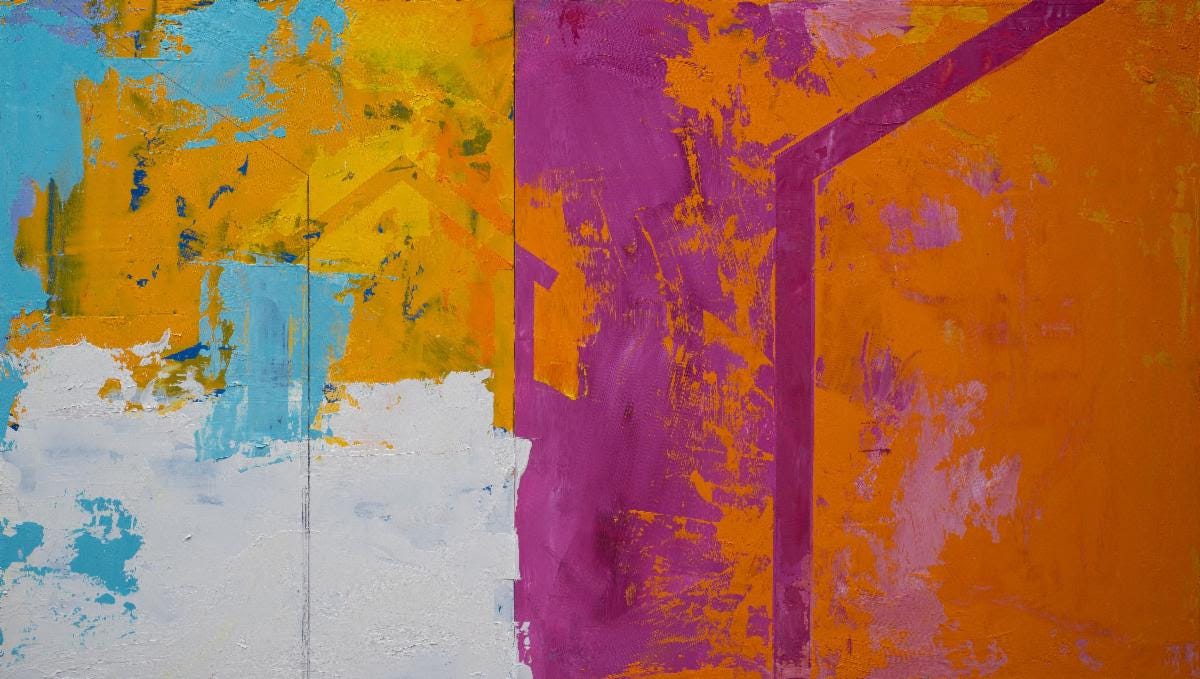
Christopher Baer, “Home 08” (Addison/Ripley Fine Art)
CHRISTOPHER BAER’S PAINTINGS ARE BUILDING PROJECTS, which befits the theme of his current show, “Home.” The D.C. abstractionist’s fourth Addison/Ripley Fine Art exhibition continues in the manner of previous ones, but with a new iconic motif: the elementary outlines and subsidiary shapes of a house. In his statement, he dedicates all but one of these 18 pictures to “the therapists, physicians, healers, and witnesses who help us find our way home when we’re lost.” (The other painting, the show’s largest, is from a previous series, “Holding the Center.”)
Given the concept of “home,” it’s easy to see Baer’s splotchy surfaces as worn walls or battered floors, and the disorderly compositions as evidence of construction or demolition. But the artist’s fundamental technique was established before he began this set of oil-on-panel pictures. He layers multiple shades of paint, only to strip away some of the pigment. The hues are predominantly hot reds, oranges, and magentas, but often countered by watery or airy blues that gently reduce the overall temperature. The results are brawny, yet tantalizingly incomplete.
The house outlines, window-like openings, and marks that hint at roofs and eaves serve the same visual function as the dots and X’s in previous Baer series. They open portals into the paintings’s lower levels and punctuate the sumptuously messy expanses with the simplest of contrasting forms: tape-defined bars and drawn or incised lines. These figures may, as Baer writes, signify the sanctuary of home to the spiritually adrift. But they also ground the otherwise tumultuous paintings, giving the eye a place to take temporary shelter before again braving the storm of color and gesture.
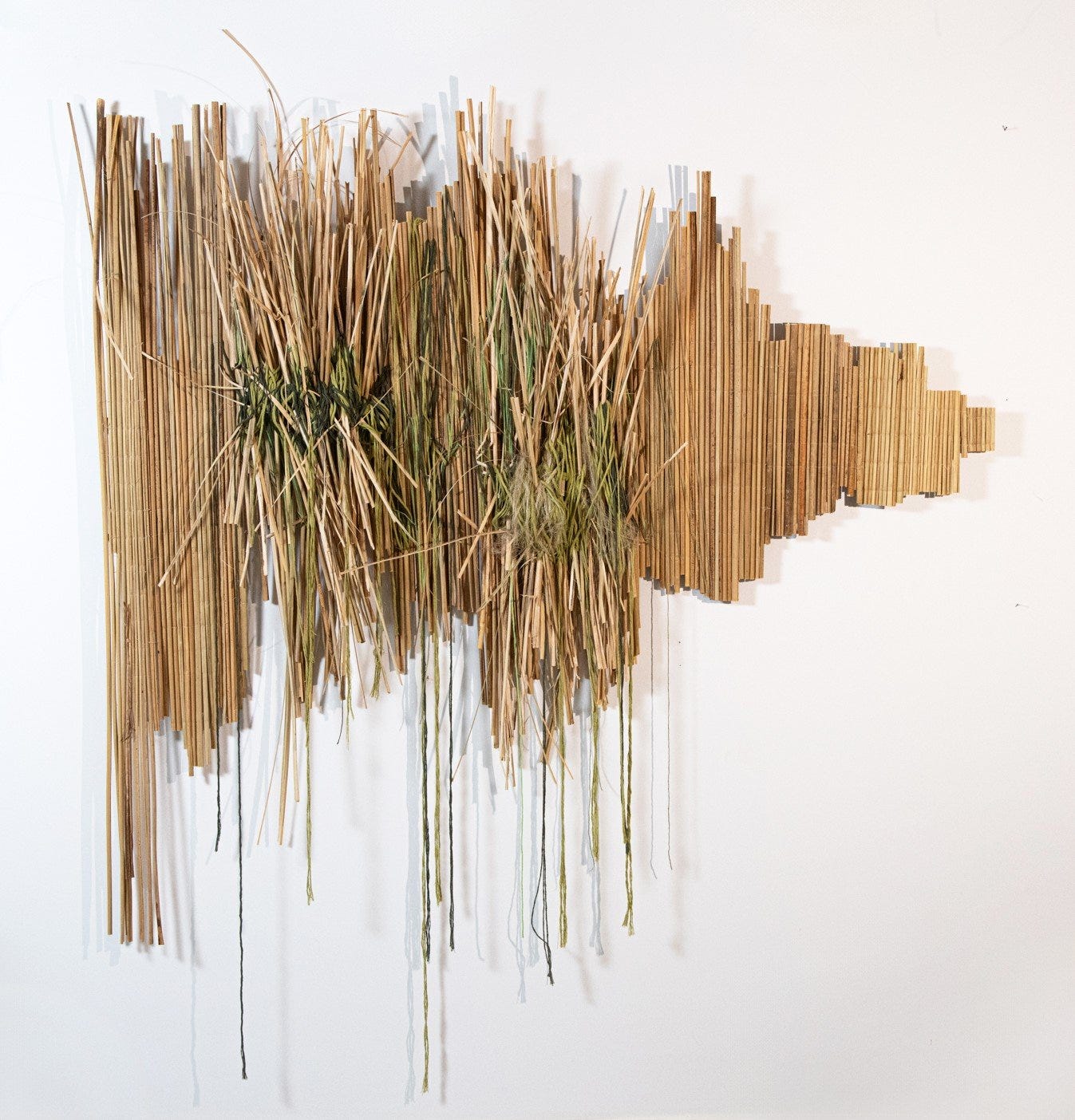
Carolina Carubin, “Wild” (IDB Staff Association Art Gallery)
DYNAMIC COMPOSITES OF FOUND AND MADE ITEMS, Carolina Carubin’s sculptures seem often to begin with a single curving branch. Trained as an architect, the Argentine artist combines fragments of trees and plants, often binding them with wire and wrapping some of the elements with neutral-hued sisal or bright red or lime green thread. Each of these hanging or wall-mounted pieces is “a small ecosystem,” according to Camila Palacios’s statement on “Silent Reach,” Carubin’s show at the IDB Staff Association Art Gallery.
Palacios’s description is appealing, and Carubin’s affinity with nature is evident. The show also includes pencil drawings, most of them with green-tinted regions, that suggest foliage without literally depicting it. One sculpture, “Wild,” stitches together reeds in a configuration that resembles the appearance of a marsh yet clearly demonstrates the artist’s manipulation of the materials.
In a short video that plays in the gallery, the artist explains that, “I choose not to erase the origins of things.” That doesn’t mean she simply gathers plant matter and clusters it, like some sort of flower arranger. She adapts and transforms the objects, pulling them from their environments and displaying them against white walls that highlight the intricate shadows cast by the dangling forms. Carubin’s creations can be seen as small ecosystems, but also as tiny buildings.
Vincent Ricardel: Chasing Light
Through Oct. 18 at Gallery Neptune & Brown, 1530 14th St. NW. galleryneptunebrown.com. 202-986-1200.
Pediment of Experience
Through Oct. 12 at Multiple Exposures Gallery, Torpedo Factory, 105 N. Union St., Alexandria. multipleexposuresgallery.com. 703-683-2205.
Christopher Baer: Home
Through Oct. 18 at Addison/Ripley Fine Art, 1670 Wisconsin Ave. NW. addisonripleyfineart.com. 202-338-5180.
Carolina Carubin: Silent Reach
Through Oct. 16 at IDB Staff Association Art Gallery, 1300 New York Ave. NW (13th St. entrance). idbstaffassociationartgallery.org. 202-623-3635.