
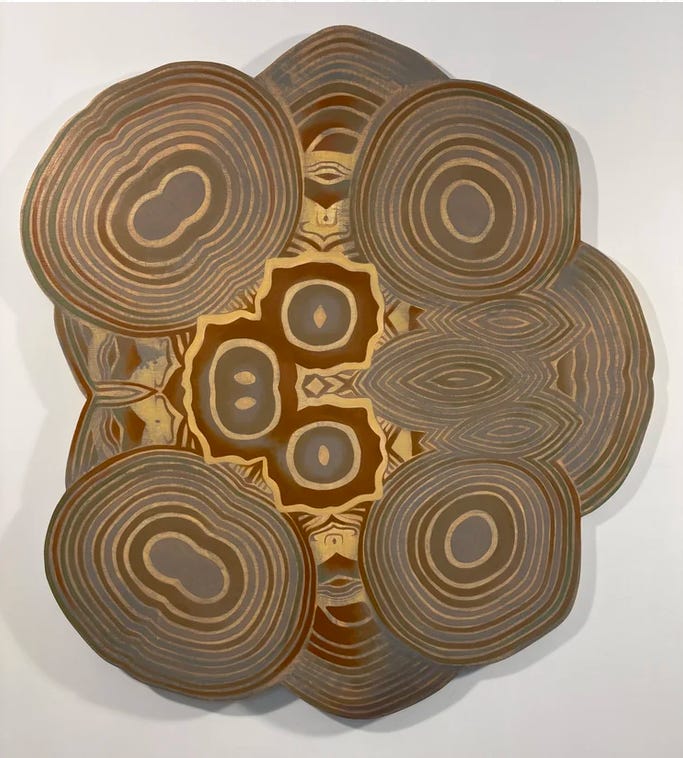
Jeffrey Smith, “Rappahannock 17” (Fred Schnider Gallery)
WASHINGTONIANS, LIKE MOST AMERICANS, live amid a forest of Indian names -- so many that they’re rarely even noticed. Growing up in McLean, Jeffrey Smith probably gave little thought to the designation of a nearby street: Powhatan. But that and other Native American place names provide the titles for all 17 works in “Paintings from the Powhatan Project,” the local artist’s impressive exhibition at the Fred Schnider Gallery of Art.
In his note on the show, Smith calls his recent pictures “an exploration of the natural and spiritual history of the Potomac and the Northern Neck.” That doesn’t mean his oils, painted on muslin or paper, are literally historical or geographical. Partly modeled via computer, the artworks combine the topographic, the decorative, and the abstract. Also, their precedents and inspirations reach well beyond the Washington region and Amerindian culture. Smith is a longtime employee of the institution now called the National Museum of Asian Art, and one of his interests is suminagashi, a centuries-old Japanese technique for marbling paper.
The artist seeks to evoke the processes of the natural world -- “growth, decay, seasons, tides, and wind” -- and so foregoes straight lines and right angles. Smith’s paintings are on shaped canvases that either echo or contrast their curving patterns. Four smaller pictures on paper are mounted on foamcore, subtly pushing the image forward. The effect of such anti-Cartesian gambits is to make the works register as things in themselves, and not just streamlined representations of such forms as tree rings, water ripples, and star flickers.
For all their precision, Smith’s pictures are as sensuously painterly as the canvases dripped, splashed, and poured by mid-20th-century color-field artists. The hues, mostly earth tones, are intricately mottled and charismatically smudgy -- and, in the smaller works, engrossingly grainy. In a picture like “Tappahannock 12,” dovetaiiling curves and blocks of solid pigment frame areas in which colors gently melt into each other. “The Powhatan Project” is a symbolic rendering of an entire area, but it’s also the testament of a singular hand.
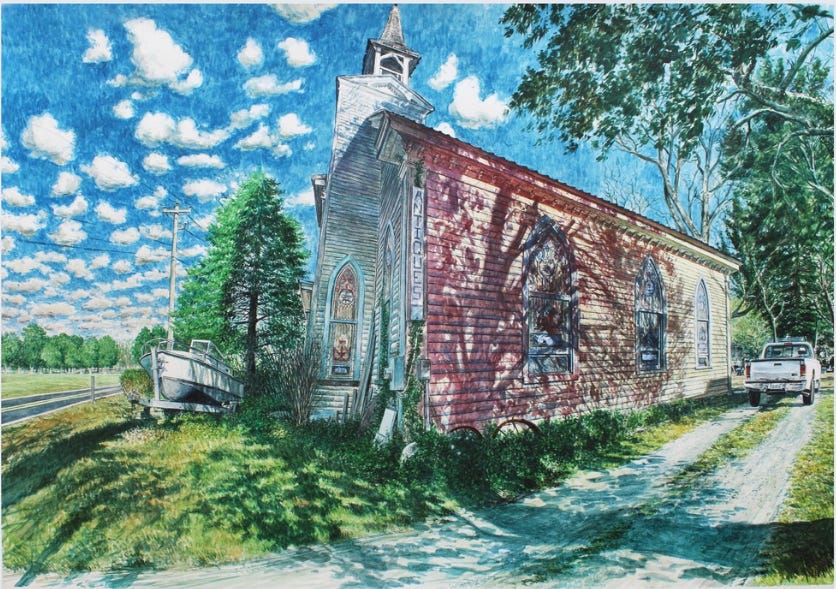
Ben Ferry, “Shore Religion” (Gallery Neptune & Brown)
HE’S NOT EXACTLY A MAGICAL REALIST, but Ben Ferry is a representational artist who specializes in enchanted locations. These frequently feature water and light, two fluid substances the D.C. artist most often renders, appropriately, with watercolor. The paintings and drawings in “Take the Long Way Home,” Ferry’s third Gallery Neptune & Brown solo show, depict everyday serenity. They represent what the artist’s statement calls “a disconnect from the chaos.”
Derived from visits to the Eastern Shore and the Pacific Northwest, Ferry’s pictures portray everyday small towns as places of refuge. “Shore Religion” is titled that in part because it’s centered on an old wooden church, but what’s most transcendent about the artwork is the symphony of sunlight and multi-hued shadows that plays across the scene. Other pictures, notably “Sun Dancing” and the shimmering “Smolder,” contemplate even more prosaic structures that are sanctified by natural light.
Ferry’s subjects, which include boats, two-lane roads, and sleeping dogs, are almost too comfy. What distinguishes his paintings and drawings are exceptional skill, an eye for beguiling detail, and -- in some dynamic instances -- immersive compositions. While most of these pictures observe from a distance, a few of them place the viewer in the middle of things: aboard a small boat in “Crabbing Off Madrona Point” or seated on the porch in “Red Table, Green Chair.” In these vignettes, Ferry doesn’t merely capture the beauty of the quiet life; he compels the spectator into it.
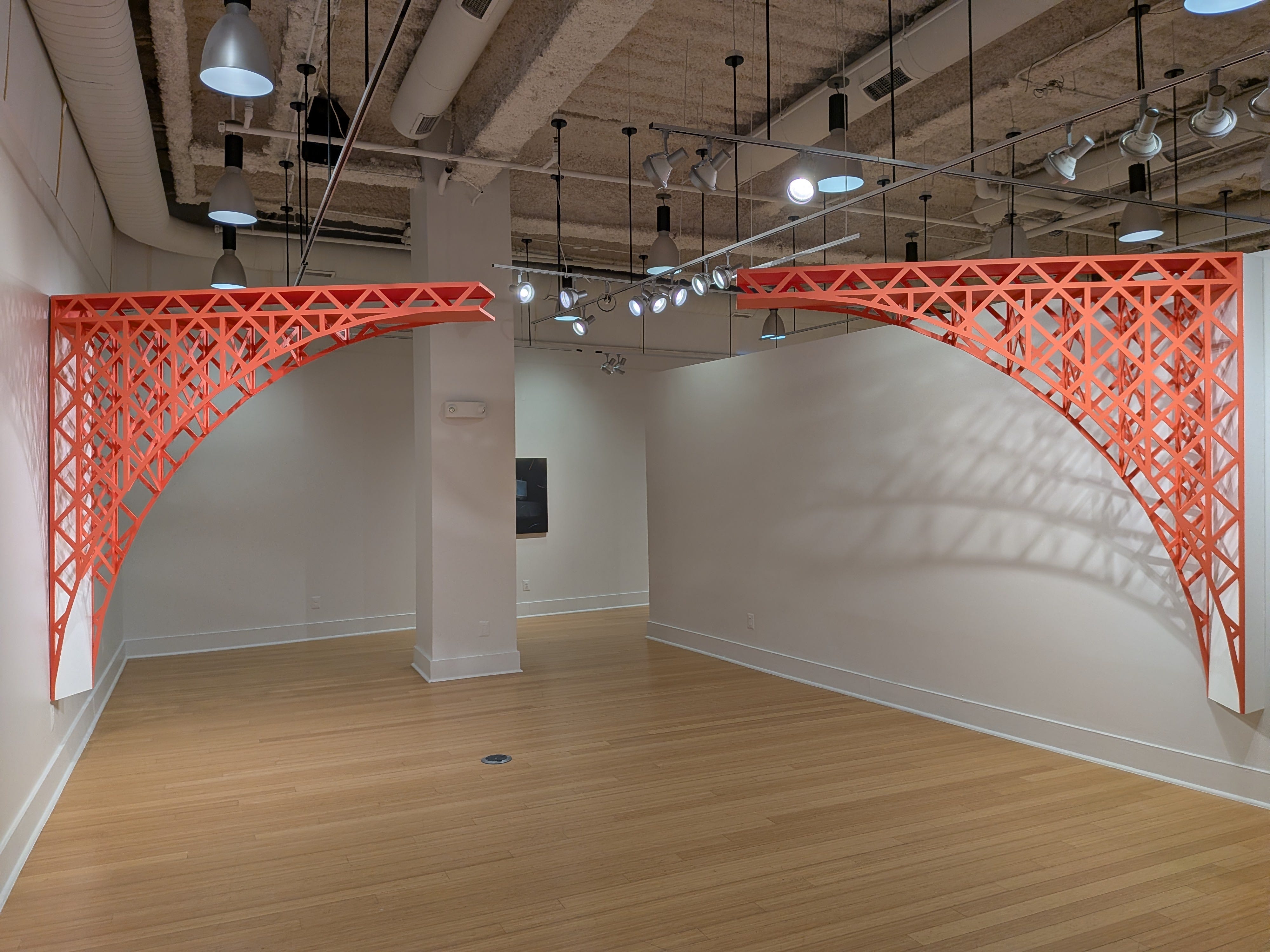
Kyle Butler, “All Approach, No Arrival” (photo by Mark Jenkins)
THE WORLD IS SOLID YET TENTATIVE in the multi-media creations of Kyle Butler. The emblematic entry in the Buffalo artist’s VisArts show, “All Approach, No Arrival,” is a large wooden model of a bridge that dominates the smaller of the Kaplan Gallery’s two rooms. The seven-foot-high structure is imposing but pointedly incomplete: A missing center span shifts the construction from a likeness of a bridge to a metaphor for uncertainty.
“All Approach, No Arrival” is VisArts’s 2026 Mentoring Curator Exhibition, supervised by John Massler of Buffalo’s Hardwalls Contemporary Arts Center. The show is about half painting, with the rest sculpture save for one performance video. In “Leisurely Confronting the Abyss,” the artist drags a recliner chair through a city to its lakefront, where he sits and watches a sunset that appears benign but is -- to judge by the spectator’s final reaction -- actually terrifying.
Butler’s intimations of chaos are tidily packaged. “Garbage Facade” employs real trash, but turns out to be a sort of stage set. The paintings, derived from online mapping sites, are hard-edged and have a vague sense of place, gently disrupted by overlaid bars and swoops. Wooden-lattice wall pieces appear to be cohering and unraveling at the same time. Closest to the spirit of pop art is a sculpture of a mop whose head takes the form of a large tongue -- one of this array’s few acknowledgments of human flesh.
“Tongue Mop” is predominantly peach-colored, which might seem a bow to realism if only that hue didn’t dominate the show. All the wooden pieces, even the towering partial bridge, are the same color. The paintings are mostly in shades of gray, but with peach tints or accents. Butler may be alarmed by the world, but his palette is ironically mild.
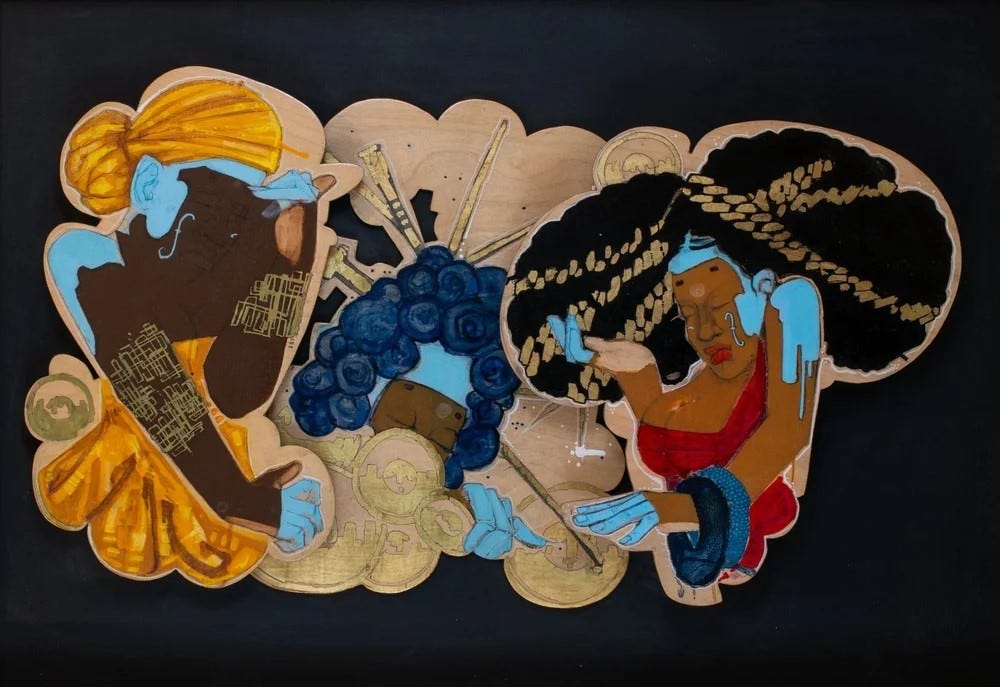
Rozeal., “Las Tres, Dos Decks (pieces of peace)” (Spilt Gallery)
INSPIRED BY JAPANESE VISUAL CULTURE and an eccentric J-fashion subculture, Rozeal. began making distinctive paintings some 25 years ago. The local artist borrows from traditional Japanese art, notably ukiyo-e woodblock prints, but incorporates elements of Black American hip-hop culture. This idiosyncratic mashup was sparked in part by ganguro, a 1990s vogue in which some Tokyo youth made their skin as dark as possible. (Guro is a form of kuro, Japanese for “black.”)
Rozeal. is still working with these ingredients, but more loosely. Many of the paintings and prints in her Spilt Gallery show, “Seed of Faith > Seed of Memory,” look like deconstructions of her earlier work. Compositions appear improvisational, and renderings are sketchier. The recent paintings are embellished randomly with pigment drips, and one is a near-abstraction that transmutes audio speakers into a Japanese-style decorative motif. Several 3D pieces are built of multiple layers, as if paintings were taken apart and then reassembled into haphazard mikoshi -- portable shrines. The notion of sacredness is underscored by the abundant use of gold, evoking Japanese temples.
As the show’s title indicates, Rozeal. is pondering memory. The show’s talismans of childhood include cartoon bears, a kid-sized big-wheeled car, and small 3D-printed plastic figures. More disturbing is a painting of a Japanese/Black woman who’s wearing boxing gloves and bleeding from the mouth, a picture titled “A.R.T. (Always Reliving Trauma: All you heard was papa don’t hit me no more...).” Whether or not this scenario is autobiographical, it does suggest another reason for Rozeal.’s attraction to Edo-period Japanese art. It was an era of relative peace, bristling with thoughts of remembered violence.
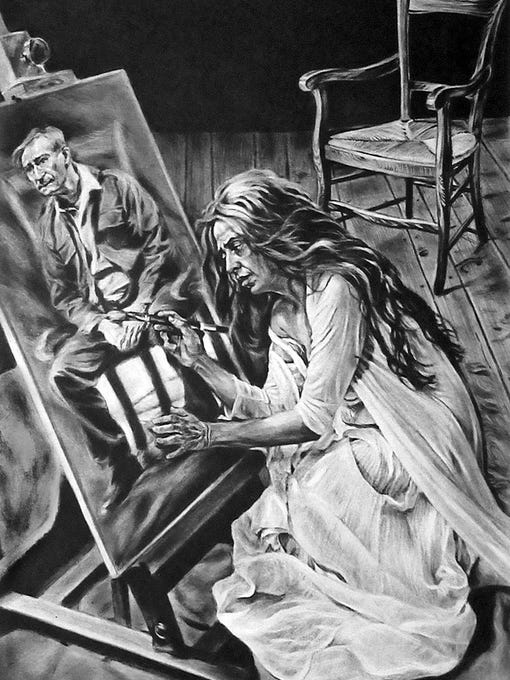
Matina Marki Tillman, “Humanography 3 (in absentia)” (Washington Printmakers Gallery)
WOMEN WILL THEMSELVES OR OTHERS INTO EXISTENCE in the exquisitely detailed prints of Matina Marki Tillman, a longtime mainstay of the Washington Printmakers’s Gallery. Among the exemplary works in the Connecticut artist’s “Humanography: Paramythia” is “Humanography 3 (in absentia),” in which a woman paints a portrait of a man. A solarplate etching derived from a charcoal-and-pencil drawing, the picture is lushly textured and exactingly realistic. Both Tillman and the artist she depicts are exceptionally precise limners.
Tillman was born and raised in Greece, and calls on that nation’s ancient myths for themes and motifs. (”Paramythia” means both “fairy tales” and “consolation,” according to the artist’s statement.) So Icarus tumbles from a fire-escape stairway, and a black-and-white Ariadne wraps pink thread around her figure. Many of the prints are twinned, whether in mirrored images like those of “A little bird told me” or the pairing of “musician messenger” and “jester warrior.”
The majority of these prints are monochromatic or almost so, accented with modest touches of color. That last duo is one of just two sets that were printed in blue and red, respectively. Just two, “Magic Water” and “Poisoned Tree,” are in full color, the result of a mix of drawing and digital collage that yielded blurred backgrounds, suggesting rapid motion. While the other pictures are less kinetic, they address change in various ways. Yet Tillman, in a show dedicated to her mother, also exalts continuity.
Jeffrey Smith: Paintings from the Powhatan Project
Through Oct. 25 at Fred Schnider Gallery of Art, 888 N. Quincy St., Arlington. fredschnidergalleryofart.com. 301-852-8042.
Ben Ferry: Take the Long Way Home
Through Oct. 31 at Gallery Neptune & Brown, 1530 14th St. NW. galleryneptunebrown.com. 202-986-1200.
Kyle Butler: All Approach, No Arrival
Through Oct. 25 at Kaplan Gallery, VisArts, 155 Gibbs St., Rockville. www.visartscenter.org. 301-315-200.
Rozeal.: Seed of Faith > Seed of Memory
Through Oct. 24 at Spilt Gallery, 2529 P St. NW. spiltdc.com. 202-527-0373.
Matina Marki Tillman: Humanography: Paramythia
Through Oct. 25 at Washington Printmakers Gallery, 1675 Wisconsin Ave NW. washingtonprintmakers.com. 202-669-1497.