
I’ll be Your Miró
The Phillips Collection’s “Miró and the United States” is a study in artistic liberty
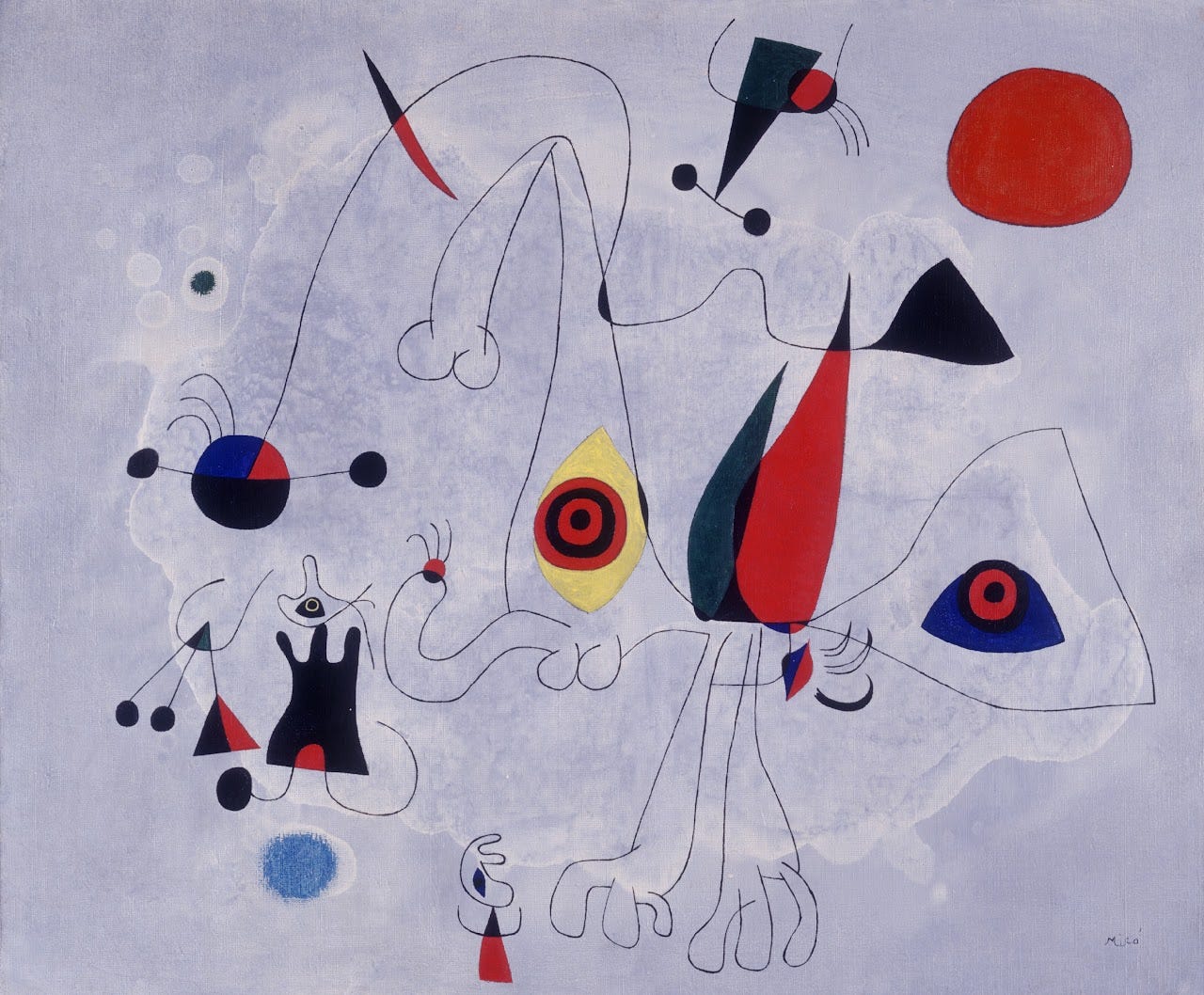
Joan Miró, “Women and Birds at Sunrise” (Fundació Joan Miró, on loan from a private collection)
BETWEEN 1893 AND 1983, many notable European artists relocated to the United States. One who didn’t is a painter and sculptor who lived for exactly those 90 years, Joan Miró. So the title of “Miró and the United States,” currently at the Phillips Collection, might seem a non sequitur. But the exhibition, which debuted last year at Barcelona’s Fundació Joan Miró, persuasively argues that the Catalan artist had a profound affinity for the country that failed to draw him into exile.
As Nazi control of France loomed in 1939, the Normandy-based Miró was encouraged to move to the U.S., but instead returned to Spain. Nonetheless, he was ultimately to remark that, “It was really American painting that inspired me.” That quotation, of course, introduces the exhibition, which was organized by Phillips Chief Curator Elsa Smithgall in collaboration with Marko Daniel, Matthew Gale, and Dolors Rodriguez Roig of the Fundació Joan Miró.
While Miró’s sojourns in France are well known, less attention has been paid to the artist’s seven visits to the U.S., made between 1947 and 1968. He was represented for decades by Pierre Matisse’s New York gallery, and had retrospectives at the Museum of Modern Art in 1941 and 1959. He influenced the styles of dozens of American artists, 32 of whom are included here.
The effect of Miró’s bold, colorful, flattened style, which combined elements of Surrealism, Fauvism, and Cubism, can be seen in entries by Jackson Pollock, Mark Rothko, Lee Krasner, Robert Motherwell, Barnett Newman, Helen Frankenthaler, Willem de Kooning, and many others. A Miró-like Arshile Gorky painting from around 1943 hangs next to the 1937 painting that inspired it, “Still Life with an Old Shoe,” which has illusory depth unusual in Miró’s work. The rounded forms of both Miró and Gorky paintings shaped an Isamu Noguchi bronze that’s displayed nearby.
To Miró’s American admirers, perhaps the most significant aspect of his style was the all-over nature of his compositions. Vivid colors and bold shapes announce themselves in such canvases as 1948’s “The Red Sun,” the first Miró bought by Duncan Phillips, the museum’s founder. Yet the picture’s red oblong, while prominent, is not centered, and is in active conversation with other elements, both soft- and hard-edged. As is typical of the artist’s paintings, there’s no single focus, and the imagery extends from edge to edge. Abstract expressionists and color-field painters surely took note.
If most of the Americans featured in the exhibition followed Miró’s lead, a few seem to have developed their styles in sync with his. This selection highlights Alexander Calder, who first met Miró in Paris in 1928. The two became close friends whose links, both personal and artistic, are illustrated by twinned pieces: Calder’s 1930 portrait of Miró, rendered in curved wire that hangs in midair, and the latter’s 1937-60 self-portrait, executed with wiry black brushstrokes on an airy canvas.
Calder made sculptures -- including mobiles -- whose skeletal frameworks and suspended forms echo Miró’s paintings. The angularity of several late-1960s Miró sculptures suggests that the influence also flowed in the other direction, although the Catalan artist also looked to the painted-metal spires of Louise Bourgeois, two of which are in this array. Miró, whose 1920s style verged on the calligraphic, was always drawn to the spindly line.
Ultimately, though, “Miró and the United States” is less about stylistic influence than shared spirit. Many of the Americans who were incited by Miró eventually abandoned his visual trademarks. The mature work of Pollock, Rothko, Newman, and Motherwell -- all represented in this show by earlier pictures -- doesn’t look much like Miró’s. What they share is their transatlantic colleague’s intuitiveness, inventiveness, and sense of fun. In short, freedom. That’s something that -- despite the current climate -- has long been the subject of a fruitful dialogue between Europe and the United States.
Miró and the United States
Through July 5 at the Phillips Collection, 1600 21st St. NW. phillipscollection.org. 202-387-2151.