
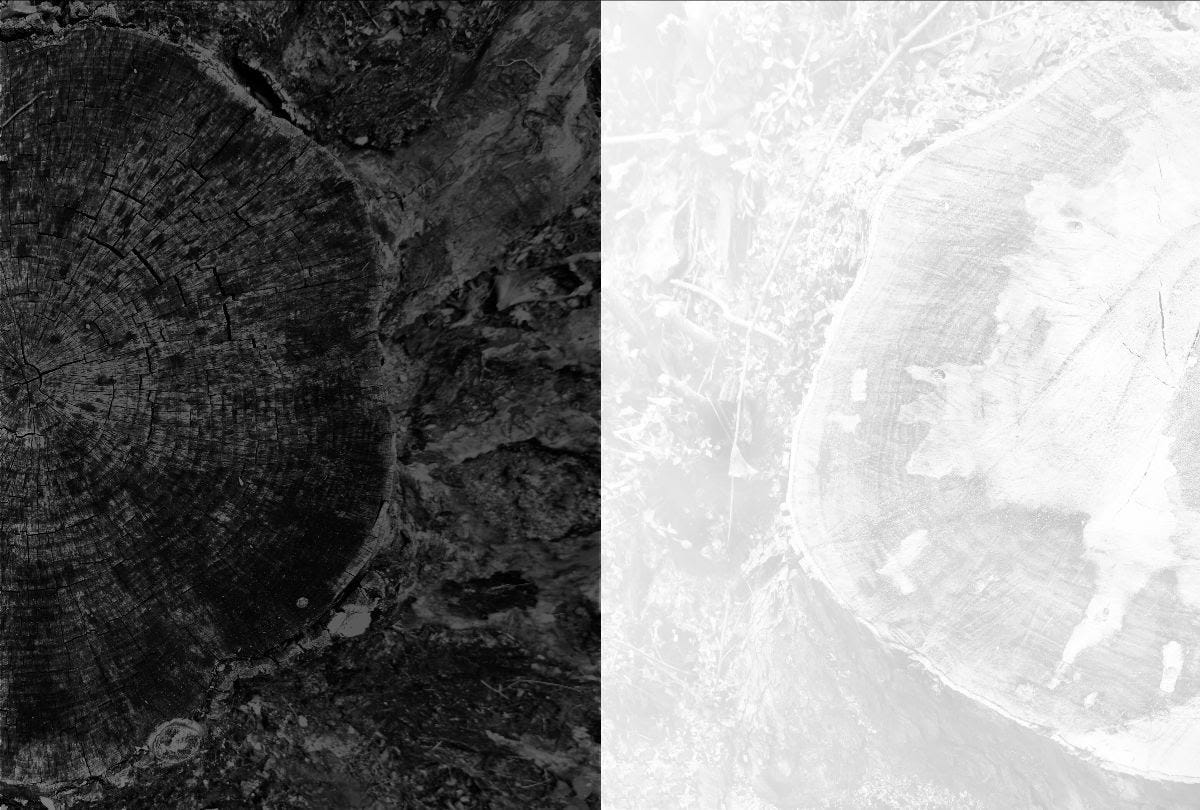
Soomin Ham, “East and West” (Multiple Exposures Gallery)
WITH HER KNACK FOR PHOTOGRAPHING THE UNSEEABLE, Soomin Ham can convey a sense of absence -- often, though not always, involving her family history. The artist’s current Multiple Exposures show ponders a different sort of loss. The South Korea-born local photographer’s “In Gray” illustrates her own displaced identity. Traveling between two homelands, she found herself “an outsider in both worlds,” according to her statement.
Ham expresses this alienation partly with two groups of diptychs, pictorially linked or flipped; one part is overlaid with white acrylic paint and the other with black Korean ink. Each of the paired images is difficult to discern, but in different ways. Another set of related pictures depicts a forest, printed either very darkly or very lightly, and with narrow insets in the opposite scheme fitted into the larger composition. Ham calls these punctuated photos the “Window series.” Again, the act of looking becomes an effort, not something that can be done without thought.
A view outside through an actual window is included in the “Revisited series,” but most of these pictures depict trees or their parts -- branches, stumps, or a single “Last Leaf,” soft as if already fading into memory. Trees “are metaphors for myself -- physically rooted in the land, yet continually changing with the world around them, “ Ham writes.
Since some of the subjects are “revisited,” they probably are things or places Ham has observed before. But their significance isn’t evident to the spectator. In fact, what the artist photographs seems less important than what happens to the images later. They may be printed on Korean hanji paper -- another token of Ham’s origins -- or layered with ink, paint, or wax. Since the pictures are all black-and-white, the results are visually stark. Yet their surfaces can be lushly hand-worked, transforming the photos from mechanical representations into personal totems. The outsider in both worlds crafts little worlds of her own.
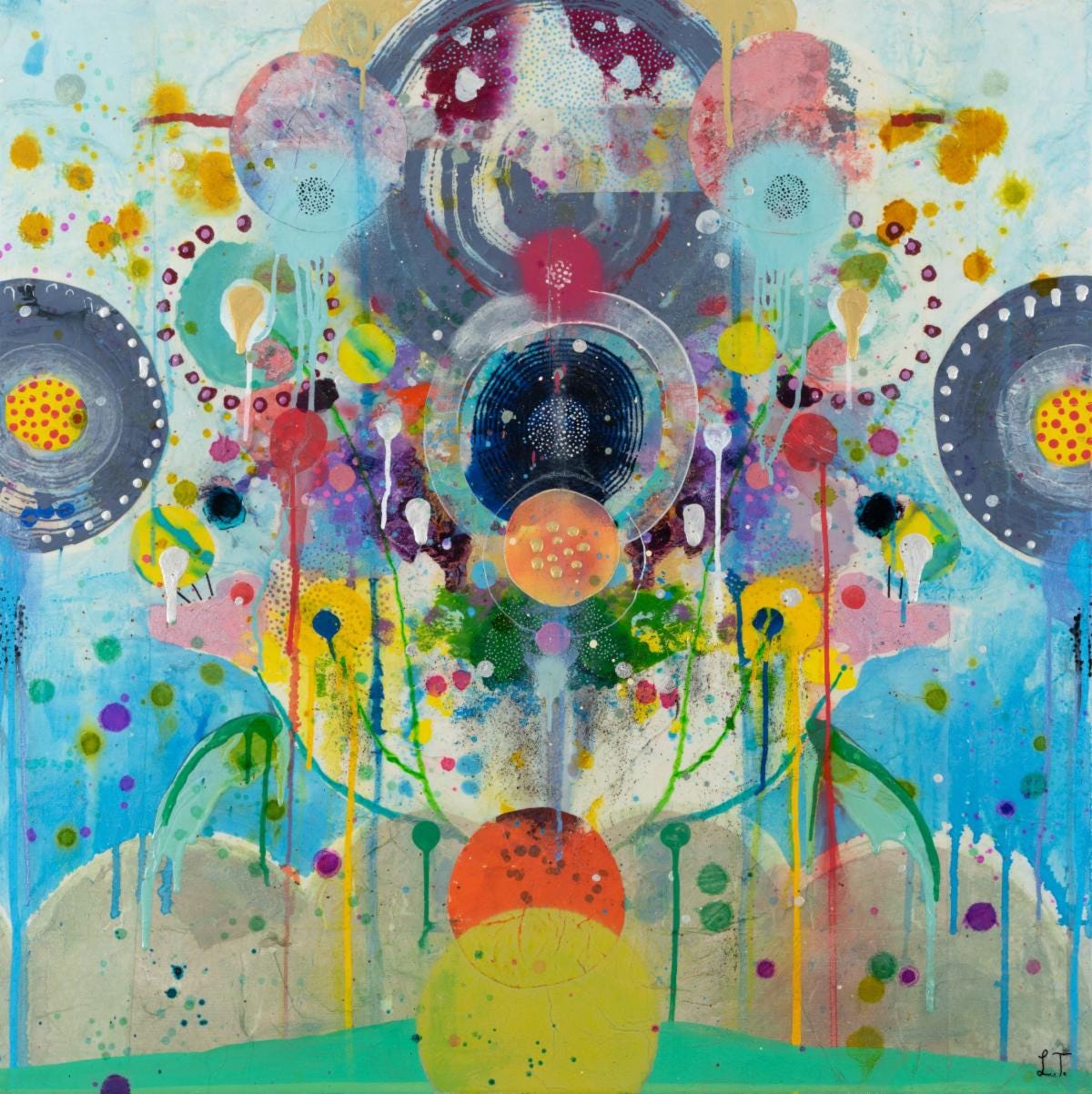
Liz Tran, “Peony” (Morton Fine Art)
A VEGETATIVE VARIETY OF ACTION PAINTING, Liz Tran’s art uses the evidence of her brushwork as a metaphor for ongoing change. The bright, lively pictures in the Pacific Northwest artist’s “Bloom/Become” conjure floral arrangements from random drips and blots, accented by painstakingly placed dots of pigment. The mixed-media abstractions in Tran’s Morton Fine Art show feel improvisational, yet their underlying compositions appear carefully considered, and even flirt with symmetry.
Although half the pictures bear titles that refer to flowers, the imagery is not literally botanical. For all their floweriness, the painted forms also suggest other things, from teeming jungles to psychedelic updates of Rohrschach ink blots. “Amulet Two” does resemble an ornate piece of jewelry, and “The Weight of Rain” is suitably drizzly. Sometimes a hint of a human form or face peers through the fluid color, although close viewing reveals just hue and texture, including an unexpected graininess that recalls canvases from the early days of stained-acrylic color-field exploration.
A few of the paintings have almost-solid backdrops that silhouette the highlighted forms, but more often the artist’s compositions, for all their intricate activity, convey a sense of openness. If Tran’s fundamental subject is change, her pictures offer pliant shapes, fluid colors, and spaces in which transformation can proceed.
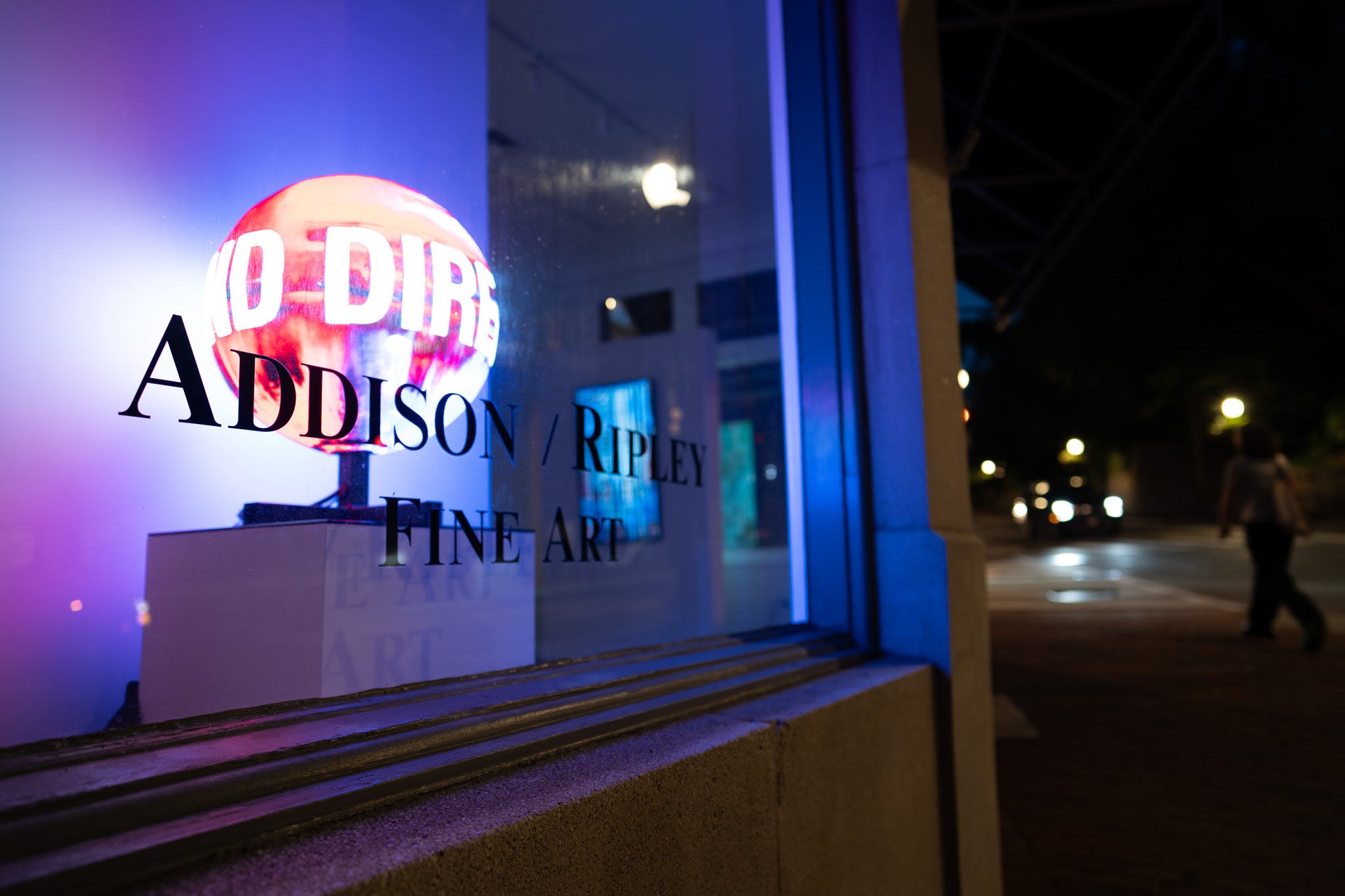
installation view of Robin Bell’s “Projection Warnings” (photo by Pat Graham)
ROBIN BELL IS BEST KNOWN FOR WRITING REBUKES to Donald Trump in light, so it’s fitting that his current exhibition, “Projection Warnings,” announces itself with two text-displaying video-spheres in the windows of Addison/Ripley Fine Art. Words circle the globes, rotating an artist’s statement and biography, complete with an incongruously upbeat quotation from Italian Marxian Antonio Gramsci, who did much of his influential writing during a decade spent in Mussolini’s prisons.
Inside the Wisconsin Avenue door are two sets of 24 square photographs of Bell’s many projections, some overlaid with paint that challenges the images’s purely documentary value. On the adjacent wall is a video that compiles what is essentially the entire show (and more) into a 30-minute montage. Although the artist intends to “protect democracy one projection at a time,” not all the entries are political -- or electronic. Included are abstract paintings, collages, and sculptures, only a few of which incorporate slogans.
Although most of Bell’s artworks are plugged-in, he takes inspiration from trees and cacti. “Milk Tree Square” is a video with digital animation, depicting slo-mo mists atop plants. “It All Starts with a Tree” is a digital projection on canvas of a plant with a green halo, a moving image that’s similar to the static one in the adjacent painting. The natural world fuels the electronic one, and vice versa. It seems that those video-spheres in the gallery’s windows exemplify Bell’s approach, in which every input is a small bend in a potentially endless feedback loop.
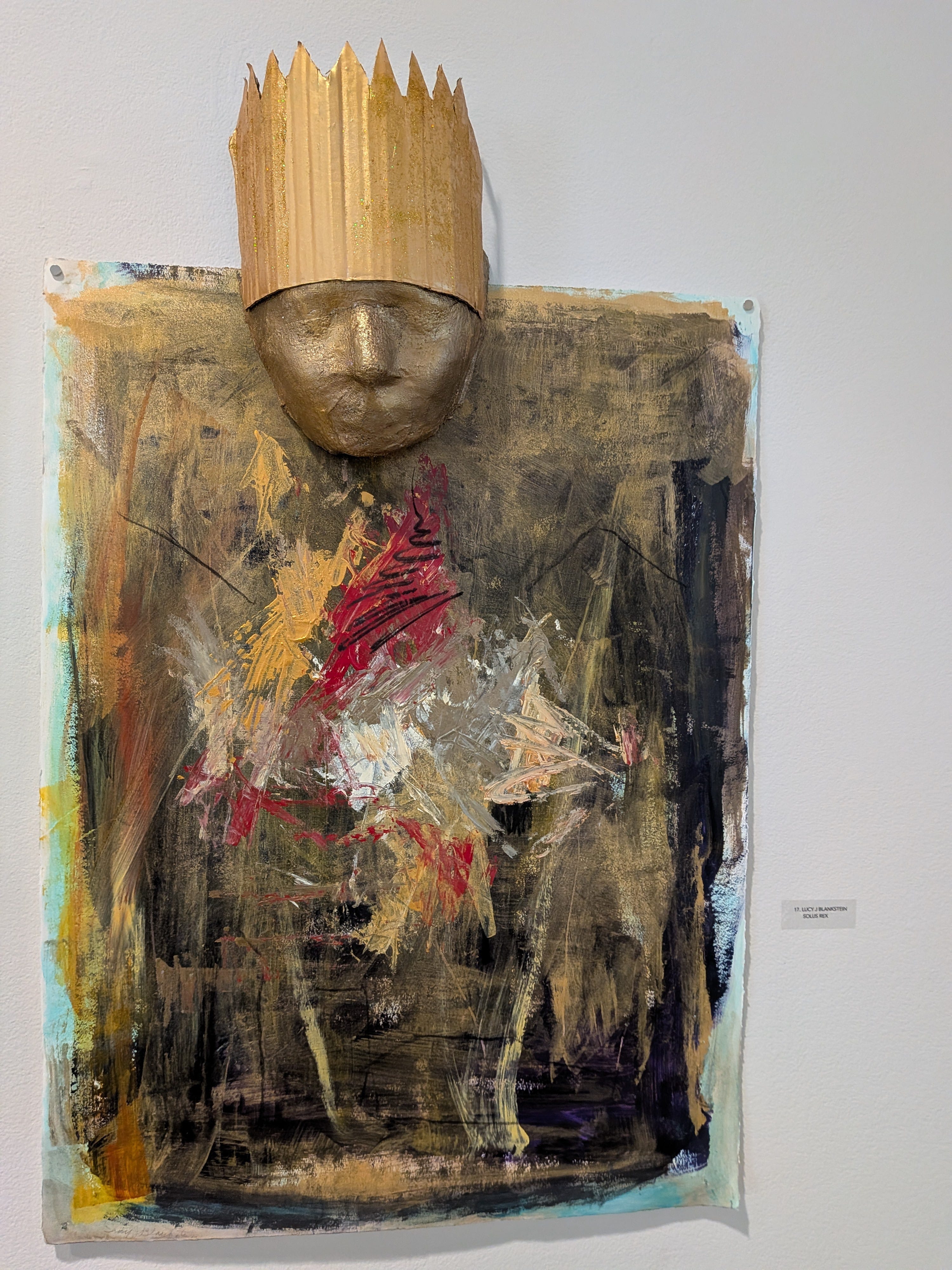
Lucy J Blankstein, “Solus Rex” (photo by Mark Jenkins)
GOLDEN FRAMES SEPARATE SOME OF THE ART WORKS in “Gilt by Association,” a 13-artist exhibition in the rotunda of American University’s Katzen Arts Center. But most of these frames are partly painted styrofoam, a quirky touch that’s entirely appropriate to this lively, far from cohesive array. The participants, who call themselves the Ward Circle faction, are not linked by subject, style, or outlook. Two of the contributors, Claudia Vess and Lucy J Blankstein, curated the selection, including work by three deceased artists: Myrtle Katzen, Luciano Penay, and Patricia Segnan.
Many of the pieces are representational, if in different modes. Michael Graham’s mixed-media pictures recall lushly rendered neoclassical paintings, while Norman Strike’s political linocuts are simple and direct. Romeo Segnan gently conjures a ship on water in a softly defined print. Blankstein makes realism out of abstraction, turning a free-form painting into the body of a man whose sculpted head is topped with a crown.
Both crown and face are golden, and Blankstein also offers the literal, if punning, “Gold Bricking” and “Gold Digger” -- a gilded brick and shovel, respectively. Few of the other artists make a big thing of gold, although there’s a hint of the color in the winged insects, fluttering on a dark blue background, in Julia Zahn’s elegant mixed-media “Night Sky.”
Many of the standouts are works on paper, delicate in form if substantial in effect. Marjorie Hirano’s pencil-outlined watercolors, abstract but suggestive of floral forms, are quietly lovely. Zahn’s layered pictures, influenced by Japanese paste-resist stencil dyeing, transform nature scenes into archetypal patterns. Just as hushed, yet politically charged, are Vess’s depictions of war-ravaged buildings, presumably in Kyiv. Using assemblage to evoke half-demolished buildings is cannily ironic.
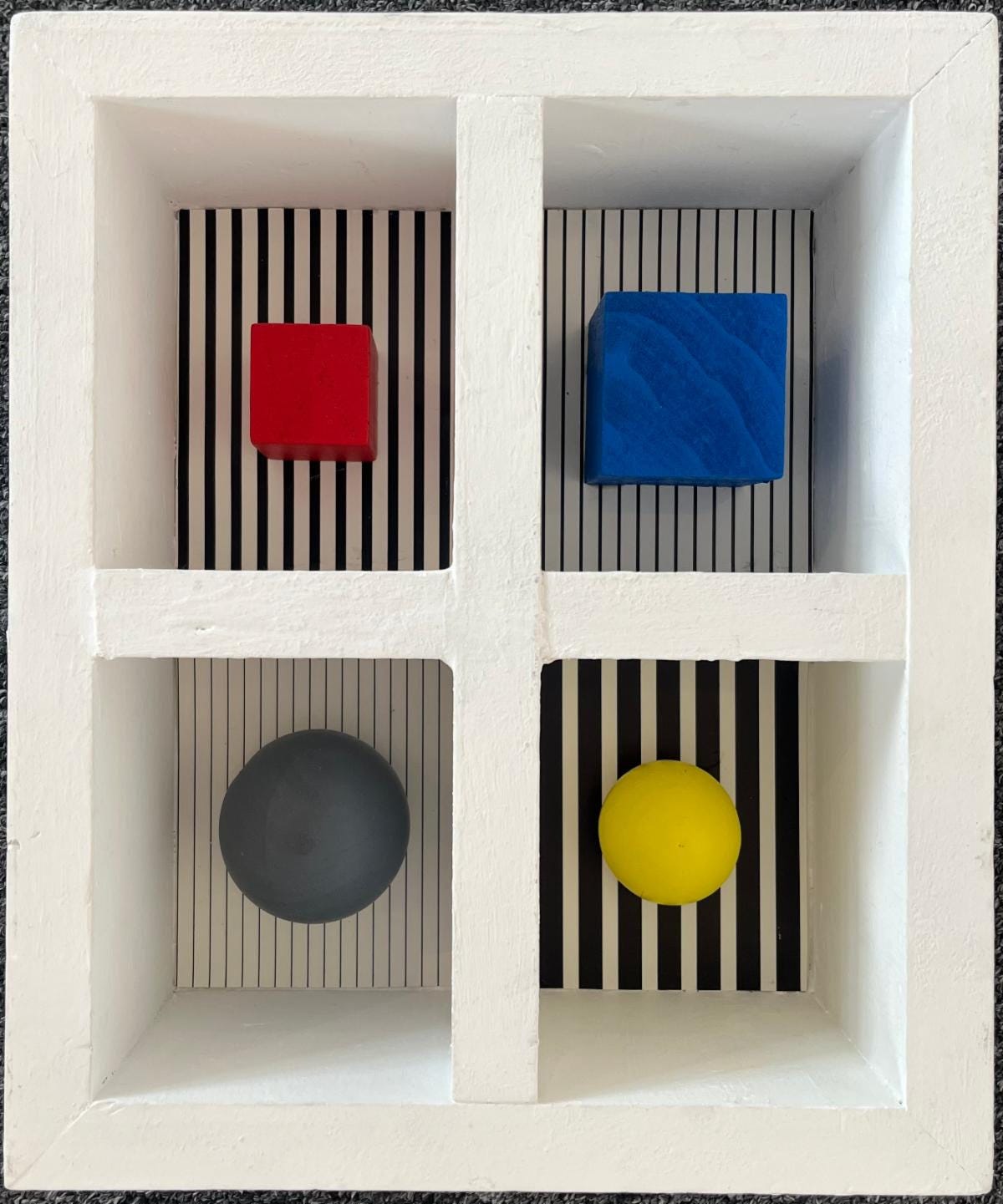
J. Ford Huffman, “Four” (Watergate Gallery)
THE RED, WHITE, AND BLUE DON’T FEATURE notably in “2026 The American Mosaic,” Watergate Gallery’s apolitical semiquincentennial exhibition, but sculptor J. Ford Huffman makes much of another color troika: red, yellow, and blue. Those primaries serve as individual backdrops for a set of three black stars inset with secondary-color blocks, and decorate a mostly white model of a structure that looks like a Mondrian painting repurposed as a midrise building. It’s one of several pieces evoking early-20th-century artistic developments that were more European than American.
Another of the eight artists, Helen Zughaib, colorizes the light-hued stone of the Washington Monument in a print that’s one in a series internationalizing local landmarks by superimposing vibrant patterns from Middle Eastern fabrics. (Some of these were also seen in “Diasporacity,” a Martin Luther King Jr. Memorial Library show that closed last month.) The effect is jaunty and playfully disorienting, and entirely compatible with Roberto Werebe’s multi-hued, rakishly geometric renderings of buildings and other subjects (including a trippy tiger).
Elsewhere, blue dominates, notably in painter Vian Borchert’s octet of near-abstract seascapes. Sabrina Pedreira’s tropical land- and waterscapes are also heavy on blue, but the largest is white-on-white, with frond-like shapes incised in the pigment. A more expansive, if muted, palette prevails in Tisha Balesi Wood’s two small expressionist paintings.
Pedreira’s sculptural picture is as sleekly stylized as Phillipe Mougne’s Cubist-style steel statue, a spindly mashup of man and machine. Since they’re made of found objects, Lauri Menditto’s sculptures are funkier. The artist studs lengths of driftwood with reclaimed Potomac River glass, yielding symbolic creatures that appear both bristling and precarious. These are mosaics of a sort, locally sourced but otherwise -- like the rest of this show -- only incidentally American.
Soomin Ham: In Gray
Through Oct. 11 at Multiple Exposures Gallery, Torpedo Factory, 105 N. Union St., Alexandria. multipleexposuresgallery.com. 703-683-2205.
watergategalleryframedesign.com. 202-338-4488.
Robin Bell: Projection Warnings
Through Oct. 17 at Addison/Ripley Fine Art, 1670 Wisconsin Ave. NW. addisonripleyfineart.com. 202-338-5180.
Liz Tran: Bloom/Become
Through Oct. 19 at Morton Fine Art, 52 O St. NW, #302. mortonfineart.com. 202-628-2787. Open by appointment.
Gilt by Association
Through Oct. 11 at Katzen Arts Center rotunda, 4400 Massachusetts Ave. NW. group93wash@aol.com. 301-461-1124.
2026 The American Mosaic
Through Oct. 17 at Watergate Gallery, 2552 Virginia Ave. NW. watergategalleryframedesign.com. 202-338-4488.