
Found Out
Fifteen artists recast castoffs. Also: Sandy Walker’s black-and-white greenery, Kendall Buster and linn meyer’s shapeliness, multiple exposures of unsettledness
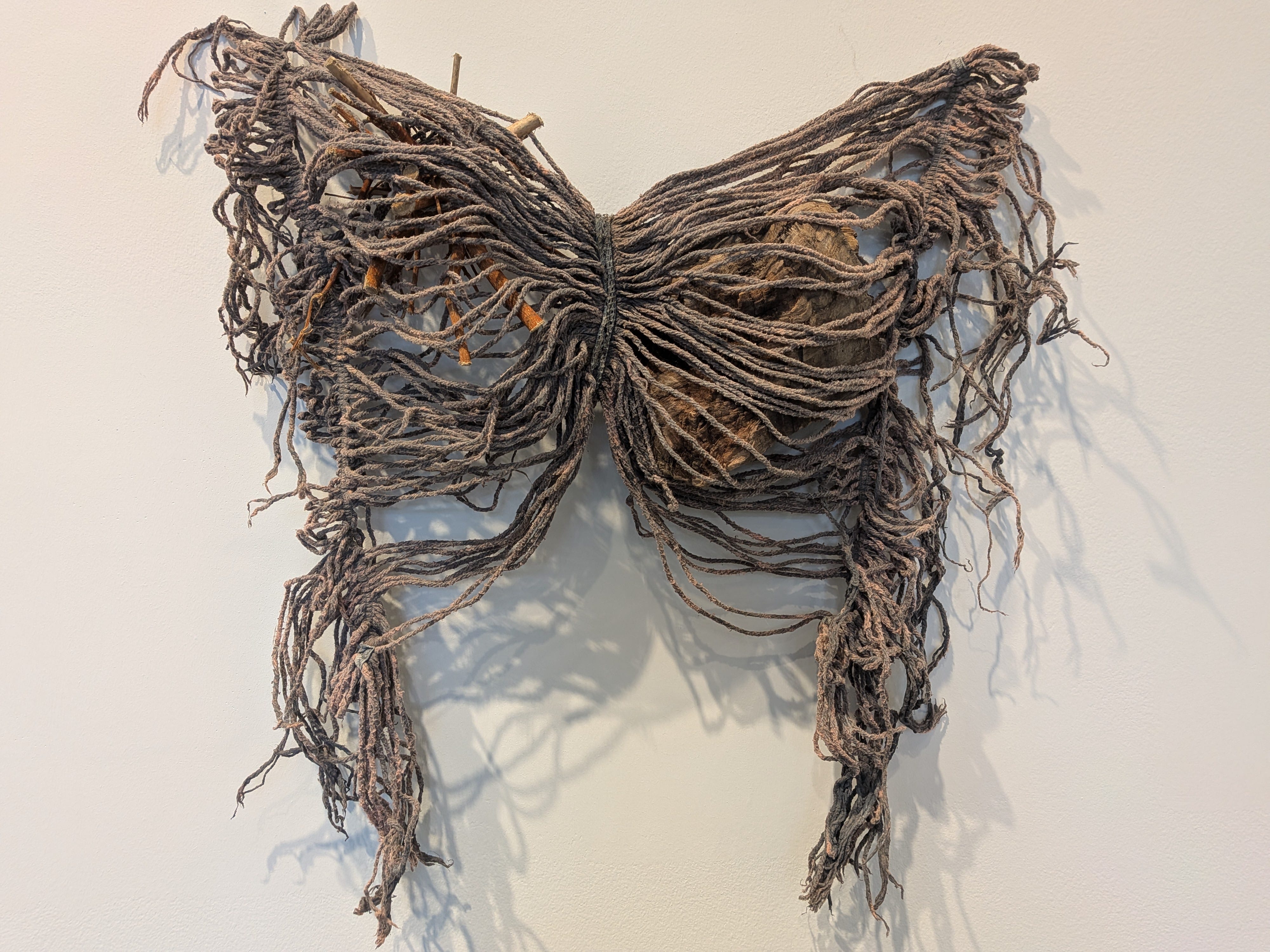
Kanchan Balsé, “Outgrowth” (photo by Mark Jenkins)
PRESENTING A FOUND OBJECT AS ART was initially a Dada-inspired jibe at bourgeois reverence for high-culture objects. But the practice has come to have significance for environmentalists as well. Not all of the 15 participants in “Finders Keepers: Making Meaning with the Materials Around Us” offer a specifically ecological message. Yet the importance of repurposing materials in a world awash in disposable products does underscore the 30-artwork I Street Gallery show.
Thus Veronica Szalus, who has long given second lives to one-use items, erects a pair of teepee-like structures whose bamboo armatures are wrapped in loops of discarded plastic film. Even if the humble edifices endure just long enough for this exhibition, the plastic strips will have served a purpose far longer than originally intended.
Equally humble in origin is “Outgrowth,” an elegant wall piece by Kanchan Balsé, who curated the show with Ira Tattleman. Balsé splayed a mop so that its heavily shadowed form resembles something organic -- a butterfly, perhaps, or a set of human lungs. Curiously, Tattleman also transforms cleaning devices: His sculpture affixes a rake, brushes, and a vacuum attachment to a wooden framework that climbs the wall like a ladder.
Tattelman’s other piece, “Sitting Stick,” is the show’s closest thing to a Duchampian readymade. But it’s two simple and related things, wittily combined: a worn bicycle seat atop a walking stick, a useful appliance for people who don’t know if they’re staying or going.
There seems to be a backstory, personal and untold, to Sondra N. Arkin’s “Refinancing,” a set of paper tubes made of paper from shredded financial documents. As the pipes dance across the wall, they suggest a melodic rhythm that complements the fanciful wood-and-wire sculptures of Layne Garrett, whose constructions play at being musical instruments.
Also evocative of music are Gayle Friedman’s wall sculptures, which are made mostly of looping bandsaw blades whose metallic sheen is alchemized into flower-like hues with leftover house paint. Metal takes a more literally natural shape in Niki Asfar’s assemblage, which outlines a mountain range by arranging shards of a mirror. One of Gloria Vasquez’s contributions is a clump, somewhat heart-shaped, of dried red flowers preserved unnaturally in clear resin.
The show’s most literal nature image is a video of a grassy field sequestered behind a metal-link fence in a mixed-media piece by Chris Combs, who often places up-to-date digital art inside battered old containers. There’s also a video element to Combs’s other piece, but it’s hidden inside a scourged metal box and activated by inserting a quarter. The artist not only makes interactive devices; he also pays tribute to the interactive machines of a simpler era.
The odd person out is Luis Del Valle, who paints realistic portraits, often of blue-collar workers. What makes him a finder is his choice of canvas: He typically renders his pictures on international-orange road signs, connecting his subjects to gritty work sites. In an age of machine-made, mass-produced, and near-valueless products, Del Valle celebrates labor and individuality.
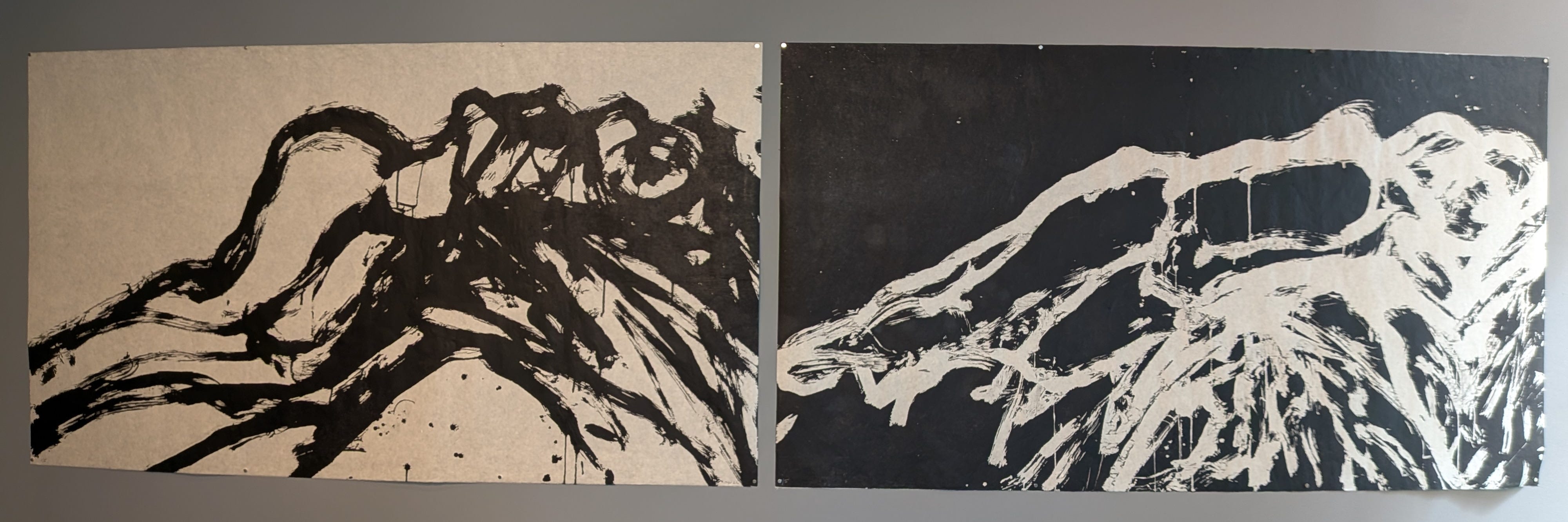
Sandy Walker, “Day/Night” (photo by Mark Jenkins)
THERE’S NOT A TRACE OF GREEN in “Out of Green Mansions: The Woodblock Prints of Sandy Walker,” a selection of exuberant black-and-white artworks. Line alone represents nature’s abundance in these large pictures on display at the American University Museum (and curated by its director, Jack Rasmussen). The Oakland-based Walker is a D.C. native who has lived in many places in North America, some of them rustic. The latter locales seem to have shaped these pictures, which are simultaneously minimalist and lush. Most of the prints sprawl across multiple pieces of paper, as if their subjects are too sweeping to be contained on a single sheet.
Made between 1987 and 2022, the pictures have a painterly quality, even though they were painstakingly carved rather than spontaneously brushed. (The most recent artworks were incised for the 83-year-old Walker by an associate, Ryan Harrison.) The abstracted nature scenes are often dense; the black-heavy “Green Mansions” conjures the sense of being deep inside the deepest of woods. But others are airy, and even verge on the skeletal. The jaggedly horizontal forms in the first half of “Day/Night,” which are roughly mirrored in reverse in the second part, starkly suggest bones or tendons as well as roots or branches.
“Day/Night” is also the most calligraphic of these pictures, whose swooping forms recall stylized East Asian writing -- another form of brushwork. Paper itself, whose complex textures are evident in the sometimes vast areas of white space, is also integral. Walker’s works retain the attractions of prints while pushing toward something looser and, fittingly, wilder.
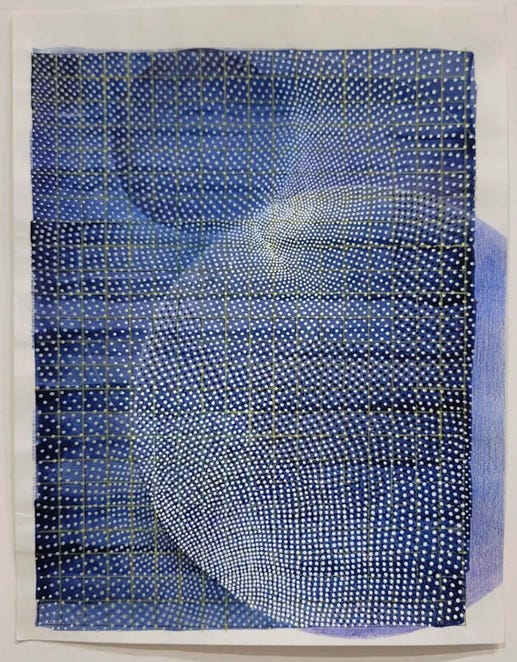
linn meyers, untitled (Spagnuolo Gallery)
SINCE NEITHER ARTIST DEPICTS REAL-WORLD PHENOMENON, perhaps it’s inaccurate to say that Kendall Buster portrays things and linn meyers illustrates places. But the work of the two artists, paired in “Speculative Morphologies” at Georgetown University’s Spagnuolo Gallery, does divide roughly that way. Admittedly, there’s an architectonic quality to many of Buster’s drawings and sculptures. But the Richmond-based artist’s “specimens,” as she terms them, are discrete and self-contained, while meyers’s drawings sprawl, interlock, and spiral as if toward infinity.
Buster has a background in microbiology, which may explain the seemingly organic forms of many of her graphite-on-mylar renderings. Richly textured and deftly modeled to simulate three dimensions, the pictures suggest new varieties of vegetables. Yet the monochromatic drawings are from a series of “biological models for a new architecture,” and some resemble buildings more than plants. These complement the show’s paper-and-foamboard sculptures, whose shapes are geometric rather than organic. Stacked neatly on three shelves, the white forms appear ready to be assembled into an urbanistic whole like “Model City (Constraint),” which was exhibited two years ago at the Kreeger Museum.
There are grids and circles in meyers’s exquisitely intricate drawings and prints, but they’re drawn freehand so the lines gently slip and slide. That’s usually evident only on close inspection, which reveals subtle deviations in pictures that appear systematic from a distance. The artist, a part-time Washingtonian, sometimes superimposes such elementary shapes as circles or diamonds over tight grids or fingerprint-like whorls. The myriad lines appear to spin or bend, seemingly refracted by a prism or a looming star. If Buster’s creations appear anchored to the earth, meyers’s can seem interstellar.
This exhibition is presented in partnership with the Kreeger Museum and was curated by Georgetown University Curatorial Studies graduate students Abigail Dunnigan, Miranda Glasgow, Jessica Harris, Mia Johnson, Alexandra Morse, Qaman Omar, Anne Satre, Lily Schwegler, Reina Shin, and Mason Stempel, guided by Professor Jaynelle Hazard.
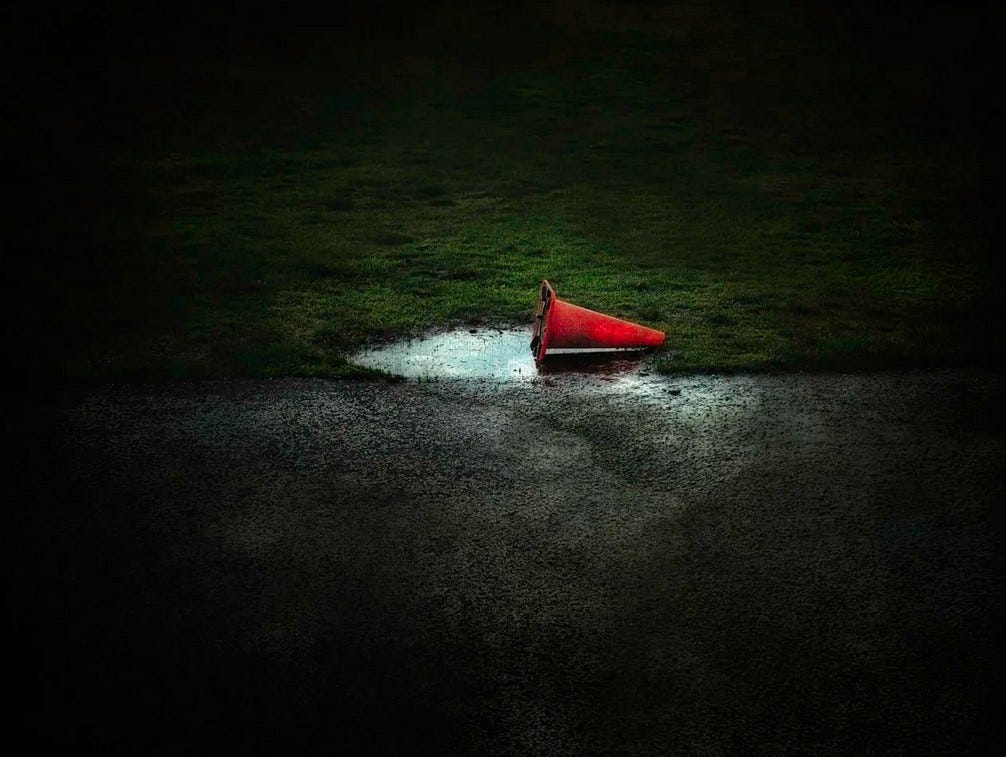
Maureen Minehan, “Toppled” (Multiple Exposures Gallery
THE CURRENT SHOW AT MULTIPLE EXPOSURES GALLERY -- the first in its new first-floor space -- is one of its least cohesive. But perhaps that should be expected of an exhibition whose title, and theme, is “Unsettled.” The photographs selected by juror Susan Ruddick Bloom are intriguing, but aren’t hung on any apparent through-line.
A sense of loneliness characterizes Stacy Smith Evans’s study of an agricultural canal in rural California, as well as Eric Johnson and David Meyer’s pictures of, respectively, abandoned structures and building materials scattered in the grass. But people engage with each other in Van Pulley and Fred Zafran’s photos -- some of the show’s most colorful -- of front-stoop conversation or diner patrons.
Hints at narrative energize Russell Barajas’s trio of medically themed vignettes, Soomin Ham’s photo of a runner who might be chased by a distant figure, and Irina Lawton’s pair of surreal pictures of a woman who strikes a gravity-defying pose. Nature shows various degrees of power in Sarah Hood Salomon’s image of a flooded picnic table and Tom Sliter’s photos of ice floes highlighted by vivid blue accents. Tiny yet potent bits of color draw the eye into Guillermo Olaizola’s picture of a person in near darkness, apparently on a grand staircase, and Maureen Minehan’s shot of an orange traffic cone toppled into a small light-blue puddle amid a grassy green-black expanse. That cone is literally unsettled, yet in the instant frozen in this picture, every element appears in immaculate balance.
Finders Keepers: Making Meaning with the Materials Around Us
Through May 22 at I Street Gallery, D.C. Commission on the Arts and Humanities, 200 I St. SE. founddc.net/finders
Out of Green Mansions: The Woodblock Prints of Sandy Walker
Through May 17 at the American University Museum, Katzen Arts Center, 4400 Massachusetts Ave. NW. american.edu/cas/museum
Kendall Buster and linn meyers: Speculative Morphologies
On view through May 17 at Spagnuolo Gallery, Georgetown University, 1221 36th St NW; 202-687-9206; art.georgetown.edu/galleries
Unsettled
Through May 17 at Multiple Exposures Gallery, Torpedo Factory, 105 N. Union St., Alexandria. multipleexposuresgallery.com. 703-683-2205.