
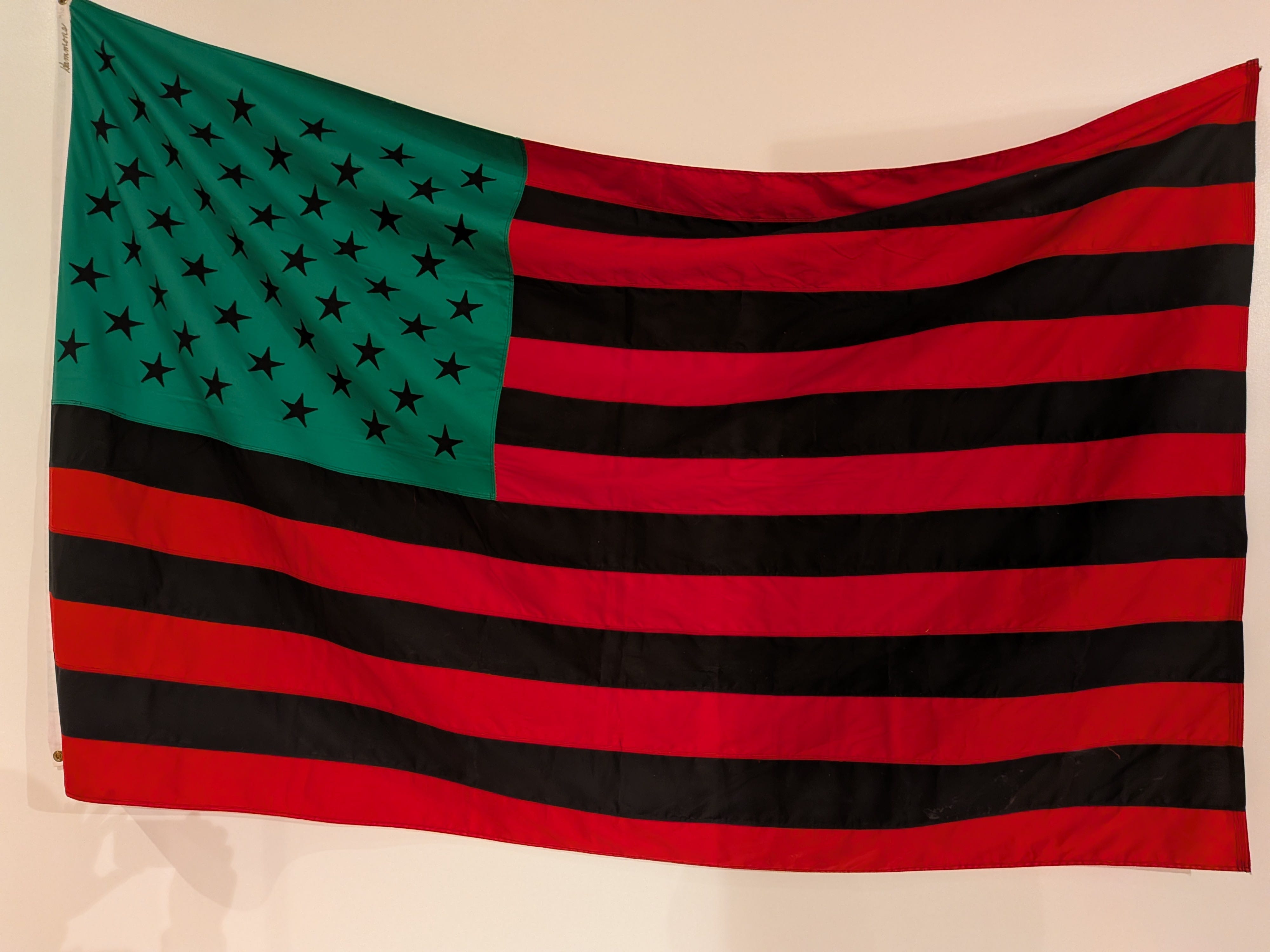
David Hammons, “African-American Flag” (photo by Mark Jenkins)
AS THE UNITED STATES PREPARES TO CELEBRATE 250 years of freedom for some of its inhabitants, the David C. Driskell Center surveys the Black American response to the country’s star-spangled iconography. “America Will Be!” includes works by nearly two dozen artists, many of them well-known. Most of the entries are recent, but the selection stretches as far back as Gordon Parks’s 1942 “American Gothic, Washington D.C.,” the bitterly ironic photograph in which a Black cleaning woman stands in front of an American flag. More than 60 years later, photographer William Anderson found another symbol of broken promises in the same flag, now in front of a Katrina-ravaged house.
Not all the pieces include or deconstruct the U.S. flag. Wilmer Wilson IV photographed himself covered in “I voted” stickers as a homage to Henry “Box” Brown, an enslaved man who mailed himself from Virginia to freedom in 1849. Faith Ringgold’s series of silkscreen prints illustrate the Declaration of Independence, with some pertinent asides by Sojourner Truth and Abigail Adams about people the founders overlooked.
Several contributors use flags, banners, or streamers to commemorate victims of American-as-apple-pie violence. In Michael C. Gibson’s upside-down flag, the mixed-media red stripes appear to drip like blood. Mostly black stripes characterize June Edmonds’s hanging monument to the Black troops remembered in the film Glory. Hank Willis Thomas suspends blue banners with a white star embroidered for each of the people -- 14,719, shockingly -- killed by guns in 2018.
Thickly impastoed paintings, also by Edmonds, take a banner-like template and derive their colors from the skin tones of people of African descent, including her Barbadian grandparents. Mark Thomas Gibson sticks with red, white, and blue, but transforms the stripes into wave-like swells. Sanford Biggers constructs a two-faced textile piece on a 3D matrix to display with the stars-and-stripes on one side and a traditional quilt on the other. Sonya Clark offers a replica of the dish towel waved as a flag of surrender by Confederate troops in 1865.
David Hammons and Ato Ribeiro redefine the U.S. standard by incorporating African motifs. Ribeiro’s flag-like construction of repurposed wood employs a pattern reminiscent of Ghanian kente cloth. Hammons retains the design of the U.S. flag but employs the red, black, and green of the Pan-African flag created by Marcus Garvey and his followers.
June Clark’s response to the American flag is simple but perhaps the most powerful. The New York-born artist, long resident in Toronto, reduces the flag to a pile of red, white, and blue scraps, heaped on the floor with a few 3D stars. Piecing it back together would be a major undertaking. And, when viewed from a haven outside the country, perhaps not worth the bother.
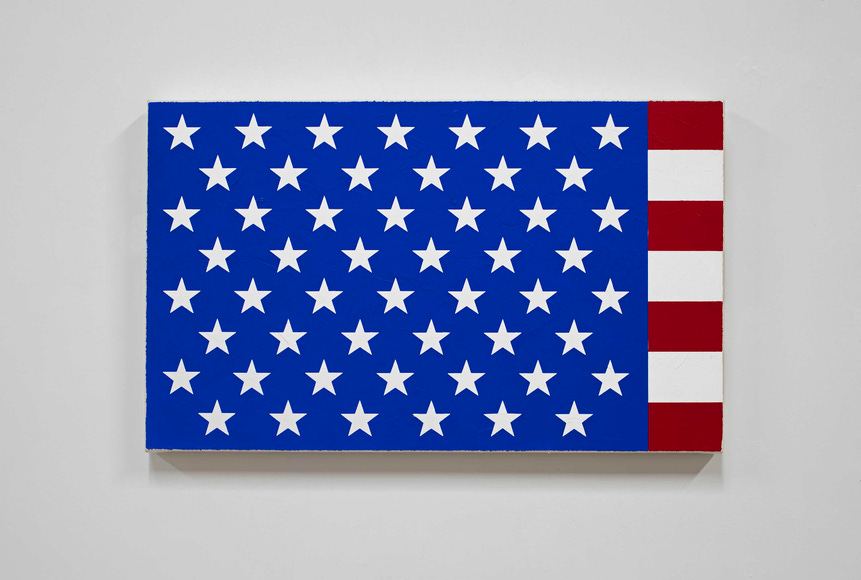
Mark Kelner, “52 Stars” (Hemphill Artworks)
FLAGS ALSO FEATURE IN MARK KELNER’S “American Mosaic,” although the artist’s perspective on the red, white, and blue is particularly attuned to red. Born in the U.S. to Russian parents, Kelner often explores the kinship between political propaganda and commercial marketing. The 12 pieces in the local artist’s Hemphill Artworks online exhibition include a set of “Eight American Reds,” paint swatches that represent shades of consumer packaging -- including “MAGA” -- and the promotional slogans of five U.S. states as translated into Russian.
Among Kelner’s elegantly designed and rendered artworks are several versions of the American flag, notably one made from the red, white, or blue spines of hardback books. More pointed is “52 States,” in which potential statehood for D.C. and Puerto Rico causes the star-spangled blue field to expand dramatically, nearly crowding out the stripes that commemorate the original 13 colonies. Other flag-like pieces take the shape of a Zippo lighter -- once an American icon -- or turn the bold colors into black-and-white bar codes like the ones now found on nearly all products.
The latter painting is titled “Flag (After Jasper Johns),” in recognition of the pop artist who painted so many U.S. flags. It’s natural to think of Johns when looking at Kelner’s work, but the two artists are more unlike than similar. Where Johns’s flags were rendered with intentional roughness, Kelner’s style is as crisp and clean as computer-generated imagery.
Also, while Johns and his cohorts viewed American culture ironically, Kelner makes such politically (and personally) charged sculptures as “Jews Will Not Replace Us,” a Star of David constructed of tiki torches like ones carried by the right-wing demonstrators who chanted that phrase in Charlottesville in 2017. Some of Kelner’s creations are detached observations, but others are active statements of resistance.
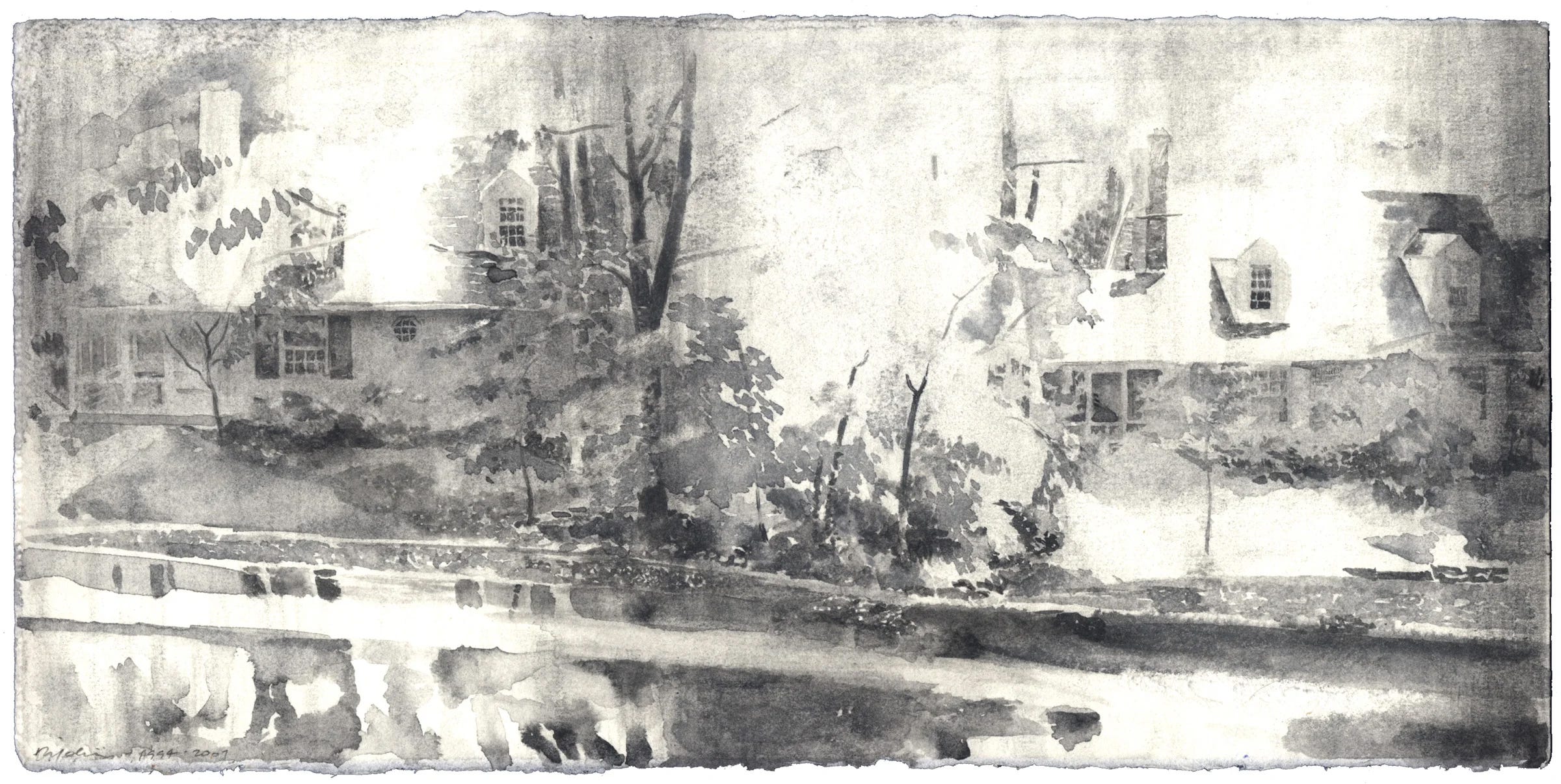
Charles Ritchie, “Midday Rain” (Gallery Neptune & Brown)
ALL THE WORKS IN “CARTE BLANCHE,” a diverse 10-artist show at Gallery Neptune & Brown, are on paper. But some of the most striking ones are of paper as well. Caleb Nussear uses diamond-shaped folds to add topographic interest to vivid multi-color fields rendered with colored pencil and pastel. Alexandra Chiou cuts hand-painted sheets of paper into feathery, nature-inspired shapes and assembles the pieces into spiraling organisms that certify such titles as “Emerge” and “Renewal.” Both artists deftly use simple materials to evoke complex phenomena.
Among the other abstractionists are Erick Johnson, who places subtly striated, watery hued geometric shapes into cobblestone-like arrays; and Nick Lamia, whose freehand ink drawings contrast map-like sections with open -- or perhaps just uncharted -- spaces. Ben Tolman’s crypto-architectural drawing playfully piles a baroque array of objects and abstract forms at the front of a space whose wall and ceiling are patterned with regular black squares. Typical of the elegance of linn meyers’s style is her drawing of a large circle defined by tightly hand-drawn black lines on a dark gray field.
The selection includes work by three photographers, including Michael Dax Iaccone, who uses his camera to document panoramas of his land-art endeavors. Redeat Wondemu, who’s known for portraits, offers a sextet of pastoral views and floral closeups, all made at Hillwood Estate, Museum and Gardens. Most atmospheric are two pictures from Soomin Ham’s “Windows” series, whose evocation of the past is both metaphorical and literal: At the bottom of the multi-level montages are photos made by the artist’s grandfather.
Not a photographer, but sometimes a photorealist, is Charles Ritchie, who contributes four drawing-paintings. These range from the mistily monochromatic “Midday Rain,” made with pencil and watercolor, to the colorful but muted “Kitchen II,” precisely rendered with pencil, ink, watercolor, and acrylic. Ritchie depicts domestic scenes with an attentiveness that transforms everyday into exceptional.
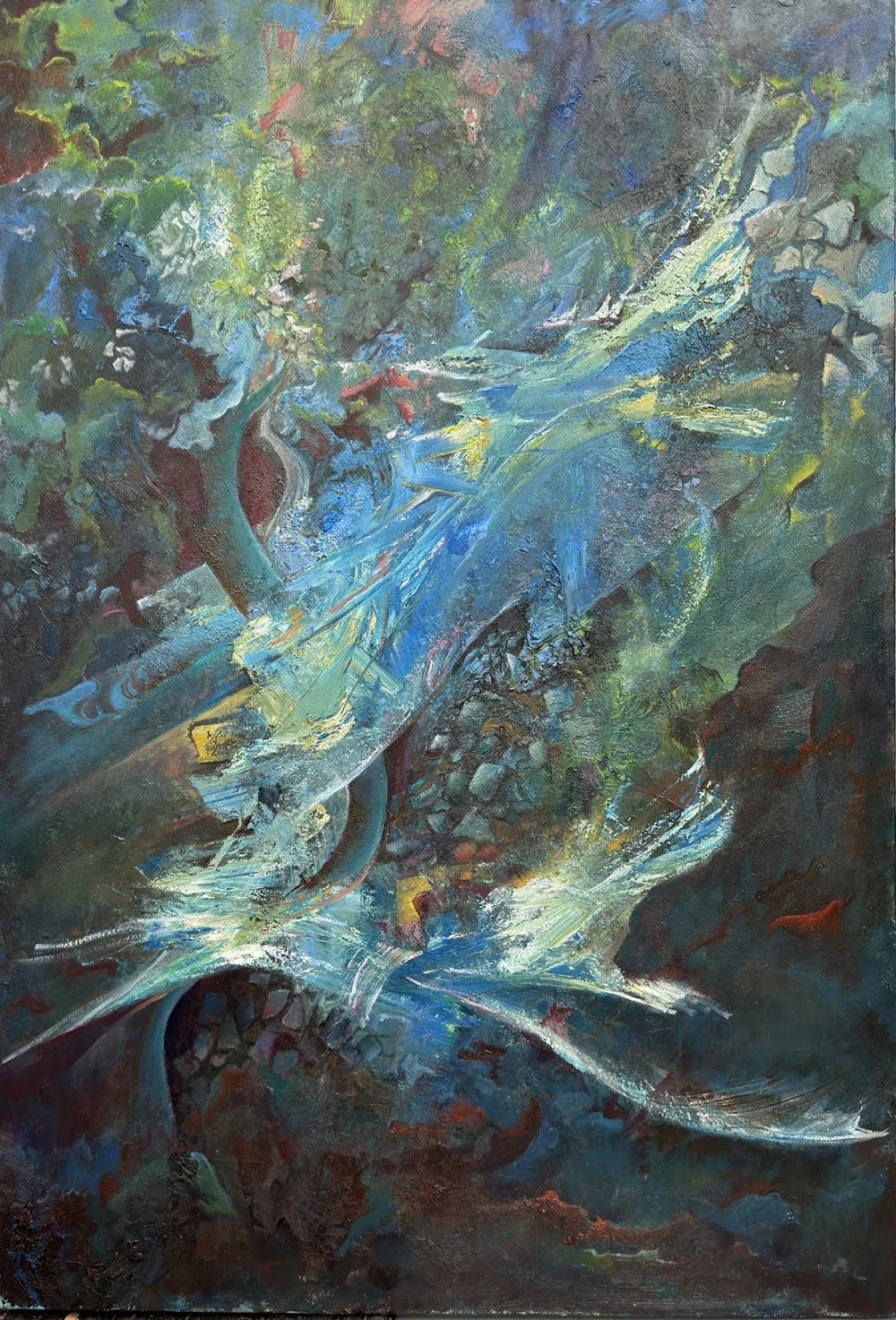
Carolee Jakes, “Waterfall” (Studio Gallery)
BLOSSOMS APPEAR TO EMERGE FROM BLACKNESS in the eight large Carolee Jakes paintings at Studio Gallery. In fact, they’re emanating partly from older pictures, as is specified by the show’s title, “Pentimenti: New Work on Old Canvases.” The near-abstract paintings take much of their power from what Jakes calls “the complex, deep dark in Old Master paintings,” which accentuates the luminous highlights. The lush backgrounds are mostly black and dark brown, but there’s enough blue that the compositions suggest underwater scenes as often as they do shadowy, candle-lighted 16th-century interiors.
The details often resemble flowers, as Jakes acknowledges but says was not her original intent. Intriguingly, the artist most often paints precisely, producing imagery that has an art nouveau feel in such pictures as “Mosaic.” Yet some areas are much looser and seemingly more intuitive. All these elements -- including the partly painted-over pentimenti -- harmonize splendidly. The deep darkness splits open, as if pierced by unexpected, uncontainable light.
Near “Pentimenti” are three collaborative drawing-paintings by Jakes, Chris Chernow, and Elizabeth Curren. As airy as Jakes’s paintings are dense, the pictures juxtapose interlocking patterns, hard-edged and curling forms, and primarily pastel hues. Most of the imagery is abstract yet evocative of nature, although two include a pencil drawing of a partial person. The most effective of the trio is “Reaching,” in which whorl-filled triangles partly block oceans of seaweed-like green tendrils. One triangle leads to a ghostly hand, a reminder that these intricate patterns were made rather than found.
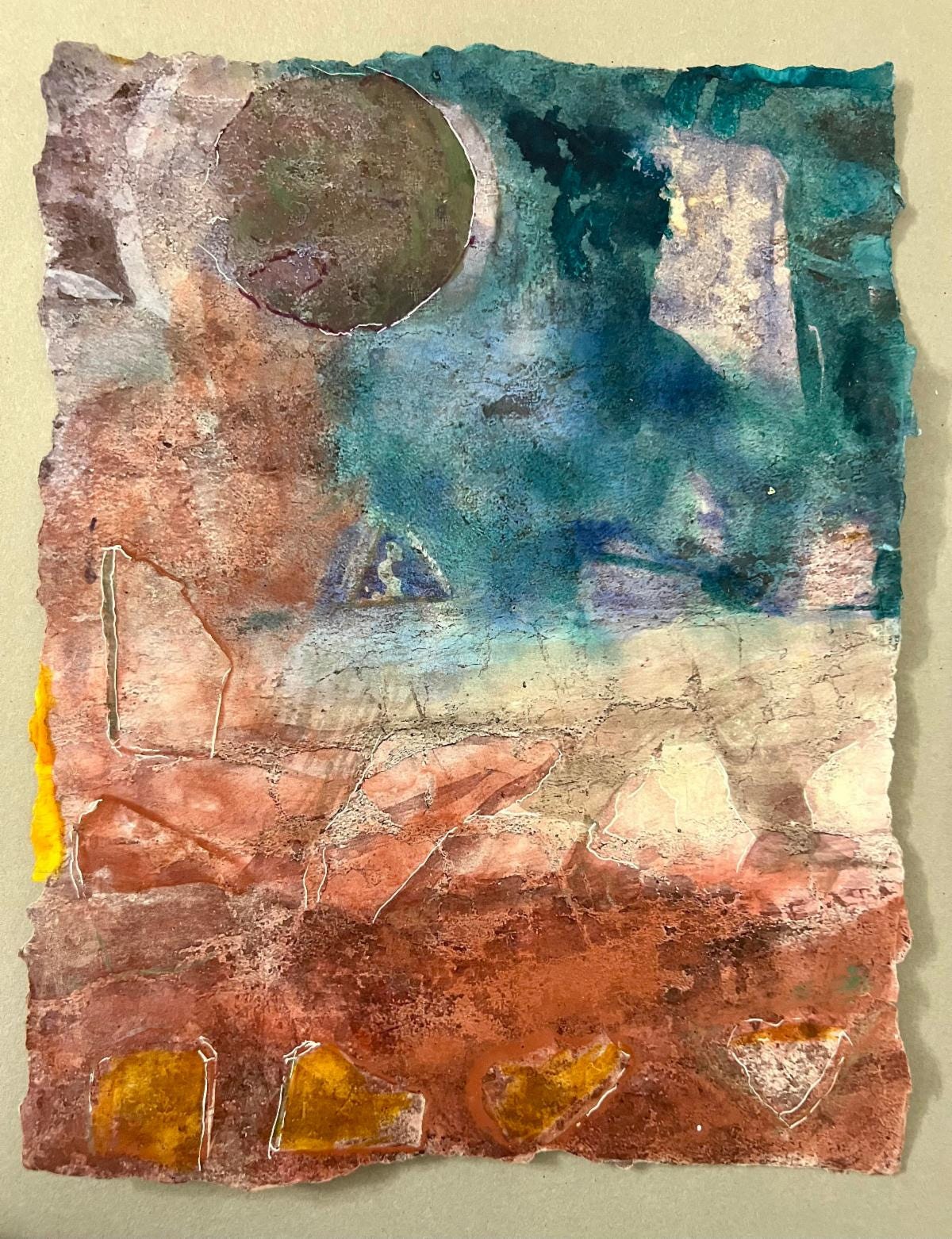
Don Kimes, “It Was a House” (Ashe & Norton)
LIKE JAKES, DON KIMES BUILDS ATOP EARLIER IMAGES, the results of a 2003 flood that destroyed his previous work. Traces of this deluge can be seen in multi-layered paintings by the artist, who divides his time between D.C., New York, and Italy. His abstract imagery often suggests stone, minerals, and gems as well as more fluid substances. The 15 small mixed-media pictures on paper in the window at Ashe & Norton’s storefront gallery feature earthy hues and forms that appear to be veined, cracked, or weathered.
The show is titled either “Thoughts from Umbria” or “Thoughts on Umbria”; the press release says the former, while a handout says the latter. Whatever the correct preposition, Kimes’s thoughts have recently strayed far from northern Italy. Individual titles invoke Darfur, Gaza, and Mariupol, and “It was a House” could depict desolation under a black sun.
That’s merely a possibility. These paintings, made with ink, acrylic, and gouache, can be read purely as complex exercises in color and texture. They’re entirely satisfying as such. But the allusions to recent conflicts adds a provocative thematic level to work that also offers multiple visual strata.
America Will Be!
Through May 8 at the David C. Driskell Center, 1214 Cole Student Activities Bldg., University of Maryland, College Park. driskellcenter.umd.edu. 301-314-2615.
Mark Kelner: American Mosaic
Through May 9 at Hemphill Artworks online. hemphillfinearts.com. 202-234-5601.
Carte Blanche: Works on Paper
Through May 9 at Gallery Neptune & Brown, 1530 14th St. NW. galleryneptunebrown.com. 202-986-1200.
Carolee Jakes: Pentimenti: New Work on Old Canvases
Chris Chernow, Elizabeth Curren, Carolee Jakes: Collaboration
Through May 16 at Studio Gallery, 2108 R St. NW. studiogallerydc.com. 202-232-8734.
Don Kimes: Thoughts from Umbria
Through May 10 at Ashe & Norton, 2440 Wisconsin Ave. NW, #A. ashe.norton@gmail.com.