
Fields of Gleams
Mostly new ‘60s-style abstraction; issues on display in WOW 12; nature in wide shot and in close-up; villains and more villains; landscapes in black & white
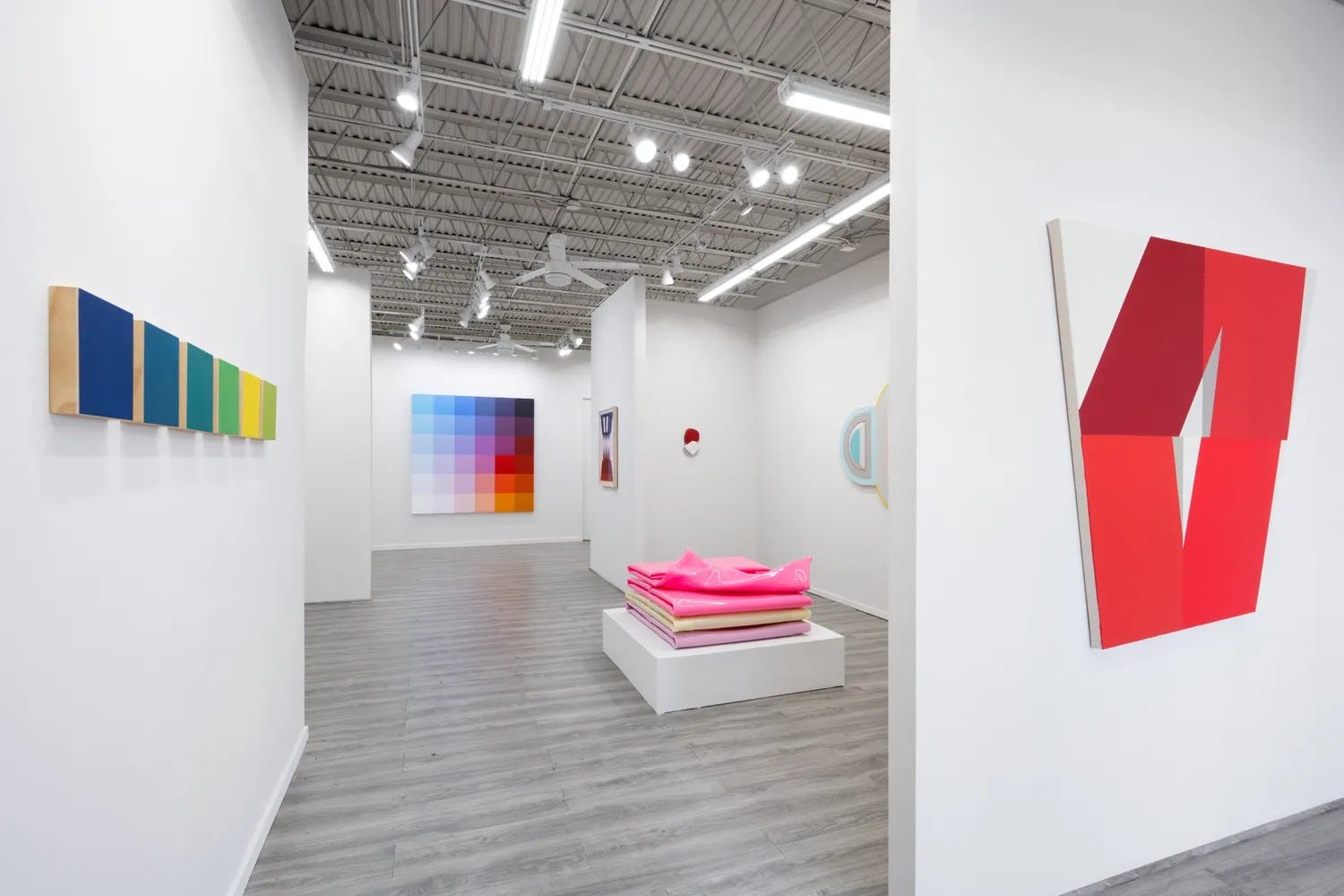
“Chromatic Scales” installation view (photo by Vivian Doering)
SUITABLY AND SATISFYINGLY EYE-POPPING, the mostly hard-edged color-field artworks now at PFA’s Kensington location reach back to the 1960s for strategies that remain potent today. There are two ‘60s pieces in the show, which contains a single entry by each of 11 artists. The oldest is a handsome 1965 study in color -- green, aqua, yellow, and centered lavender -- and geometric shape by Paul Reed, who was the last surviving original Washington colorist when he died in 2015. All but one of the other items were made since 2018.
However recent, the art seems to draw more than formal gambits from the ‘60s; it also shares the era’s directness, exuberance, and sense of optimism. Beverly Fishman’s sleek, multi-piece sculptural painting even partakes of the spirit of pop art, hinting wordlessly at commercial signage. Among the other high-gloss pieces are one of veteran local sculptor Mimi Herbert’s elegant constructions of molded plastic sheets, with hot pink atop paler yellow and pink; and Li Trincere’s dynamic arrangement of four red near-parallelograms, shadowed in silver, on a tapered canvas.
Two of the artists cunningly arrange colored squares: Robert Swain positions them on a single canvas, where the hues move from light to dark and cold to hot; Liane Nouri charts six single-color panels that shift from dark blue to light green, a procession jauntily interrupted by a yellow interloper. Ever so slightly looser, Tom McGlynn’s painting arranges eight not-quite-square pure-color rectangles on a neutral gray field.
The second oldest piece, Marcia Hafif’s mostly gold 1968 painting, is the only entry that features mottled color. But Ruth Pastine’s bright-red picture seeps softly darker along the sides, echoing Leon Berkowitz’s more epic transitions. Red or pink feature in most of these paintings and sculptures, even the one that at first seems incongruously monochromatic. Ken Weathersby places a pair of toothed abstract forms in opposition, bristling in black on white. Between the two, and barely visible, is a thin line of smudgy pink. It’s a reminder that all these coolly precise artworks are animated by warm hues.
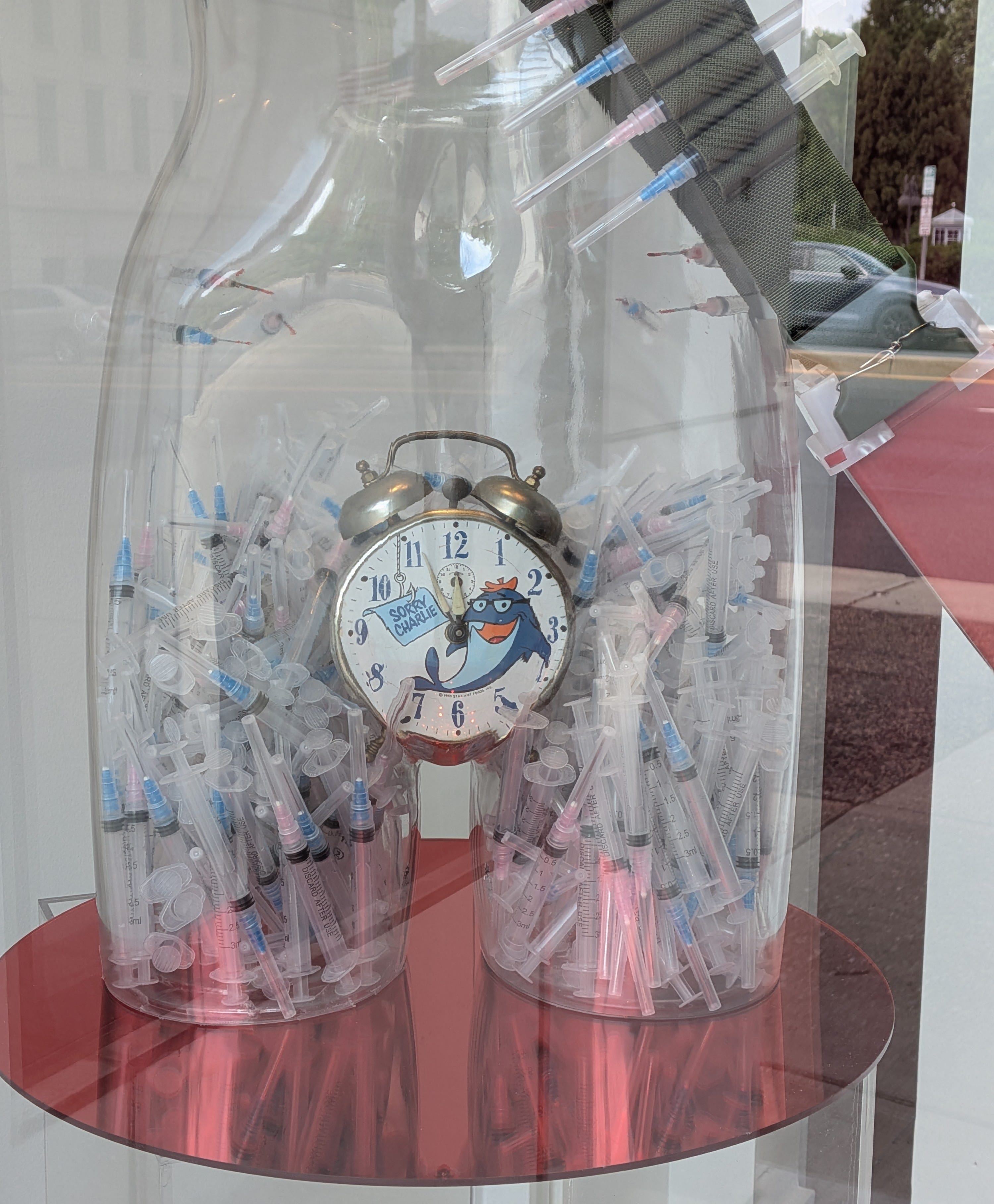
Jackie Dobranski, “Sorry Charlie” (detail) (photo by Mark Jenkins)
A TYPICALLY ECLECTIC ARRAY, the latest installment of Windows on Wisconsin features painting, sculpture, and prints. Considering that the venue is a series of shop windows, viewable 24-7, the most appropriate entries in the 14-artist “WOW 12” are surely Taina Litwak and Jackie Dobranski’s found-object assemblages.
Litwak’s window-filling piece is “Plastic Tsunami,” a version of which was previously shown at I&A at Hillyer. This cascade of consumer-product detritus, each of the hundreds of items painted a nondescript gray, surges through the space as if about to overflow the building and swamp the nearby luxury emporiums.
A contemplation of her own biological clock, Dobranski’s “Sorry Charlie” is a clear-plastic female torso filled with symbols of fertility, including toy vending-machine capsules that contain babies. Syringes represent hormone therapy and IVF, while a clock that features former Starkist mascot Charlie the Tuna offers the title’s mocking apology. Time, the spokes-fish warns, waits for no woman.
In nearby display windows, nature is refracted into many forms. Margery Goldberg’s trio of wooden sculptures, two of which feature human faces, celebrate the qualities of their material. Mauricio Athie’s prints don’t initially appear to be representational yet actually depict the interior of squash, a key crop in the artist’s native Mexico. Suzanne Yurdin’s “Katy’s Garden,” a painting on unstretched canvas, abstractly portrays nature’s fecundity. Misia Broadhead indulges a more fabulist disposition, painting landscapes in which small animals gambol with fairies.
A pair of Andrew Wohl paintings that boldly contrast red and green have a pop-art swagger. But these renderings of explosions were inspired not by consumer packaging but by Trump’s threats to Iran. Time, in the case of these artworks, has proved Wohl grimly prescient.
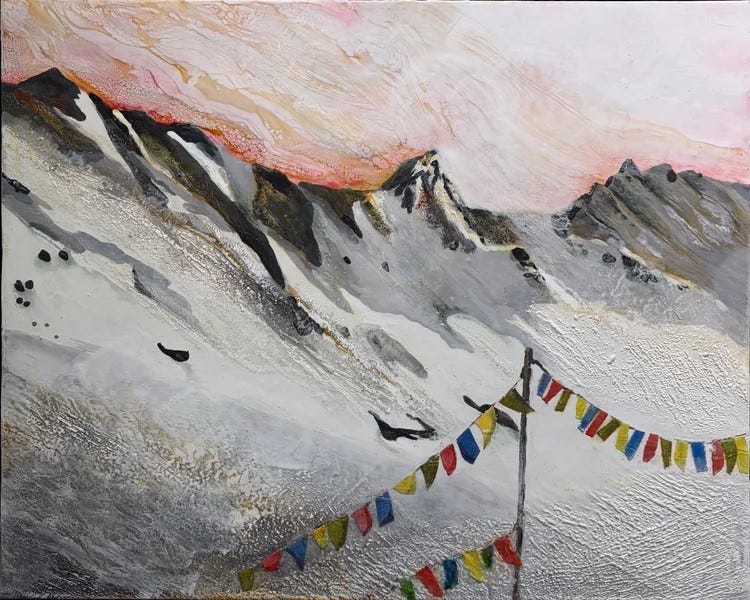
Leslie Clarke, “Nepal at Large” (Touchstone Gallery)
LESLEY CLARKE AND ANICE HOACHLANDER specialize in different media, but their interests overlap so much that they were able to collaborate on three pictures. These artworks, with Clarke’s encaustic gestures atop Hoachlander’s photographs, hang at the intersection of the local artists’s otherwise separate Touchstone Gallery shows.
With a background as an architectural photographer, Hoachlander has an affinity for studies of structure. The images in her “Nature as Architect” range from trees to flowers to expanses of fungi, the last photographed with a macro lens. Some of the pictures of smaller objects emphasize repeated patterns, or employ narrow depth of field to render gauzy everything but a lone crisp region or detail. The canny technique draws the eye into the recesses of flowers and leaves, offering a seemingly privileged view.
Other pictures are more environmental, literally. Made at South Carolina’s Lake Marion, a series titled “Water’s Edge” observes trees that emerge from water, sometimes to be drenched in moss and mist. These soft swathes match the milky light, conjuring a world that looks real but feels dream-like.
While mountains and waterfalls appear in Clarke’s “Echoes of Place,” the artist shares Hochlander’s eye for detail. Inspired by travels in Croatia, Iceland, Nepal, and Scotland, Clarke makes sumptuously textured paintings whose layers of encaustic wax unify images that seem to be constructed from fragments.
The larger paintings are the most realistic, while smaller ones are more abstracted, representing “how memories soften, shift, and distill into feeling,” according to the artist’s statement. The pictures have a geologic quality that’s bolstered by the pebbles or glassy stones occasionally incorporated into them. One piece is just a circle of tightly arrayed stones from Iceland, as if to prove the concreteness of places that Clarke transmutes into visual reveries.
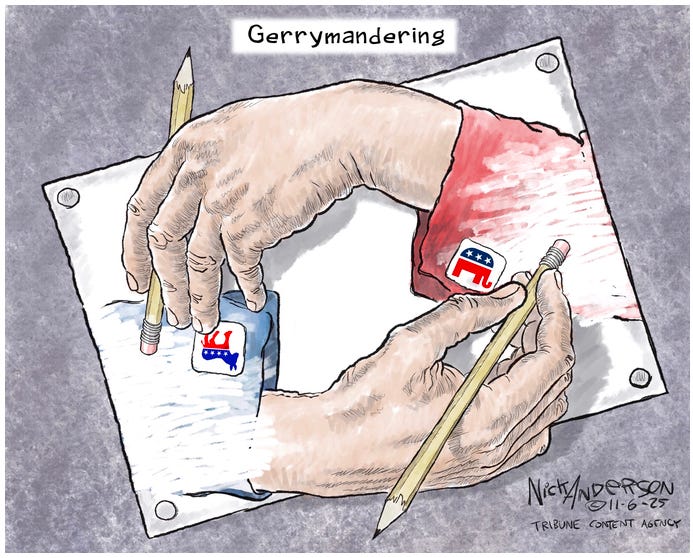
Nick Anderson, “Gerrymandering” (Amy Kaslow Gallery
CRANKY, CAUSTIC, AND ENTIRELY JUSTIFIED, the political cartoons in Amy Kaslow Gallery’s “What’s So Funny” present a cavalcade of villains, with just a few heroes. For every image in which the late Congressman John Lewis serves as a bridge to Black enfranchisement, commentators Nick Anderson and Mike Luckovich offer a dozen withering likenesses of Donald Trump, JD Vance, Elon Musk and -- most ghoulish of all -- Stephen Miller.
Anderson and Luckovich are syndicated cartoonists who continue their trade during the twilight of metropolitan daily newspapers. What they’re showing here are mostly prints, colorized and otherwise enhanced, of published cartoons. The selection also includes 13 of Luckovich’s originals, which are black-and-white and about half the size of the prints.
Of the full-color offerings, Anderson’s tend to be more detailed and more subtly shaded and hued. Anderson also delivers one of the few bipartisan blasts, an M.C. Escher-inspired denunciation of gerrymandering that gives equal weight to Republican and Democratic efforts to shape electoral districts in their favor. But Trump and his enablers are, inevitably, the focus of most of these quick-take commentaries. After all, as smartly encapsulated by Luckovich’s picture of Jan. 6 rioters swarming out of Trump’s mouth, our current national crisis mostly emanates from one man’s loose lips.
LANDSCAPES TURN DRAMATIC AND EVEN EERIE when stripped of color in “Seeing in Black and White,” a 13-artist Photoworks show. Some of the locations, such as Niagara Falls, are inherently formidable, but William Dusterwald makes an especially memorable image by highlighting explosive mists above the cataract. Other scenes are distinguished by the play of light: Alan Simmons captures a tree in an enchantment of ghostly illumination, which pulls it visually from a dark wooded backdrop. Carl de Moor gazes out from the shadows, shooting from underneath a charismatically battered pier.
Two other contributors set off sweeping scenes with piquant details. Tom Sliter offers three studies of dunes rippled by small ridges, but only one includes a tuft of grass, a small detail with large pictorial impact. The sharpest juxtaposition is in Craig Nedrow’s view of three swans on a lake on whose far side sits a belching industrial complex. The picture is notable for its rich middle tones, but also for its vision of serene nature in the shadow of manmade ruination.
Chromatic Scales
Through July 11 at PFA, 4228 Howard Ave., Kensington. pazofineart.com. 571-315-5279.
WOW 12
Through July 12 at 5500-5510 Wisconsin Ave., Chevy Chase. Info: kirstylittle9@gmail.com.
Lesley Clarke: Echoes of Place
Anice Hoachlander: Nature as Architect
Through July 12 at Touchstone Gallery, 901 New York Ave. NW. touchstonegallery.com. 202-682-4125.
Nick Anderson and Mike Luckovich: What’s So Funny?
Through July 19 at Amy Kaslow Gallery, 7920 Norfolk Ave., Bethesda. amykaslowgallery.com.
Seeing in Black and White
Through July 12 at Photoworks, Glen Echo Park, 7300 MacArthur Blvd, Glen Echo. glenechophotoworks.org. 301-634-2274.