
Empty Quarters
Photographers give presence to absence. Also: Art by Barbara Liotta, Taina Litwak, Adjoa Burrowes, Catherine Day, Betsy Packard, Rania Hassan, & Katherine Blakeslee
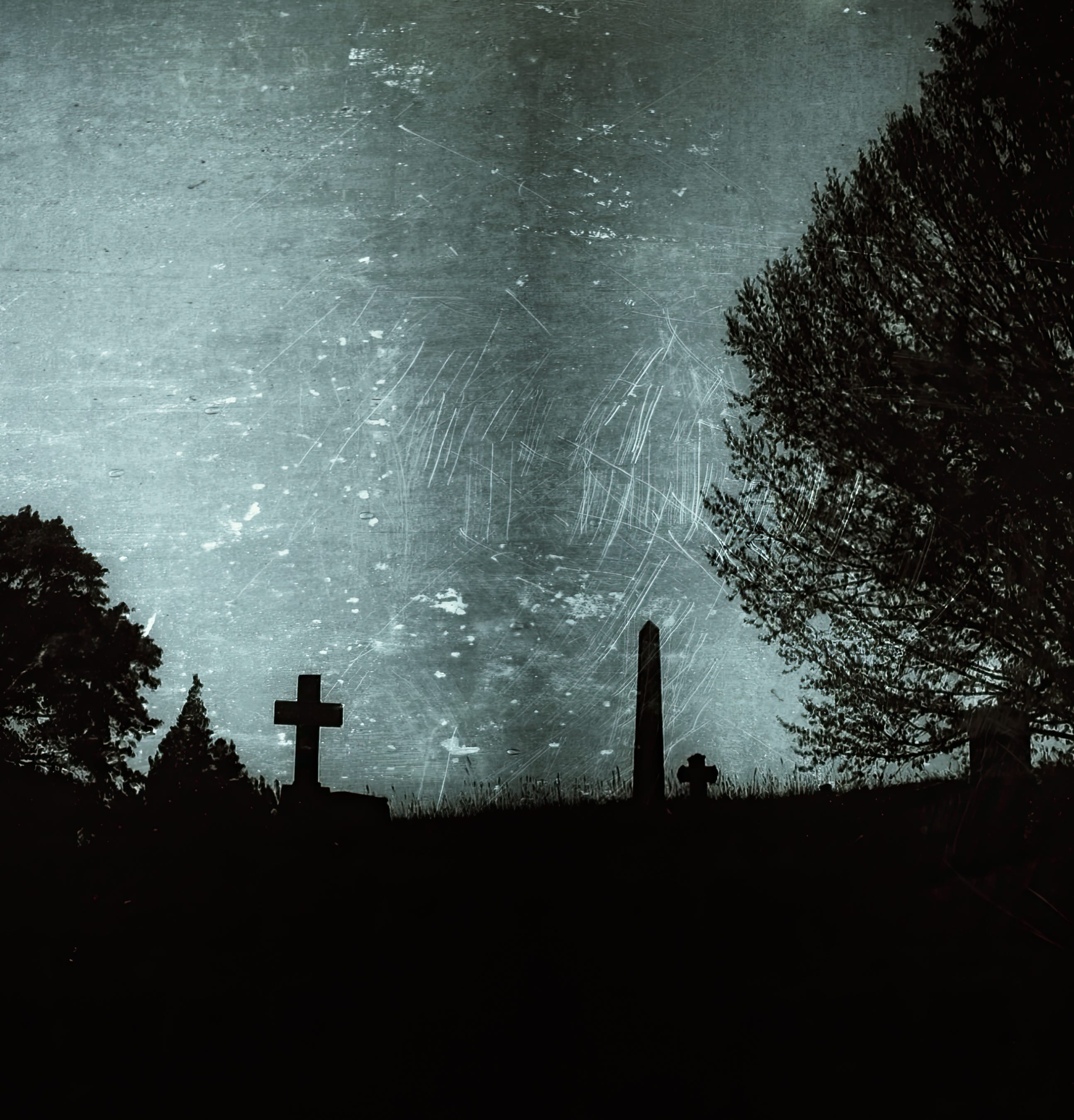
Maureen Minehan, “Missed” (Multiple Exposures Gallery)
MANY STAND-INS FOR HUMANS FEATURE IN “ABSENCE,” Multiple Exposures Gallery’s current group show: a bicycle, an obelisk, a couple of boats, and above all several chairs and a bench, unused and seemingly bereft. There are even three humans lurking in these 23 elegantly made photographs, although the pictured people are distant, obscured, and in one case headless. These pictures are environmental portraits in which the environment dominates and even overwhelms.
The photos were selected from work by the gallery’s 13 members by juror Gavin Glakas, whose statement doesn’t expound on the motif of absence. So perhaps it’s acceptable to imagine another theme: routes. About half the photos are defined by some sort of visible passageway, including an alley, a boardwalk, a muddy rut, two very different staircases, and two sets of train tracks, one headed straight for the horizon and the other sensuously curved.
Some of these pictures are dovetailed on the wall in the manner of the gallery’s almost-narrative conceptual exhibitions, which correlate unrelated photos via visual rhymes. Thus the rutted path of Stacy Smith Evans’s “On Brawner Farm” leads to the two railroad pictures, Maureen Minehan’s “Gone” and Soomin Ham’s “Burke Station.” These links exemplify how an authoritatively composed image compels the eye to travel in a particular direction -- whether into, across, or upwards, as Minehan’s view of a night sky whose star trails appear both fixed and in flux.
The firmament looms gray-green over a silhouetted cemetery in the picture, whose muted color scheme is typical of the nine photos that aren’t black-and-white. Mists, shadows, and darkness characterize most of the images, from which bold hues and bright light are mostly missing. But Van Pulley locates emptiness under a blazing sun in “Among Infinite Horizons,” a vista of desert dunes, and Fred Zafran pits blue against vivid red in “No One,” a theatrical interior that looks like a still from an unmade David Lynch film. Cloaked in ebony darkness, the scene suggests another title for “Absence”: “Unseen.”
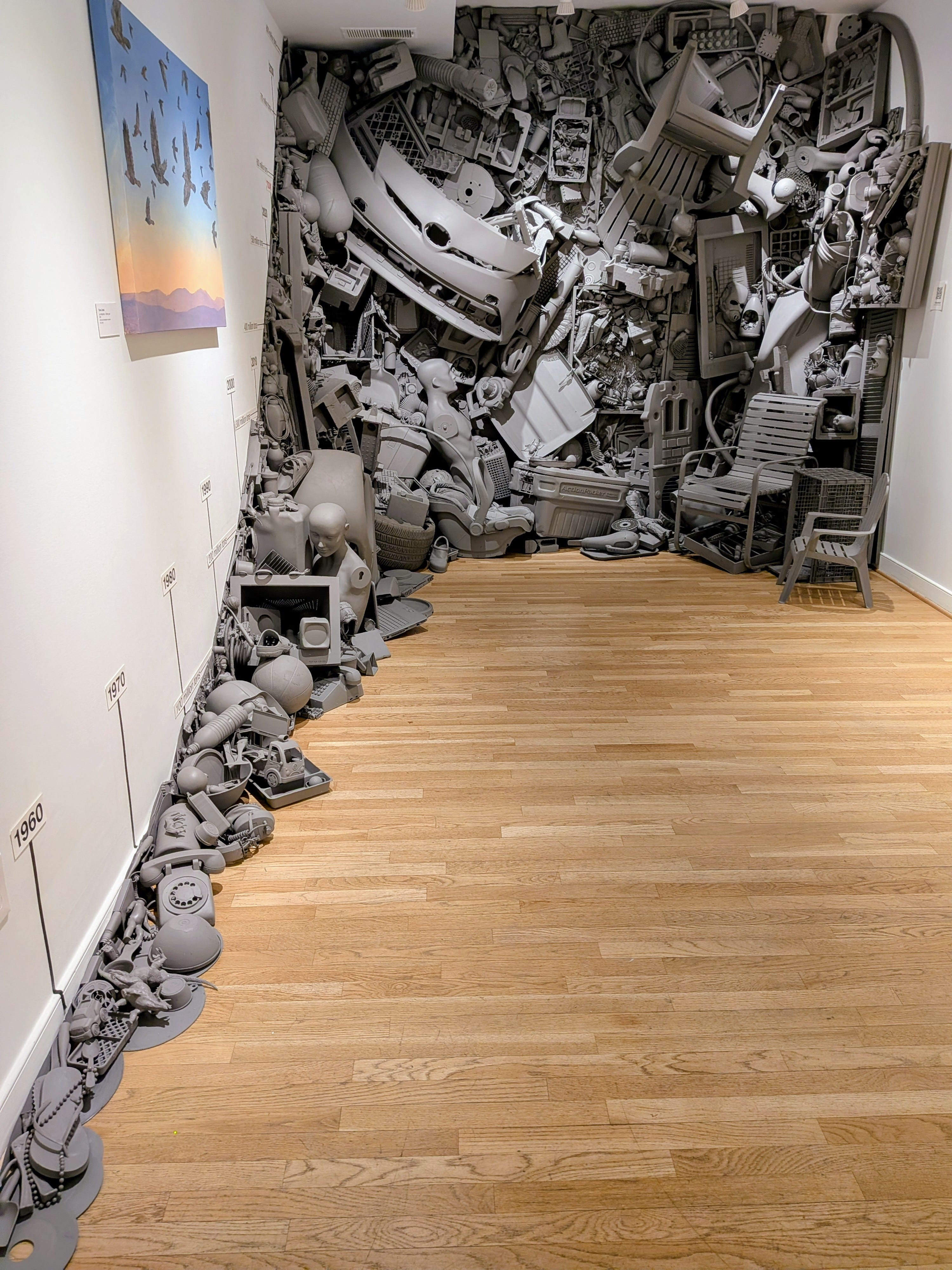
Installation view of Taina Litwak’s “Life in the Anthropocene” (photo by Mark Jenkins)
THE JAGGEDNESS OF BARBARA LIOTTA’S SUSPENDED-STONE SCULPTURES has never been more ominous than in “Knives,” one of nearly two dozen pieces in her IA&A at Hillyer show, “The Gathering.” The D.C. artist usually dangles small rock shards on vertical cords, contrasting the fragments’s solidity with the airiness of the overall assemblage. The three large granite blades of “Knives,” however, are more substantial. Sustaining the position of these chunks in midair feels unusually challenging, and yet the effect is nonetheless ethereal.
The bulk of those rough granite daggers aside, the notable thing about this show is that Liotta has grouped the many sculptures into four closely arrayed flocks. The individual pieces may or may or not be similar. One set, for example, includes multiple jellyfish-like clumps of hanging cords -- which the artist calls “Meduses” -- but also two armadas of tightly clustered rocks. It seems apt that Liotta invokes sea creatures for this batch of sculptures. Standing or walking amid them, the sensation is of breaching something that, while heavier than air, is still a substance in which stone can bob and sway.
In several group exhibitions that have included her work, eco-oriented artist Taina Litwak has shown either collage-paintings or assemblages of castoff plastic. Both are included in her “Life in the Anthropocene,” which packs a lot into the smallest of IA&A’s three galleries.
Most of the suburban Maryland artist’s collage-paintings are crisp, tidy nature scenes endowed with urgency by newspaper headlines about climate change and other environmental threats. The texts are clipped into the shapes of leaves and overlaid with autumn colors, which are pretty yet evoke biological decline and decay. Also on display are similar works with birds whose outlined shapes are filled with snippets of maps.
These relatively genteel warnings are overshadowed by a found-object installation that slides down one wall and surges fully over the adjacent one. This is a 3D graph of plastic production since 1950 to today -- just under 600 million tons annually in 2025 -- and a bit beyond. All painted gray, the highly clustered objects range from bottles and toys to car parts and chairs. The individual pieces are commonplace and unthreatening, but the totality is every bit as overpowering as Litwak intends.
A more benign vision of nature occupies the adjoining gallery, where Adjoa Burrowes’s partly abstract garden scenes are teeming and vibrant. The D.C.-area artist’s “Earth Sanctuary” was inspired by a visit to the Lynchburg, Va. garden of Harlem Renaissance poet Anne Spencer (1882-1979).
Burrowes renders lush flowerscapes in prints and paintings, adding 3D touches such as dangling fringes and wrapping one picture, “Garden Cloak,” into a tent-like shape supported by the sort of stakes used to support young plants. The wooden posts aren’t the only physical link to the artist’s subject; her monotypes are printed from actual plant parts. While Burrowes isn’t a literal botanical illustrator, her pictures partake from the substance of what they portray.
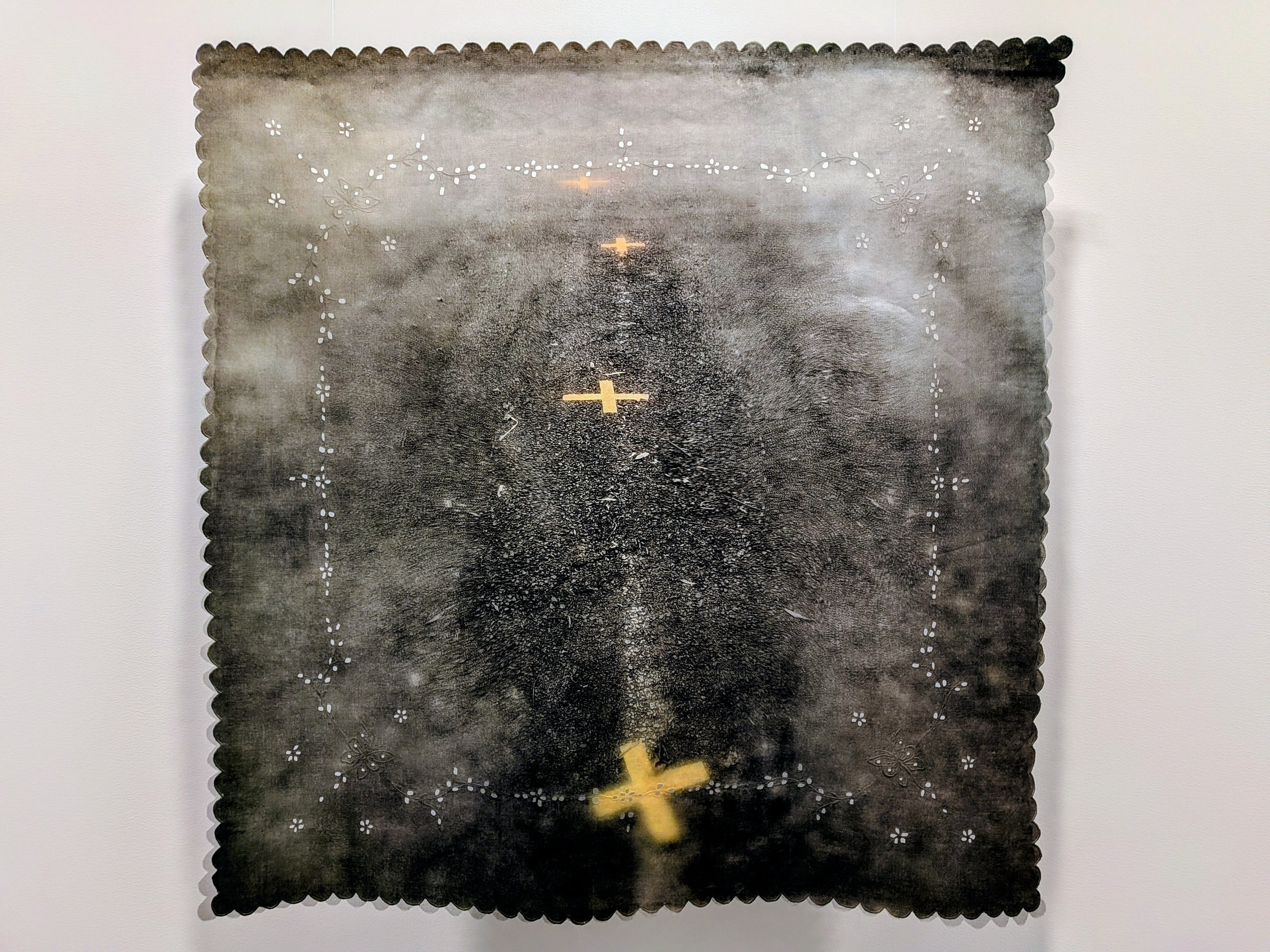
Catherine Day, “Altered Landscapes, Four X’s” (photo by Mark Jenkins)
NEARLY ALL THE WORKS IN “SUBTLE ENERGY” are made entirely of fabric, which suggests a strong affinity between the two artists in the Fred Schnider Gallery of Art show. Yet Catherine Day and Betsy Packard work in contrary modes. Day prints her photographs on doilies, handkerchiefs, and other antique cloth items, thus shadowing views of everyday contemporary phenomena with delicate echoes of the past. Packard combines found textiles -- and in one piece, human hair -- into objects that denote nothing save themselves.
Both contributors are minimalists, albeit in dissimilar ways. Day’s photos are usually uninhabited closeups in muted colors. Her subjects include gravesite details, vines in winter, and arrows or X’s painted on asphalt. According to Day’s commentary, the starkness of these works was inspired by the distancing at the peak of Covid-19 distancing.
That feeling of disruption doesn’t bleed into the artist’s style, which is tidy and precise. The images are neatly centered, and soften around the edges to highlight the principal feature. Preexisting aspects of the material are aligned with the photo, so that stitched patterns became readymade borders for the pictorial information. Day may depict a world that’s off-kilter, but she counters this with her own strong sense of order.
Packard’s approach could hardly be more different. Her work appears intuitive and spontaneous, and is never regular or symmetrical. It’s almost as if the artist submits to the bidding of the socks, sleeves, and bits of ribbon she assembles, letting the pieces nestle together however they wish. The results are as haphazard as they are profound. From prosaic and often mass-manufactured items, Packard concocts one-of-a-kind hybrids whose singularity is their essence, and their appeal.
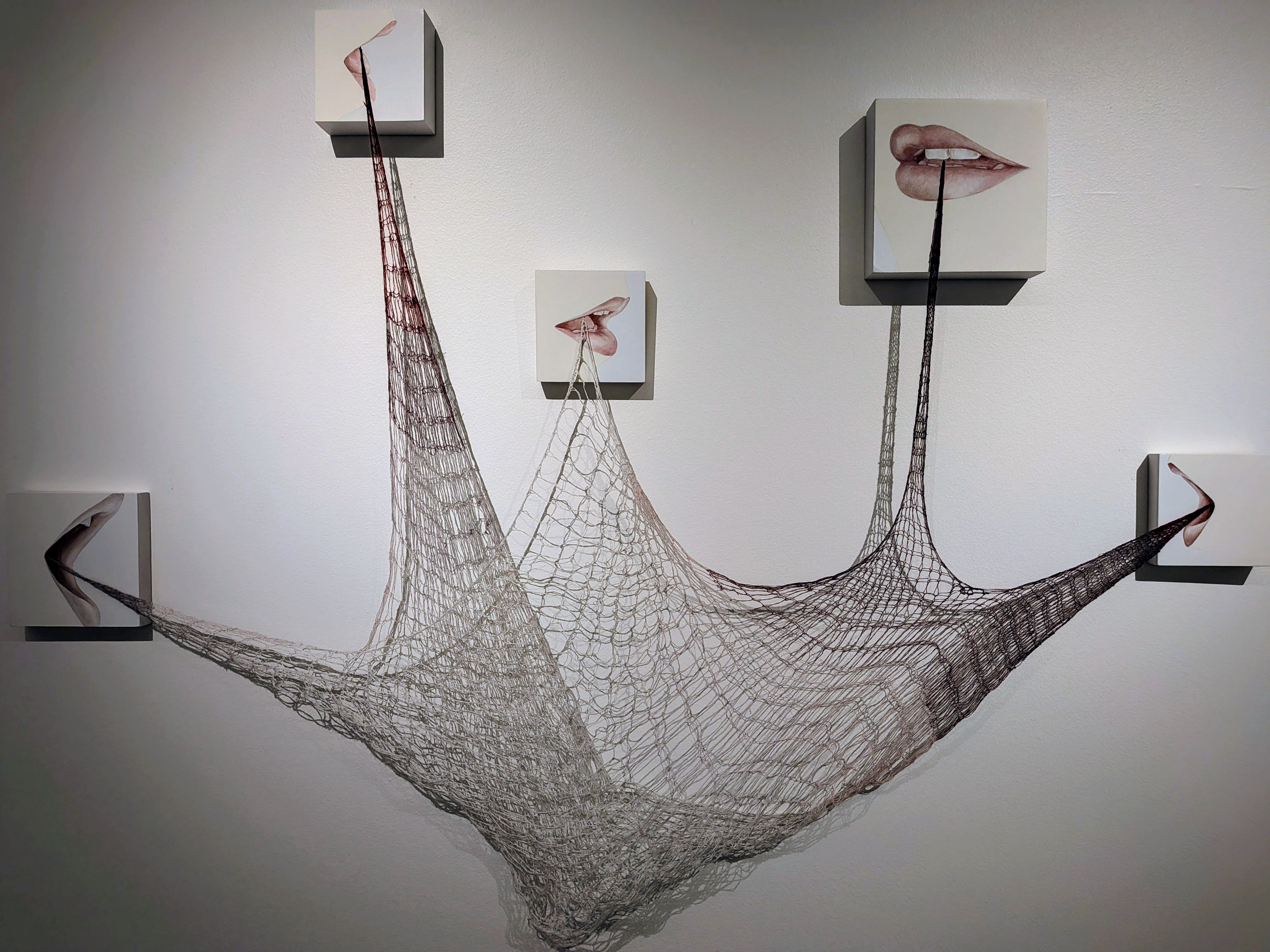
Rania Hassan, “Tangle V” (photo by Mark Jenkins)
LINES ARE BOTH LITERAL AND CONCEPTUAL in Rania Hassan’s “Lineal,” which expands from pencil drawings of interlocking curls and curves into 3D constructions of related forms. The D.C. artist is known for large-scale sculptures and installations, and her show at Silva Gallery x Latela Curatorial addresses familiar concerns on more intimate terms. Most of the works are on or made of paper, and are rendered in graphite with touches of pink. Some of the paper-loop assemblages shift from white at the top to pink at the bottom, as if the hue is flowing downward.
The drawings and paper constructions refer to knitting and other fabric crafts, and to the lineage of women who have taught such skills to younger generations. Yet lines have a different significance in the show’s centerpiece, “Tangle V.” This wall piece consists of five small realist paintings of a woman’s mouth, each on an individual white wooden panel and linked by gathered strands of a hammock-like web. Separate yet connected, the mouths can represent affinity or alienation, communication or miscommunication. Like all of Hassan’s imagery, “Tangle V” appears at once enduring and achingly fragile.
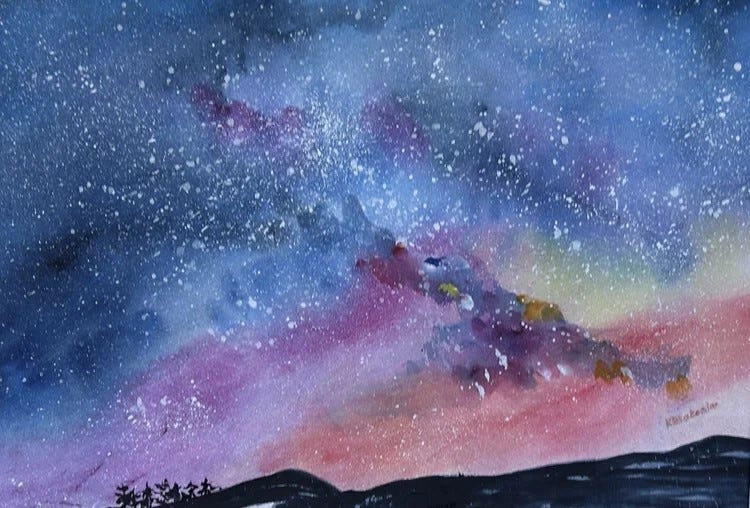
Katherine Blakeslee, “Celebration” (Foundry Gallery)
“SOLSTICE,” THE TITLE OF KATHERINE BLAKESLEE’S Foundry Gallery show, promises wintry vistas, and the local artist’s paintings do include a snowscape and a dark sky scene whose dominant color is an icy blue -- although there’s also red, pink, and yellow beneath the white spatters that conjure a starry night. But Blakeslee’s principal subjects, as befits a watercolorist, are fluid. “Rough Surf” splashes diffuse grays atop lighter ones, momentarily freezing an ocean’s perpetual motion, while “Waterfall’s” ambiguous point-of-view seems to plunge the eye into the cataract.
Most of these pictures depict nature, loosely but unmistakably. The exception is a set of six vivid abstractions made with alcohol ink rather than watercolor. These paintings are predominantly blue, suggesting water, but include purple, black, and even lush gold accents. Perhaps inspired by sea or sky, the pictures are small yet immersive. It’s impossible to say just what the images represent, but once again Blakeslee succeeds in drenching the viewer in liquid color.
Absence
Through Dec. 28 at Multiple Exposures Gallery, Torpedo Factory, 105 N. Union St., Alexandria. multipleexposuresgallery.com. 703-683-2205.
Barbara Liotta: A Gathering
Taina Litwak: Life in the Anthropocene
Adjoa Burrowes: Earth Sanctuary
Through Dec. 28 at IA&A at Hillyer, 9 Hillyer Court NW. athillyer.org. 202-338-0680.
Catherine Day & Betsy Packard: Subtle Energy
Through Dec. 27 at Fred Schnider Gallery of Art, 888 N. Quincy St., Arlington. fredschnidergalleryofart.com. 301-852-8042.
Rania Hassan: Lineal
Through Dec. 28 at the Silva Gallery x Latela Curatorial, 1630 Columbia Rd. NW. latelacuratorial.com.
Katherine Blakeslee: Solstice
Through Dec. 28 at Foundry Gallery, 2118 8th St. NW. foundrygallery.org. 202- 232-0203.