
Doors of Perception
Three approaches to cultural intersections and a meditation on Hiroshima at MOCA. Also: Washington Sculptors Group turns 40; social justice viewed through glass; and assemblage as autobiography
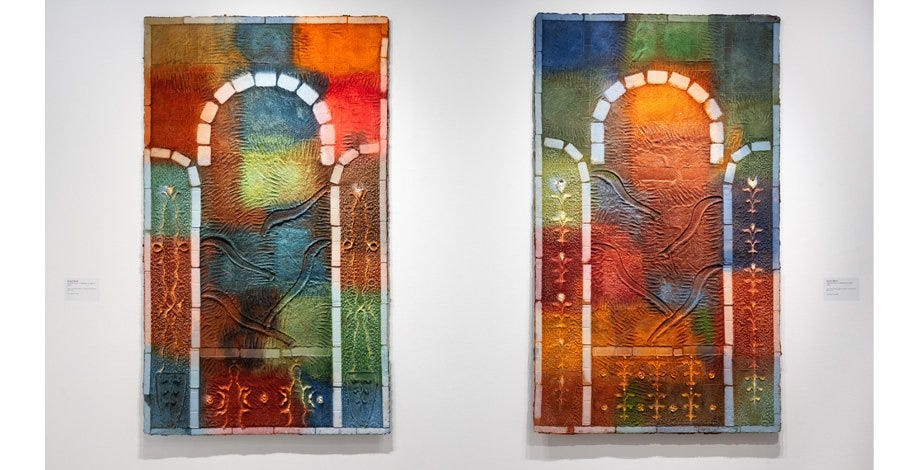
Aryana Minai, "Gateway of Light I and II" (MOCA Arlington)
ALL THREE CONTRIBUTORS TO "PORTALS" make fanciful images, but one of them actually references a real-world location: the frontier between Pakistan and India. The Museum of Contemporary Art Arlington exhibition also features an artist who depicts Iranian-style gates and another who portrays scenes in which Sri Lankan folklore bleeds into everyday Los Angeles. The trio of artists, based in L.A. or New York but rooted in South Asia or the Middle East, were brought together by guest curator Donna Honarpisheh.
The most straightforward pieces are Iranian-American artist Aryana Minai's paper relief sculptures of literal portals, nearly flat but intriguingly textured. These reflect the Islamic aversion to depicting humans and animals -- both common in traditional Persian art -- yet brandish such fecund nature forms as leaves and flowers. Most of the handmade-paper creations are in tones of desert and dust, but a pair titled "Gateway of Light I and II" are significantly more colorful. These two luminously hued entrances really look as if they might lead into a realm of illumination.
Based on daily ceremonies performed by soldiers on her homeland's border, Aiza Ahmed's cartoonish pictures are charcoal drawings on wooden cutouts, sometimes fleshed out with smeary paint. A set of the Pakistan-born artist's military caricatures are arranged against a bright red wall that might connote the region's bloody history, but in this case seems simply to express playful delight.
Frolicking has a weirder edge in Shyama Golden's paintings, which feature such nightmarish wonders as a man with a crocodile-like head. Some of the Sri Lankan-American artist's pictures are based on yakkas, animistic spirits worshipped by a tribal minority that lives in the island's interior. Residing in California, Golden may see the fur-covered yakka as embodying a part of her historic identity. This is suggested most strongly by "The Double," in which a human face peers from the hairy chest of a masked yakka. But Sri Lanka is not notably stranger than L.A. One of these is a set on a curving mountain road that might be Mulholland Drive. Golden's alluringly disturbing vision is half Yakka, half David Lynch
ONE GOAL OF KEI ITO'S "EMBODIED SPECTRUM" is to visualize the unseeable. But the Tokyo-born Baltimore artist also seeks to represent what should have been unthinkable: dropping a nuclear warhead on a site full of civilians. Ito's installation, also at MOCA Arlington, is the latest in a series inspired by the ordeal of his grandfather, who survived the A-bombing of Hiroshima.
Ito employs three slide projectors, which rotate through synchronized text and images, accompanied by a suitably ominous whooshing sound. The picture is actually a single one, derived from the first-ever photo of the sun -- made in 1845, exactly a century before the bombing. Subtle variations of this scratchy image, scraped in differing ways, are overlaid with tints that match the colors atop the phrases split across the other two screens. "We have engineered radiance/without joy," laments one.
The artist's cross-cultural references include Ra, the ancient Egyptian sun god, and Amaterasu, the Japanese sun goddess. (The latter's supposed divinity is key to the imperial system that led the Japanese to follow their emperor into the murderous mania of World War II.) Despite such wide-ranging associations, Ito's installation is fundamentally minimalist. The viewer is left alone with a flickering sun and the artist's thoughts. The first is light and the second dark.
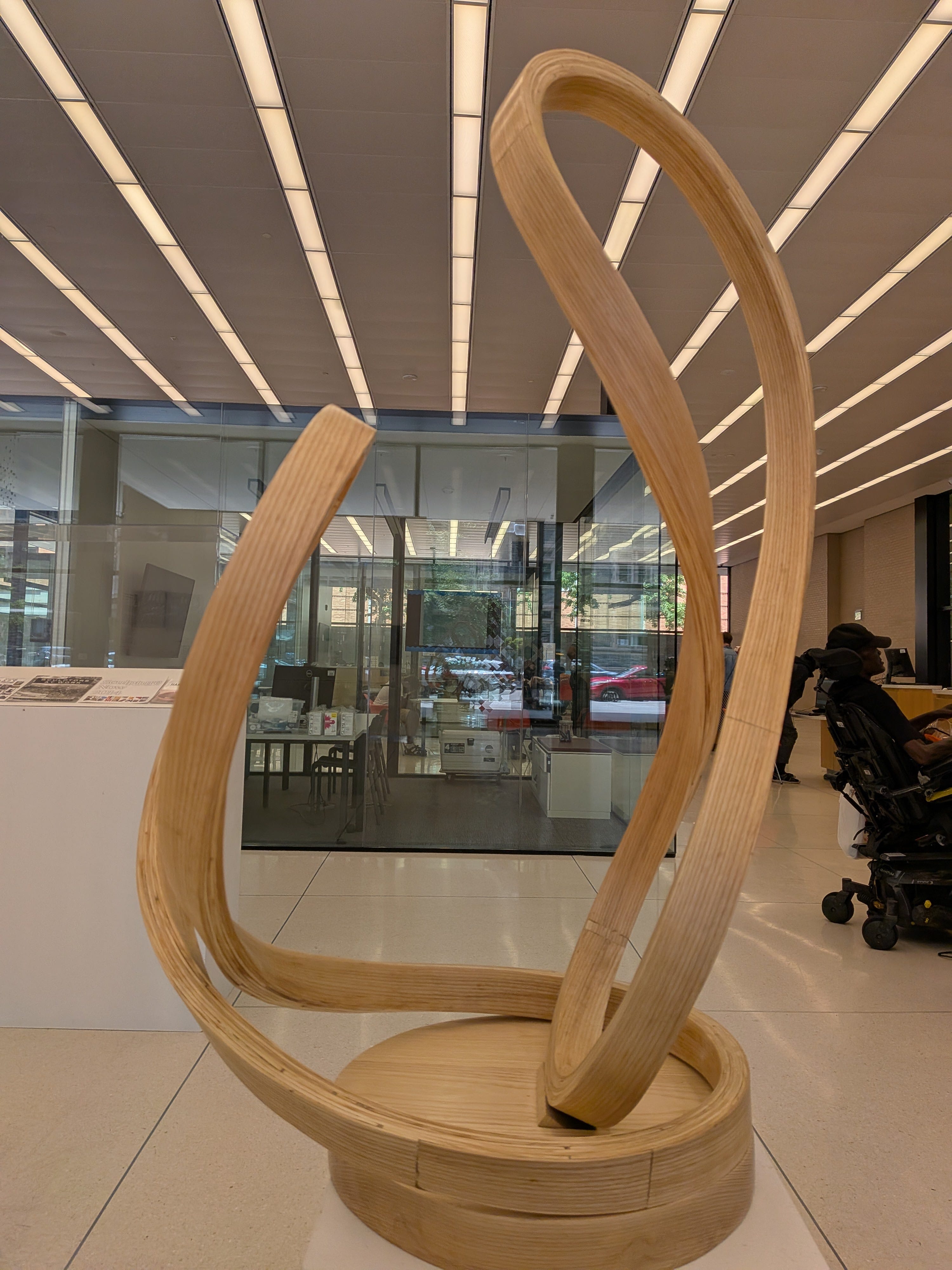
Lynda Smith-Bügge, "Mobius Redux" (photo by Mark Jenkins)
ALTHOUGH IT'S THE WASHINGTON SCULPTORS GROUP'S 40TH anniversary show, "Looking Back -- Looking Forward: Sources of Artistic Inspiration" seems inspired as much by its venue as by the organization's history. Installed on the main floor of the Martin Luther King, Jr. Memorial Library, the show includes several nods to the building and its purpose. There's even a piece titled "D.C. Punk Archive," named for the library's much-touted collection of materials from the hometown music scene. The sculpture is a small acrylic maquette for Eugene Provenzo's life-size sheet-metal rendering of a guitarist in a heroic stance and sporting a (not-very-D.C.) Mohawk hair style.
Among the other library-related works are Sally Canzoneri's "Banned Book Week" collage, which arrays signs over photos of the revamped MLK's staircases; and an enigmatic assemblage by Jeffrey Jenkins (no relation) that includes German text and a clock half-packed into a metal box stenciled "public library." From a distance, Vienne Rea's "I Have a Dream" is merely a ladder, but a closer look reveals that the rungs are made of hot-type letters that spell out MLK quotations.
Barbara Liotta's "Descent for MLK Library" makes use of the building's most conspicuous feature, its glass wall facade, as a backdrop for one of her trademark essays in solidity and airiness: shards of slate that dangle on cords in an arrangement that gets progressively denser as it approaches the floor. Equally stark and elegant is Lynda Smith-Bügge's "Mobius Redux," two pirouetting loops of curved ash that conjure infinite motion.
Like Liotta, Amity Chan contrasts heaviness and delicacy, but she utilizes a very different form. Each of her three small concrete rectangles is inscribed with a Chinese character, supple and fluid at the center of an unyielding block. The essence is even more hidden in Julie Zirlin's metal-looking ceramic wall sculpture, in which two squashed faces lurk behind the spike-like bars of a structure that's half helmet, half cage. Zirlin's vision of apparent imprisonment is not auspicious, but it is powerful.
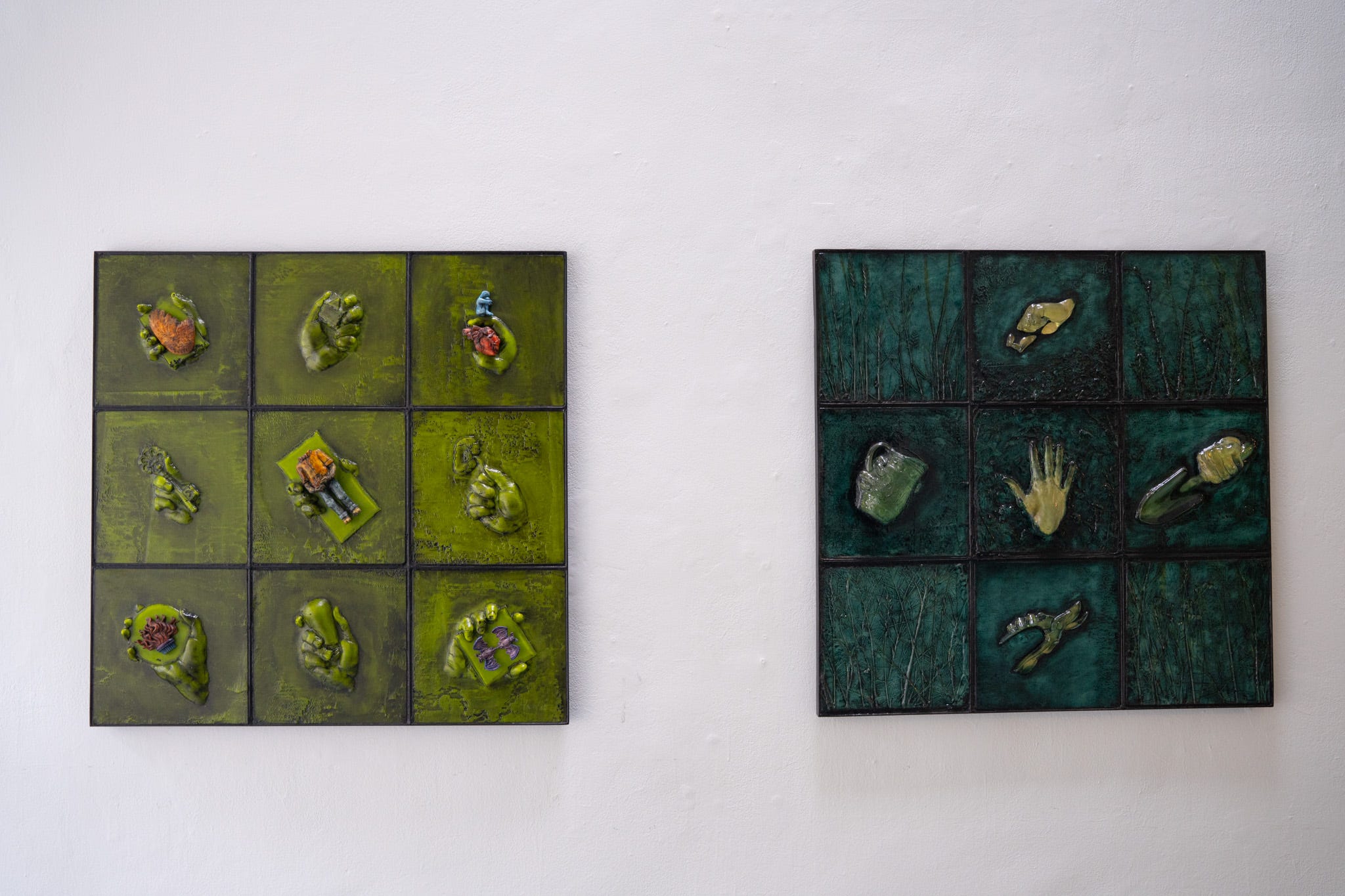
Works by Tim Tate and Nilou Kazemzadeh in “Glass for Social Justice” (photo by Camille DeSanto)
THE FOUR DEVELOPING ARTISTS APPEAR WELL-DEVELOPED in Transformer's "E22: Glass for Social Justice: A Litany for Survival." (Its cryptic alphanumeric designation is short for "22nd Annual Exercises for Emerging Artists.") Local glass virtuoso Tim Tate is the mentor for the D.C.-area participants, two of whom have made elegant pieces much like their teacher's.
Tate's "In Search of New Identities" consists of nine greenish panels, each of which incorporates the 3D shape of such items as a wing, a key, a light bulb, and what appears to be a fire-topped cupcake. Nilou Kazemzadeh and Arden Colley follow the same nine-square format, but where the former places a human hand at the center of an array of tools, the latter sculpts hands in various configurations, all within the brightly hued sectors of panels that are partly grayed-out. Kazemzadeh's scenario is narrative as well as symbolic, representing the process for planting a seed. Colley's statement indicates that her creation depicts "our isolation from each other" and "our separation from Nature."
The three clear glass forms crafted by Tina Villadolid are just part of an installation that encapsulates her Filipina-American heritage. The glass blocks hang on cords of "Manila" hemp above a pile of rice inside a burlap bag. Placed within gilded frames, the seven assemblages C.S. Corbin's "The Heirlooms" feature molded glass, usually combined with vintage photographs. All embody what Corbin terms "the ongoing story of trans resistance."
All the artists has their particular issues and identities to cast in glass. But the show's largest message is one long conveyed by Tate and his cohorts at the Washington Glass School: that glass is not simply decorative, but can explore any of the subjects addressed by other visual media.
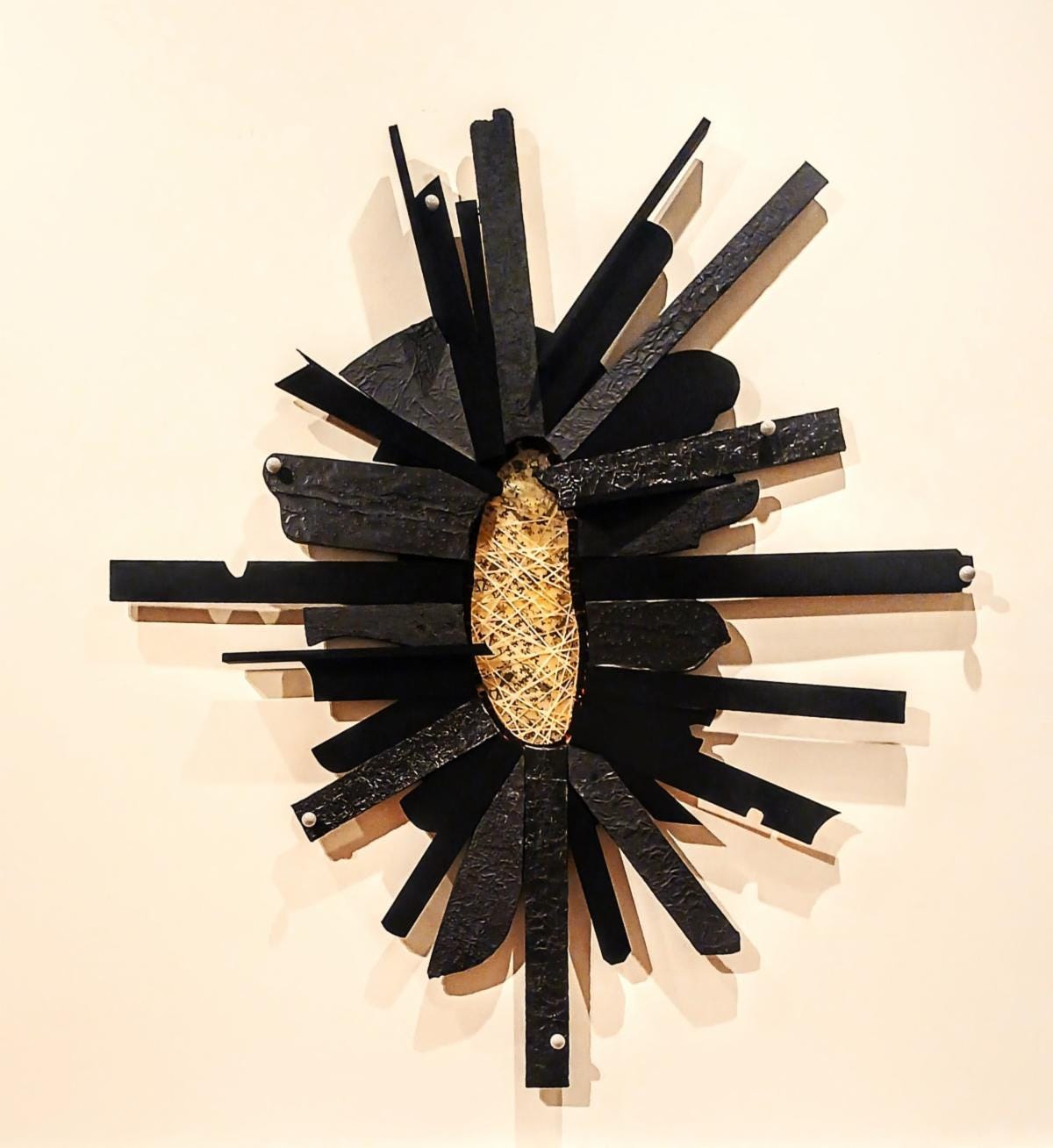
Terence Nicholson, “Home of No Return” (IA&A at Hillyer)
TERENCE NICHOLSON'S ARTWORKS ARE TYPICALLY AUTOBIOGRAPHICAL, but that's hardly limiting since the Washington native (now living in Baltimore) has so many lives. He's an artist, an installer, a curator, a musician, and a practitioner of Chinese martial arts. The eight works in IA&A at Hillyer's "The Eternal Echo" -- five of them from 2025 -- range from big, bold assemblages to a video of shadowboxing.
A large painting-drawing (the only 2D entry) features glyphs that suggest Nigeria's secret writing system, while a set of pew-like chairs holds pillows embroidered with the words "thoughts" and "prayers," a reference to American society's sanctimonious refusal to take meaningful action against gun violence. The latter piece is supplemented by music whose churchy organ tones are disrupted by woozy glitches.
Nicholson sees his works as "questions, musings, and reflections that happen to manifest as objects," according to his statement. These are often complex, yet unified by repeated motifs -- like dozens of clear-resin, doorknob-shaped reliquaries attached to a single door -- or exuberant visual gestures. "Home of No Return" accents its oblong core with a thicket of wooden gashes, all painted black. The life chapter this construction recounts is unclear, but the exuberance with which it's told is pointed.
Portals
Kei Ito: Embodied Spectrum
Through Sept. 7 at the Museum of Contemporary Art Arlington, 3550 Wilson Blvd., Arlington. 703-248-6800.
WSG: Looking Back -- Looking Forward: Sources of Artistic Inspiration
Through Sept. 7 at Martin Luther King, Jr. Memorial Library, 901 G St. NW. washingtonsculptors.org.
E22: Glass for Social Justice: A Litany for Survival
Through Sept. 6 at Transformer, 1404 P St. NW. transformerdc.org. 202-483-1102.
Terence Nicholson: The Eternal Echo
Through Aug. 31 at IA&A at Hillyer, 9 Hillyer Court NW. athillyer.org. 202-338-0680.