
Cross Purposes
Neo-minimalists draw the line at PFA; disparate approaches to collage at Pyramid Atlantic and I Street Gallery; Studio’s best contemplate the worst
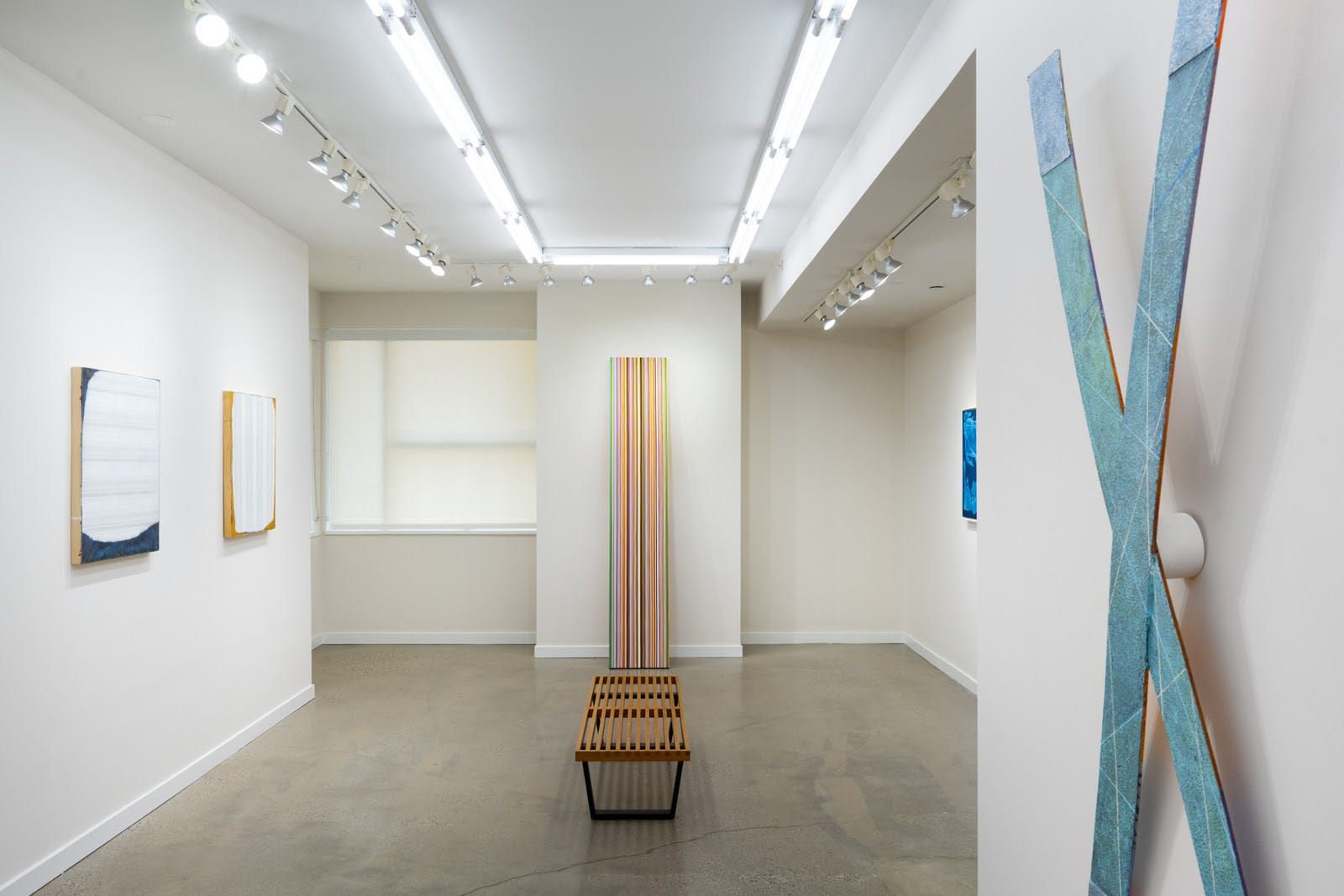
“Crosshatch: Making Networks” installation view (photo by Vivian Doering)
“X” MARKS SOME OF THE SPOTS in “Crosshatch: Making Networks,” a four-artist show at PFA Gallery’s downtown location. The bulk of the work is by Maryland-based artist Francie Hester, who crisscrosses twinned spars of metal-emulating Plexiglas. The two largest of these wall-hugging sculptures have patinas that suggest oxidized copper or steel. The smaller ones, which line the venue’s hallway, are covered with diverse patterns that resemble collaged paper. In both cases, the complex surfaces effectively contrast the elemental form.
Tim Doud, once known primarily as a portrait painter, revisits the format of Gene Davis’s best-known pictures with three vertical stripe paintings. Doud makes the design his own by applying the pigment in stripes that gently blur into each other. The D.C. artist also experiments with form by leaning the painted panels against the wall to achieve a sculptural quality that recalls the work of another Washington colorist, Anne Truitt. But Doud’s striped slabs are jauntier and less austere than Truitt’s minimalist pillars.
Parallel lines also characterize the work of Joseph Shetler, who uses silverpoint to inscribe banks of thin, orderly marks. The D.C. artist frames these lines, which can be either horizontal or vertical, with single-color borders that are smudgy and irregular. “Untitled (verde valley)” also arrays the bordering green under the lines, but rendered softer and fainter. Viewers may find the artworks meditative even without knowing that they draw from Shetler’s strict Mennonite upbringing in Indiana.
The least geometric works are by Seth Adelsberger, who swirls layers of gesso and acrylic paint on canvas. Although the Baltimore artist forgoes straight lines and right angles, he is something of a minimalist. Each of his three textured paintings arrays a single shade of purple, greenish blue, or bluish green on a black field. That the effect is luminous is entirely apt. The artists of “Crosshatch” are as concerned with voluptuous surfaces as they are with recurring patterns.
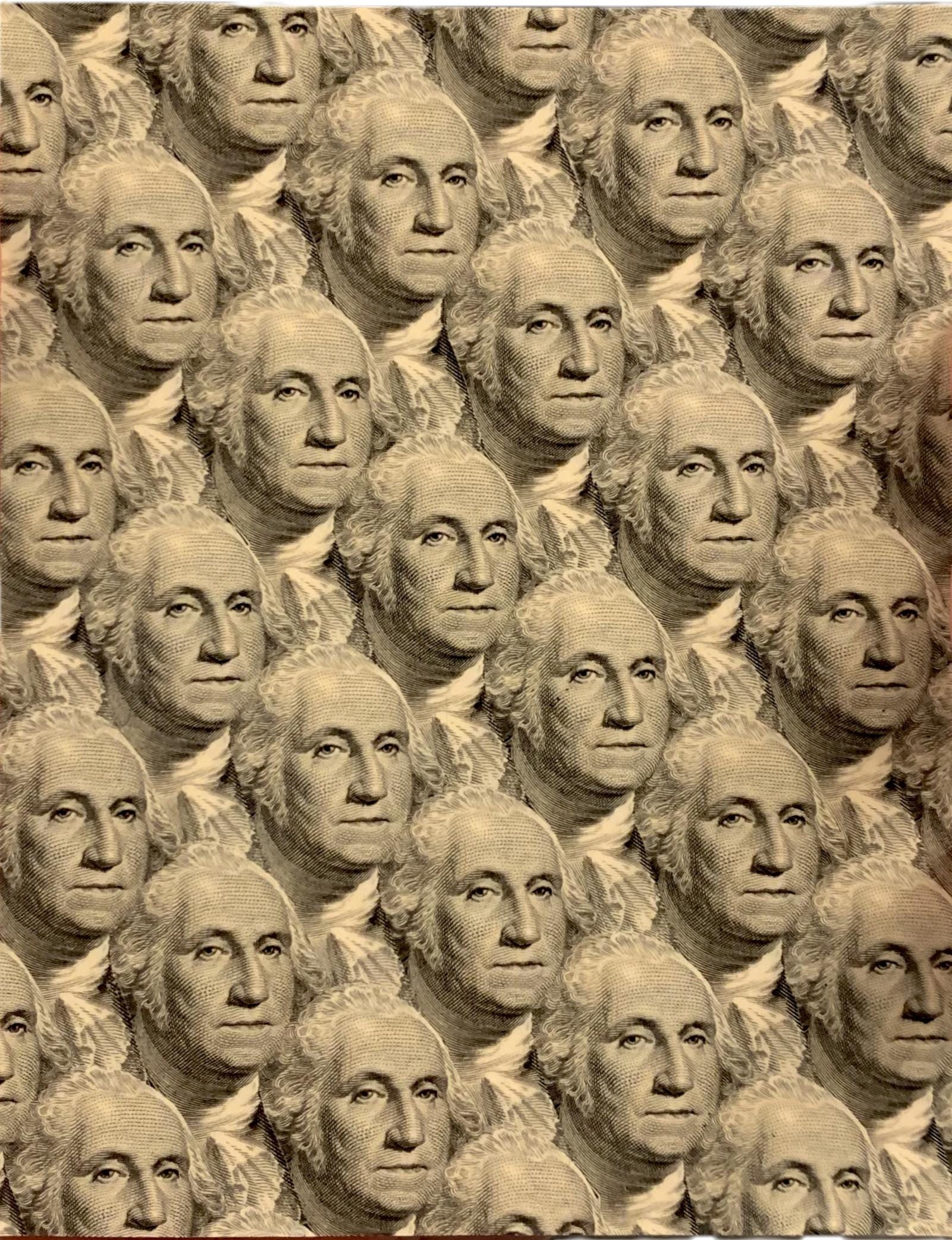
Mark Wagner, “The Court of Common Please” (Pyramid Atlantic)
A FRAGILE DELICATE PERCH BETWEEN CHAOS AND UNITY is where the most striking pieces in “Superimposed” land. The Pyramid Atlantic exhibition presents the work of nearly 75 artists from across the country, juried by Carlos Hernandez, Shanna Strauss, and Chadwick Tolley. Each of the jurors has a fine piece in the selection, and their range is emblematic of the show’s: Hernandez’s playfully lurid screenprint collage features a tongue and a she-devil; Strauss’s elegant block print is a portrait of a pretty Black woman outlined in green on black; and Tolley’s quartet of collaged screenprints spatters classic American cartoon characters with color.
Although this is a national show, local artists are well represented. Veronica Barker-Barzel’s multi-style memory-scape places an ominous horned creature above images of children from bygone eras. Equally mythic is Suzanne Bartlett’s mixed-media picture of Daphne, cloaked in overlapping leaf-like shapes to represent how she turned into a laurel tree to escape Apollo’s lust. Similarly layered but purely abstract is Katherine Bramante’s monotype collage, whose gray-and-tan color scheme gives it an urban feel.
Gail Shaw-Clemons’s abstract monotype-sculpture contrasts wild colors with gray expanses, and precise circles with tongues of what could be flame. Mei Mei Chang surprises with a moody abstraction, mostly brown and cyanotype, that has a red-patterned strip of fabric sewed into the center. Cyanotype also features in Marie-Béatrice Gauthiez’s partly abstract mixed-media picture, whose watery blues evoke a flood. Michael Crossett’s 85-layer cityscape montage demonstrates new techniques but retains such favorite motifs as Metro’s coffered ceilings. Jeffery Berg adds just one layer, the anti-Trump protest poster under a pencil drawing of seated men.
Various sorts of musings animate collages by Evi Sargeant, Caitlin Gill, Chas Foster, and Michael Waraksa. Sargeant invokes her history as a “transracial Chinese adoptee” in her lovely print of three bottles, each a different muted hue, labeled with Chinese text. Gill’s collage assembles exquisite textures into the forms of butchered animals, totems of male violence. Foster prints an image of a fierce werewolf on a grid of scraps of printed paper that appear to date from the same era -- seven decades ago -- as Hollywood’s first flirtation with the man-beasts. Waraksa visits similar territory with a digital collage that combines talismans of American sci-fi and horror movies with European surrealism.
Although few of these pieces protrude far off the wall, three of the most compelling ones conjure a formidable sense of space. Madeleine Underwood prints gradated red stripes on lined writing paper mounted on shaped plywood to effect an illusion of motion. Walter Plotnick divides a silhouetted image of figures atop girders, drawing the eye past the black shapes and into soft gray-and-white sky. Barbara Ziselberger (also a D.C. area artist) employs the opacity of sumi ink to give substance to a wispy, seemingly frayed frame strung with handmade paper beads. In all three works, the most important of the collaged elements may be the ones that aren’t actually there.
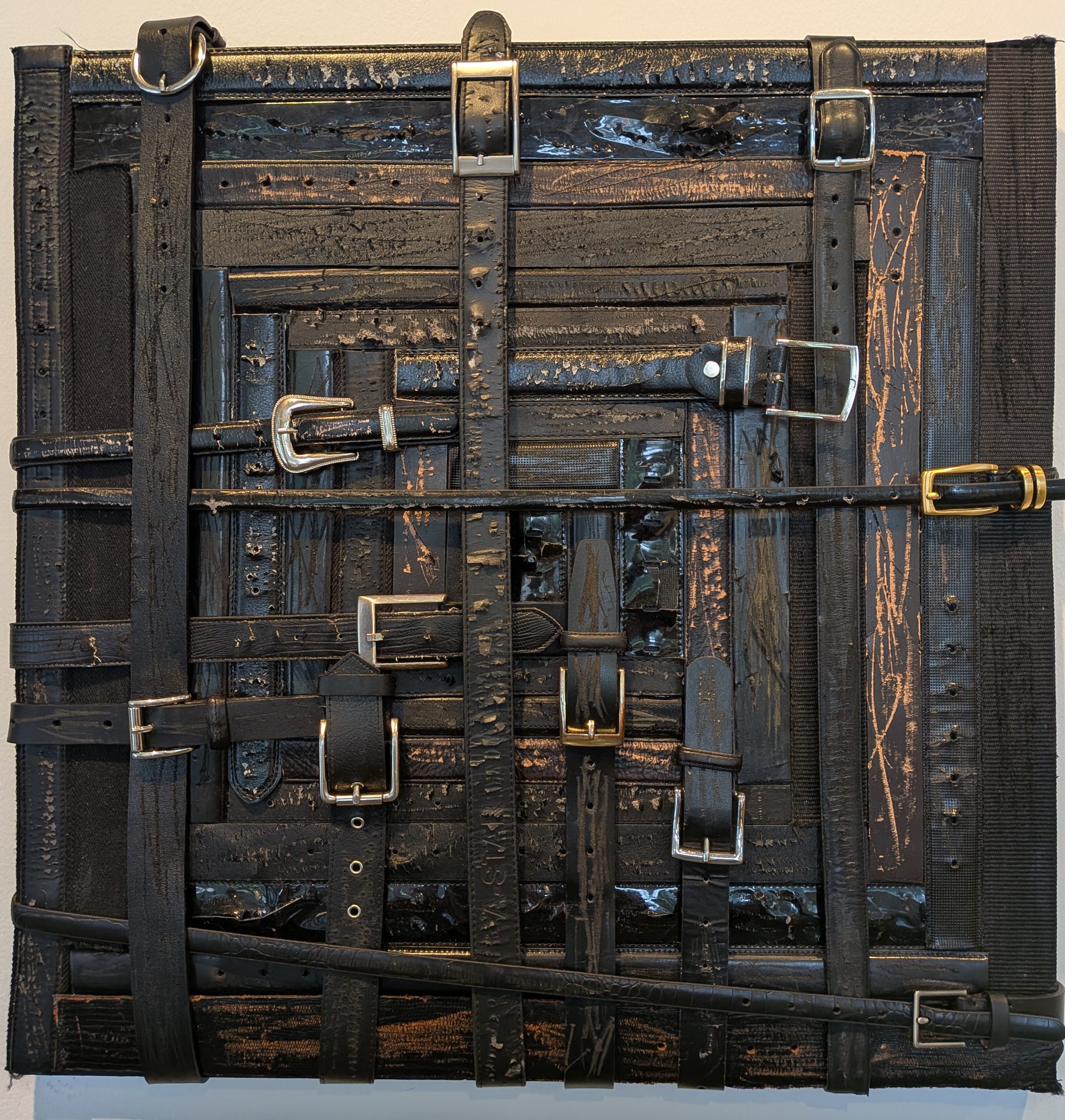
Lex Marie, “Keep it Together” (photo by Mark Jenkins)
THE SHREDDING IS OFTEN MORE CONCEPTUAL THAN LITERAL in “Rip! Tear! Collage as Critique,” a show of work by 23 local artists at the D.C. Commission on the Arts and Humanities’s I Street Gallery. Relatively few jagged edges can be seen in this array, which includes such tidy entries as Mark Kelner’s “51 Books,” a shelf of American-history books with red, white, and/or blue designs on their spines. But if there’s not much ripping, there is a lot of critique.
This ranges from such contemporary topics as the devastation from ongoing wars in the Middle East, depicted in Helen Zughaib’s stark photo-collages, to such historical ones as the love lives of queer authors, animated from photos and placed inside a large glass by Tim Tate. There are also such autobiographical pieces as Andrew Kastner’s pointillist abstraction, which speaks to his “post-stroke experience,” and Joana Stilwell’s set of small jars that contain photographs disintegrated in oil and water, representing partly dissolved memories.
Many of the artworks address the Black experience. Anne Bouie’s provocative 3D collage places fetish objects around racist antique figurines of a Black man and woman, while Amber Robles-Gordon incorporates images of Black protest into a banner-like design. Most ominous is Lex Maria’s found-object assemblage of black belts stretched across black wood, evoking corporeal punishment administered in Black households. As encouraging as Maria’s piece is dread-full, Aziza Claudia Gibson-Hunter’s sprawling installation features a cascade of small paintings that enlarge as they move from left to right. The collaged pieces appear to be separating rather than unifying, but as they come loose they ascend joyously.
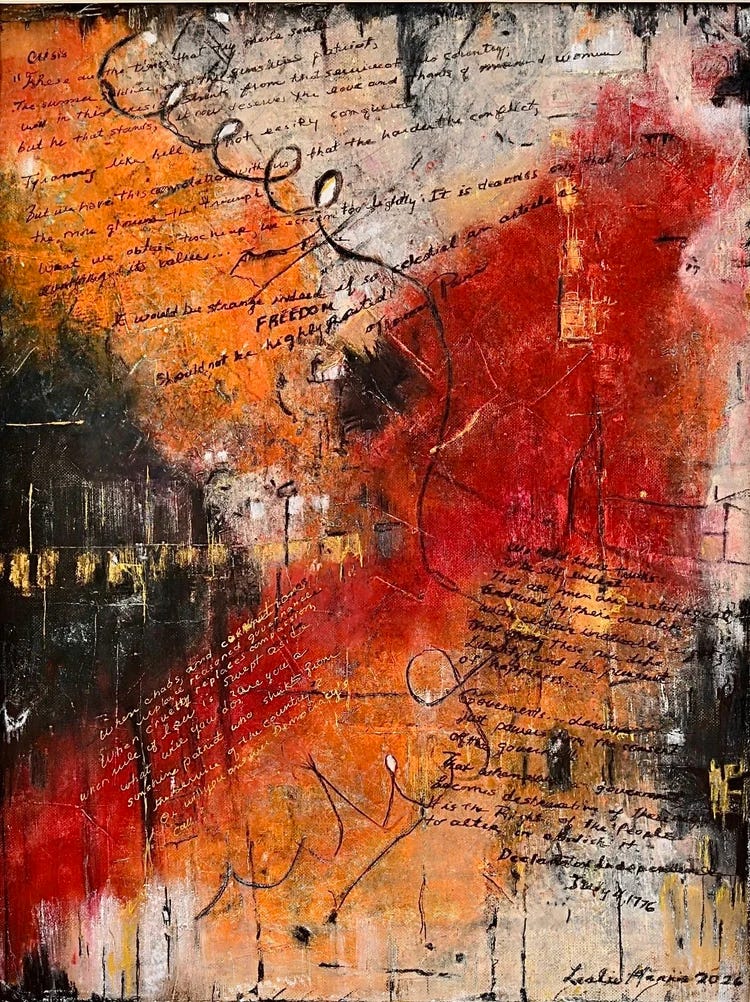
Leslie Harris, “There Are the Times” (Studio Gallery)
TWO VERY DIFFERENT PHOTOGRAPHIC VIGNETTES are among the highlights of Studio Gallery’s summer group exhibition, “It Was the Best of Times. It Was....” Gary Anthes’s picture of an abandoned Connecticut metals foundry is a vision of two separate eras: The age of American manufacturing supremacy is supplanted by the hip-hop era, represented by graffiti that’s reflected, almost glamorously, in standing water. This messy found image strongly contrasts Iwan Bagus’s elegantly staged photo of an ominous symbolic scene: A large bottle of red iodine solution appears to hover in mid-air over transparent miniature models of hospital-room furnishings in a pool of more red liquid.
Curated by painters Sabiha Iqbal and Carolee Jakes, both of whom are also contributors, the show collects work by about 20 Studio Gallery members. In Iqbal’s pictures of dancing figures, human motion is echoed, and sometimes upstaged, by colorful nonrepresentational forms. Jakes’s offerings include two renderings of solitary people and a semi-abstract picture whose dominant shades of blue are energized by near-white highlights.
Abstraction and nature images are common, and sometimes fuse, as in Iqbal’s work and Irene Pantellis’s mixed-media paintings of plants and roots, which are also studies of gestures and drippily fluid pigment. Two artists find beauty in damage and decay: Lisa Battle’s “Essence” is an abstracted ceramic representation of a flame that appears gouged on one side, as if by giant claws; and Joanne Levine’s “Regret and Resilience” is an oddly lovely photograph of browned, partly drooping tulips in a simple glass vase.
Levine’s picture is an allegory of the country’s current condition, but the piece that seems to speak most directly to the show’s title is Leslie Harris’s “There Are the Times,” a mixed-media painting. Bold swathes of orange and red seem to emanate from abundant text, including the words of Thomas Paine. Perhaps his exhortations will guide a political renewal, but for now Harris’s picture looks like a bonfire of the verities.
Crosshatch: Making Networks
Through Aug. 8 at Pazo Fine Art, 1932 9th St. NW (entrance at 1917 9 1/2 St. NW). pazofineart.com. 571-315-5279.
Superimposed
Through Aug. 9 at Pyramid Atlantic Art Center, 4318 Gallatin St., Hyattsville. pyramidatlanticartcenter.org. 301-608-9101.
Rip! Tear! Collage as Critique
Through Aug. 6 at I Street Gallery, D.C. Commission on the Arts and Humanities, 200 I St. SE. dcarts.dc.gov/node/1829986
It Was the Best of Times. It Was...
Through Aug. 8 at Studio Gallery, 2108 R St. NW. studiogallerydc.com. 202-232-8734