
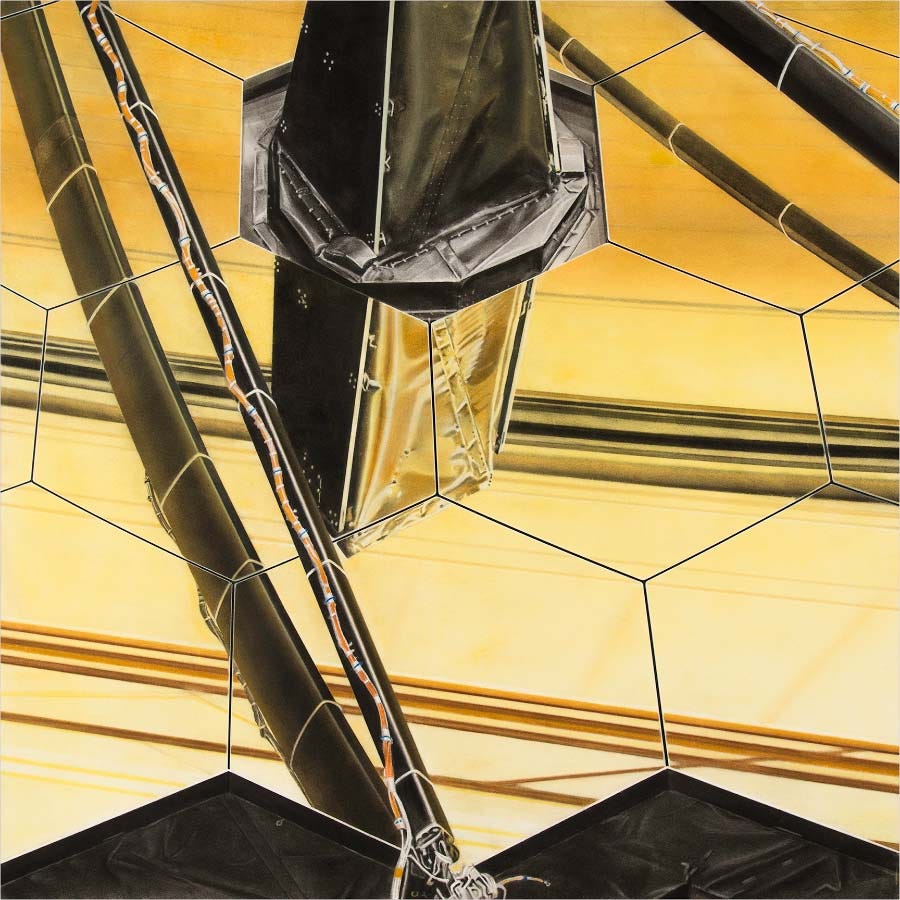
Timothy Makepeace, “JWST - Central Baffle” (detail) (American University Museum)
CHARTING PARALLEL REAL AND VIRTUAL JOURNEYS, Timothy Makepeace’s “Ghost in the Machine” is partly a chronicle of the construction of the James Webb Space Telescope. But the artist also ventures hypothetically into space to observe the telescope’s location and some of the celestial phenomena that surround it. Curated by Thomas Drymon and Michael O’Sullivan, this fascinating exhibition is the largest of six shows of work by local artists currently at the American University Museum. (A seventh, by Janis Goodman, was reviewed in DisCerning Eye previously.)
Makepeace was one of several artists selected by NASA to document the telescope before its deployment to an orbit almost one million miles from Earth. After photographing aspects of the device’s assembly at Goddard Space Flight Center in Maryland, Makepeace made elaborately detailed charcoal-and-pastel drawings whose glimmering yellows represent the telescope’s gold-plated mirror. Some of these artworks were exhibited at the National Academy of Sciences in 2021-22, before the JWST was in position in space.
“Ghost in the Machine” moves both backward and forward from the NAS show. It includes a few earlier photorealist pictures that depict less elevated technologies, whether mechanical or electrical. But most of the entries are more recent, and reflect expanded knowledge of the telescope, its mission, and its other-worldly environment. Makepeace often works from photographs, so it’s no surprise that a starscape mimics a time-lapse exposure, albeit one made with what the artist calls an “imaginary camera.”
Many of these pictures are large, in part to emphasize the vastness of the territory the JWST is surveying, and the size of the mechanism itself. One impressively massive artwork was inspired by space, but also by the museum’s architecture. A 25-wide painting is mounted on an existing curved wall in a playful nod to the curvature of space. The depiction of a soft line that stretches from a black hole to the telescope can’t be seen in a single glance, so the viewer must undertake a voyage, however modest, to apprehend the whole thing. That’s a conceptual coup in a show packed with intriguing ideas. Makepeace may not be a scientist, but he’s certainly a creative thinker.
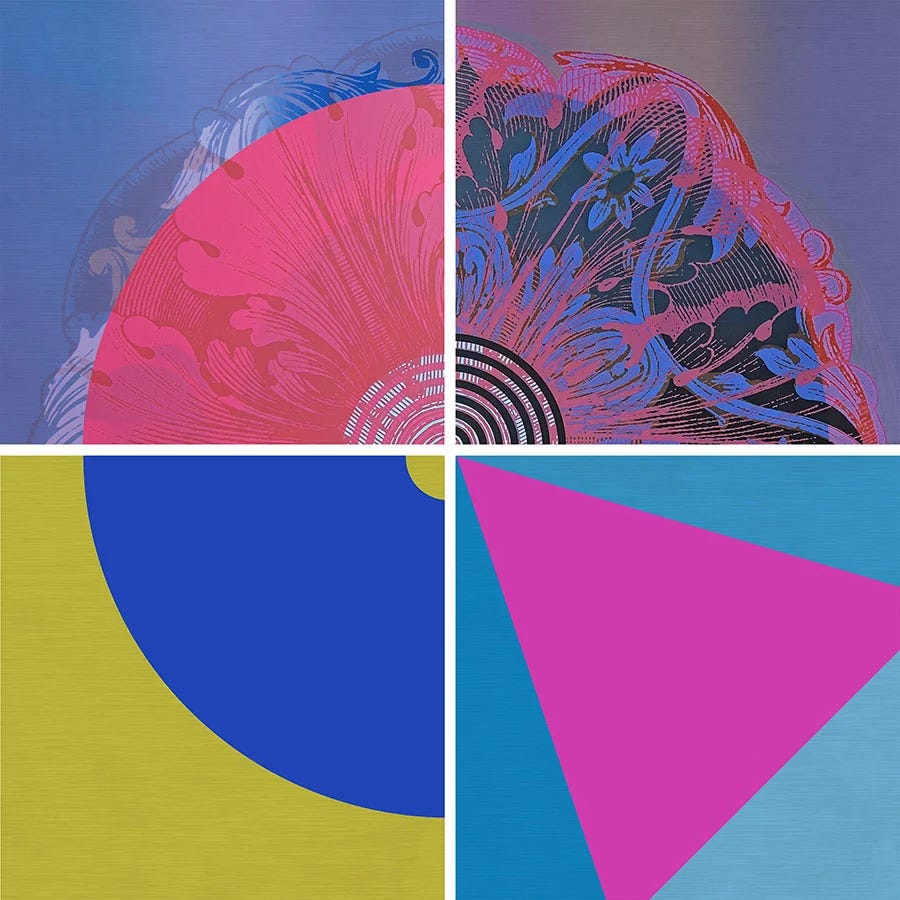
Susan Goldman, “Prima Vista 4” (American University Museum)
A SIMPLE GEOMETRIC SHAPE MAKES AN ASTONISHING ENTRANCE in Susan Goldman’s “Prima Vista,” a small but dazzling show of prints, mostly on gleaming aluminum. The artist is known for circles, sometimes taking the form of flowery ornamentation and usually split equally across four square quadrants of a larger square. Goldman’s layered, complex compositions can be seen as exercises in sheer form, but also as metaphors for evolution, mutation, and dynamism. The new dynamic element in this show is the triangle, which replaces the lower-right section of a circle in “Prima Vista IV.”
That jaunty triangle is fuchsia on a turquoise field, a typically vivid if unusually simple color combination for Goldman. Triangles appear several times in this show of work from 2024 to 2026, which was curated by AU Museum Director Jack Rasmussen. Notably, two of them intrude on “Mosaic Mélange,” a wall-filling 36-panel piece in which quarter-circles bounce around the grid, defying the customary format of the artist’s “Squaring the Circle” and “Squaring the Flower” series. As always in Goldman’s work, the system is clearly visible, yet playfully disrupted.
The selection includes a print on handmade paper, “Into the Orange Sky,” in which the hues of a sun-like orb gradate from orange to deep blue. Such pictures are also common in the artist’s recent repertoire, but this show concentrates on the latest variations on the “Squaring” series. These demonstrate Goldman’s canny contrasts of simplicity and intricacy, elemental form and ornate augmentation. In “Prima Vista” -- Italian for “first sight” -- the universe is essentially orderly, yet capable of being endlessly tweaked and teased.
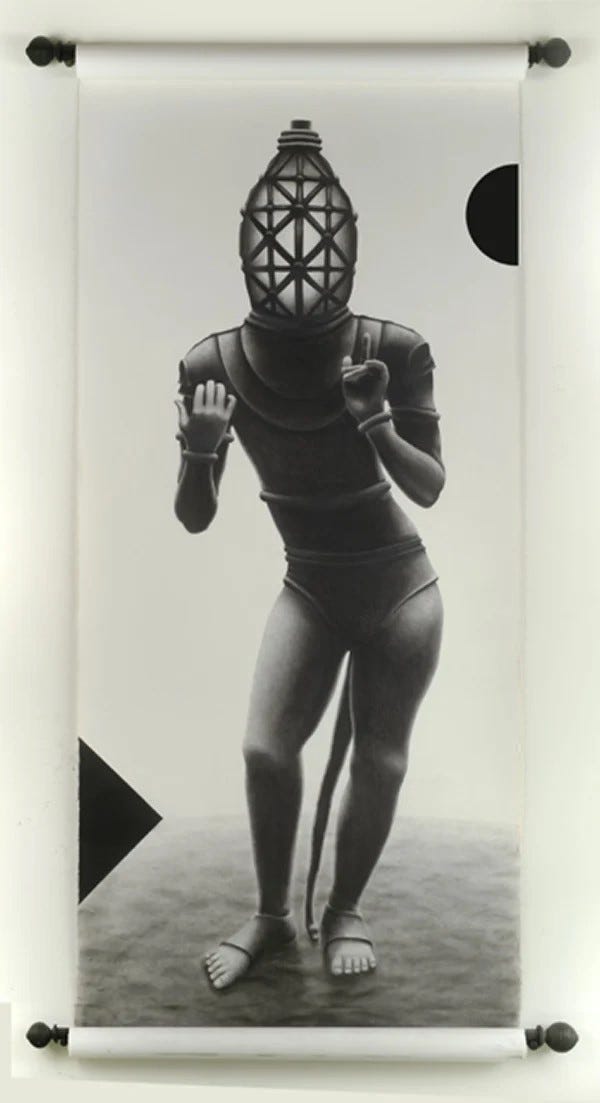
Richard Dana, “The Prophet of Mind and Body” (American University Museum)
RICHARD DANA’S DRAWINGS ARE AS MONOCHROMATIC as Goldman’s prints are colorful, but that doesn’t mean they’re austere. Using just graphite, charcoal, and black ink, the self-taught draftsman renders lush tones, complex patterns, and surrealistic visions. There’s a lot of white space in Dana’s “People, Places, and Otherwise,” a retrospective curated by Nancy Sausser, but the emptiness doesn’t read as blank. The artist skillfully uses the unmarked areas to conjure depth and breadth, so the subjects appear to be placed in vast realms whose dimensions are just out of sight.
A few drawings venture literally into the third dimension, adding scraps of collaged lace or dwelling inside a lattice of plastic frames. Also included are some M.C. Escher-like geometric fantasias, shadowed and modeled to simulate a sculptural quality. One series depicts animals on printed patterns or pleasingly outlandish hybrid creatures such as a bird with a rhino’s head. By drawing such phantasms so precisely, Dana makes the unnatural appear almost commonplace.
Many of the show’s highlights are on a long wall hung with large vertical scrolls. These pictures are usually, but not always, hyperrealistic in style, if not in subject. One impeccably detailed charcoal drawing, “The Prophet of Mind and Body,” depicts a man who wears what appears to be a diving suit. But is that an air-hose behind him, or a tail? And his head inside a baroque helmet, or is his body topped with some sort of lantern? In Dana’s work, black-and-gray lines pretend to verisimilitude, while the actual images boldly untether themselves from reality.
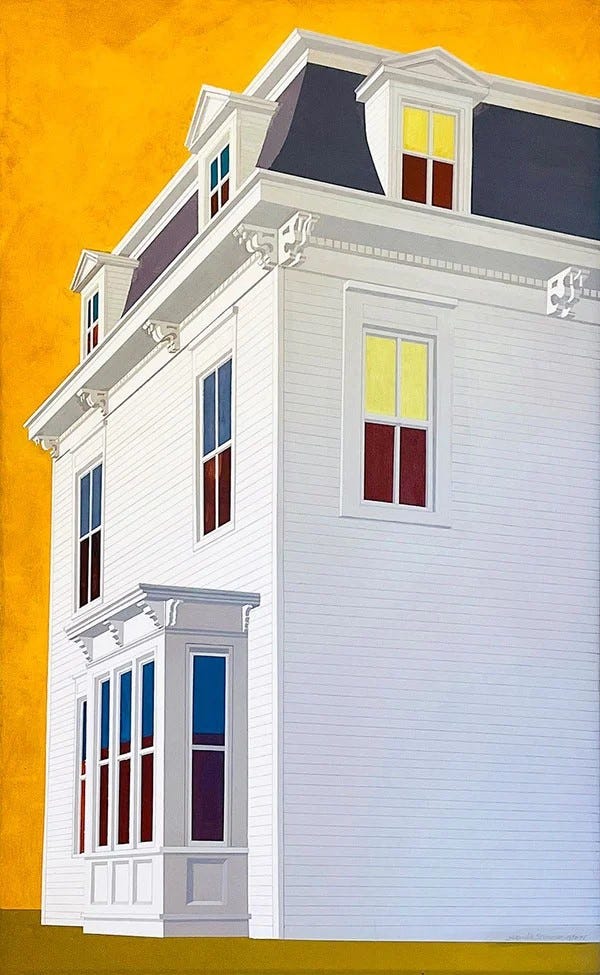
A. Brockie Stevenson, “Purple Mansard” (American University Museum)
AMERICANA APPEARS PRISTINE AND ARCHETYPAL in the paintings and prints of A. Brockie Stevenson, (1919-2009), whose art is extremely realistic and yet cannily abstracted. While his subjects suggest an earlier era, contemporary Washingtonians may find some of them familiar. The largest piece in “An American Vision,” for example, is “She’s a Mighty Engine III,” a huge rendering of a Southern Railways steam locomotive whose green exterior the artist boldly contrasts with a red backdrop. The locomotive once chugged through Dixie, but since 1962 it’s been in Washington as property of the Smithsonian.
Stevenson taught for more than 30 years at the Corcoran College of Art and Design, and many of the things he depicted are or were local. A picture of a house with a white picket fence, a scene that looks too iconic to be actual, is titled “Glen Echo,” after the historic Maryland hamlet where the artist lived and died. As this Edith Graves-curated show reveals, the American exemplar can be right next door.
Of course, Stevenson transforms his subjects, if only subtly. He flattens buildings, while employing crisp gray shadows to suggest depth. Lawns are blocks, or barely distinguished stripes, of green. Skies can be blue, but also such unnaturalistic colors as the orange of “Purple Mansard.” American flags convey old-time patriotism, but also hang, unruffled, as exercises in color and form. Stevenson’s pictures are twice idealized -- first as history, and then as geometry.
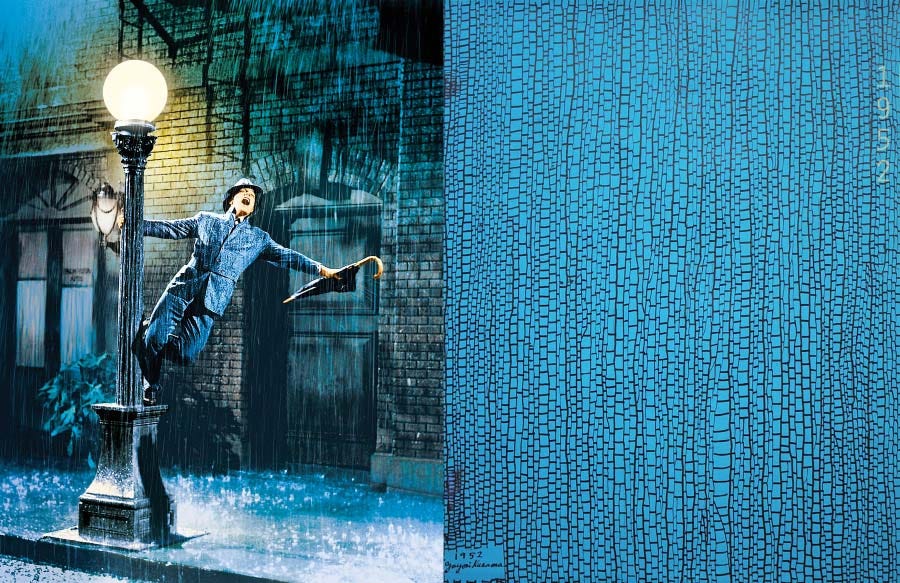
Bonnie Lautenberg, “1952 Singin’ in the Rain - Starring Gene Kelly and Debbie Reynolds, Artist Yayoi Kusama, The Sea” (American University Museum)
BONNIE LAUTENBERG’S “ARTISTICA!” is based on a gimmick, but it turns out to be a pretty effective ploy. The artist juxtaposes a film still and an artwork, both from the same year, linking the two thematically or visually. This show, subtitled “Where Hollywood Meets Art History,” presents 43 of the 90 pairings in the series.
A few of the digital-print diptychs accede to a preexisting connection: Lautenberg’s 1965 time capsule pairs a frame from Antonioni’s Red Desert with a Lucio Fontana slash painting inspired by the film. Some of the duos exploit a comparable vibe, such as the pop-sex figures from 1979: near-naked Bo Derek in 10 alongside a Mel Ramos nude who’s emerging from a candy bar like a convenience store version of Botticelli’s Venus.
Sometimes the kinship is purely graphic, as in the coupling of E.T.’s spindly title character with an angular Basquiat figure, or a still from Singin’ in the Rain next to Yayoi Kasuma’s all-over painting, “The Sea.” Hollywood musicals and Japanese minimalism have almost nothing in common, but they can agree on blue.
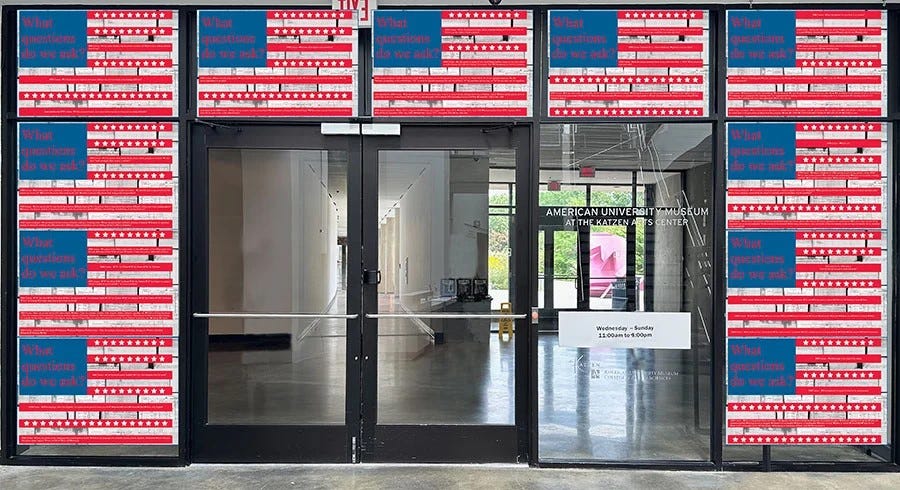
Gail Rebhan, installation of “What Questions Do We Ask?” (American University Museum)
DEMOGRAPHIC CHANGES IN THE UNITED STATES over the last 250 years are mirrored by adjustments in attitudes, premises, and expectations. Gail Rebhan illustrates these with 11 text panels, each with historic queries from the Census Bureau, mounted on windows at the museum’s entrance. “What Questions Do We Ask?” arranges the Census’s shifting concerns into various categories, including race, disability, and native language.
Each set of queries is fitted into the framework of an American flag and printed on individual sheets that can be easier to read than the widow-mounted panels. Viewers can use QR code to ask their own questions, which are posted to the artist’s website (gailrebhan.com/what_questions_do_we_ask/). The effect is, of course, open-ended. However dismal the country’s current state, the American experiment is ongoing.
Ghost in the Machine: Works by Timothy Makepeace
Susan Goldman: Prima Vista
Richard Dana: People, Places, and Otherwise
A. Brockie Stevenson: An American Vision
Bonnie Lautenberg: ARTISTICA! Where Hollywood Meets Art History
Gail Rebhan: What Questions Do We Ask?
Through Aug. 9 at the American University Museum, Katzen Arts Center, 4400 Massachusetts Ave. NW. american.edu/cas/museum