
Corridors of Power
Foon Sham’s wooden sculptures frame inviting passageways. Also: Jacob Kassay’s multi-media dualities; Chris Gregson’s calligraphic abstractions; and much mixed-media assemblage
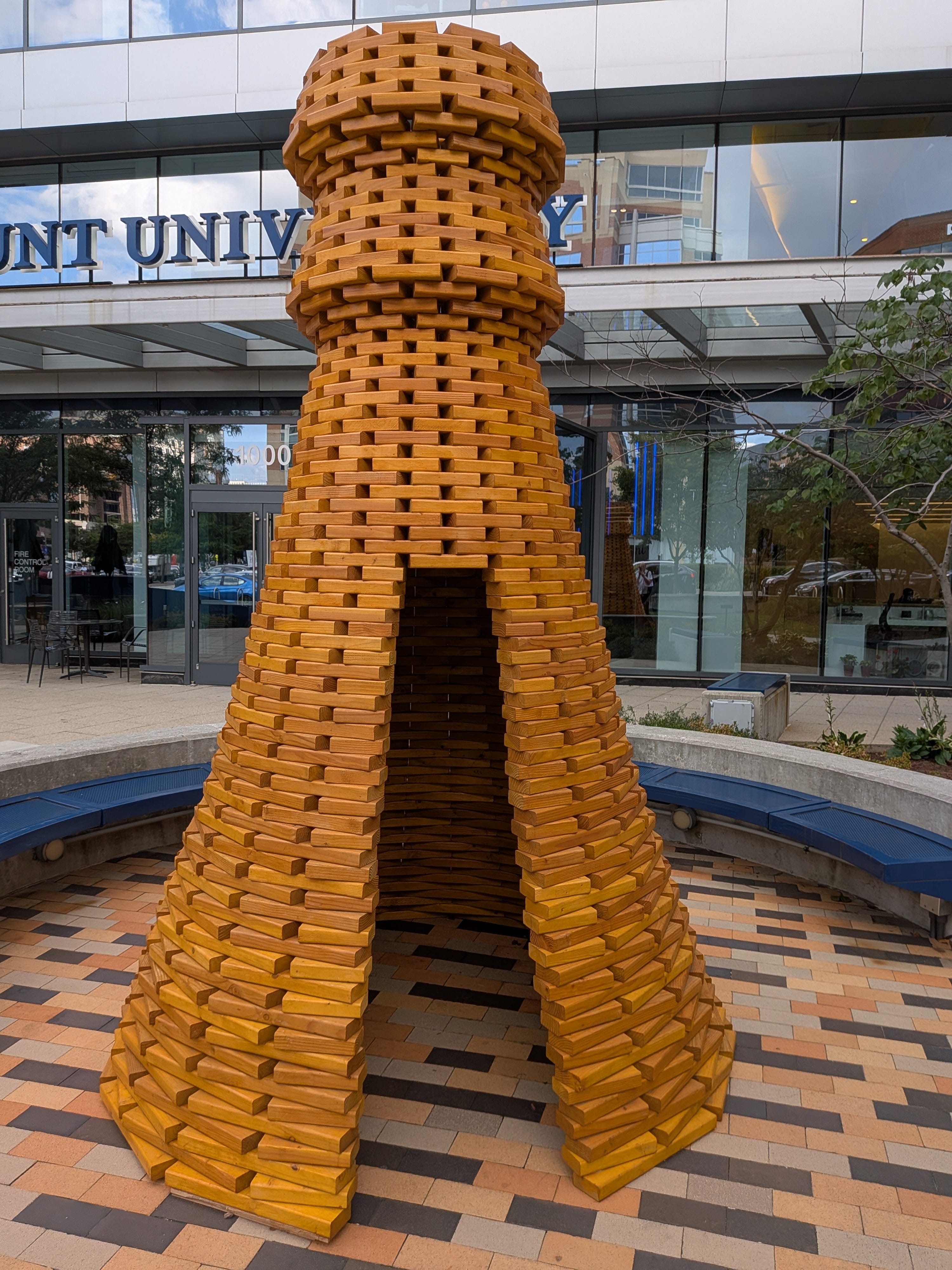
Foon Sham, “Shield” (photo by Mark Jenkins)
CONFINING FOON SHAM’S WORK to a medium-sized venue is challenging, as Cody Gallery’s “Tunnel Vision” acknowledges by placing one of the sculptor’s creations not merely outside the room, but outside the building itself. The local artist’s “Shield” stands in front of Marymount University’s Ballston Center, inviting passersby into the show -- and into the open-centered, kiln-like structure itself. Made of pine blocks, the 10-foot-high construction is a fine (if relatively small) example of Sham’s more orderly style. The hollow spire evokes trees and teepees, brickwork and basket-weaving.
The other towering sculptures exhibited in the show, which was curated by Sarah Hardesty, are represented just by photos, drawings, or small models. Among them is a pastel-and-acrylic rendering of “Ridge,” designed for a nearby Arlington park and a robust demonstration of Sham’s more jagged style. The piece’s craggy arches jab at the sky, providing a vivid contrast to the tidier “Shield.” The sculptor usually works with wood -- occasionally fused with roughly cast metal -- but he doesn’t have a usual way of working with it.
This versatility is one of the lessons of “Tunnel Vision,” which includes small constructions, a sculpted painting, drawings that incorporate tiny wood scraps, and a video of a Christo-like installation on an Uruguayan beach. The title piece is an assemblage of eccentrically shaped wooden panels organized around a small central conduit, with some orange-painted surfaces near the eye-like aperture. Where this piece suggests a view out, more often the sculptor’s creations offer a look in. Whether they resemble wooden edifices or rock canyons, the sculptures often feature a central cavity that beckons the viewer’s gaze inward. These negative spaces can be called “tunnels” or something more exalted, but they’re key to Sham’s vision.
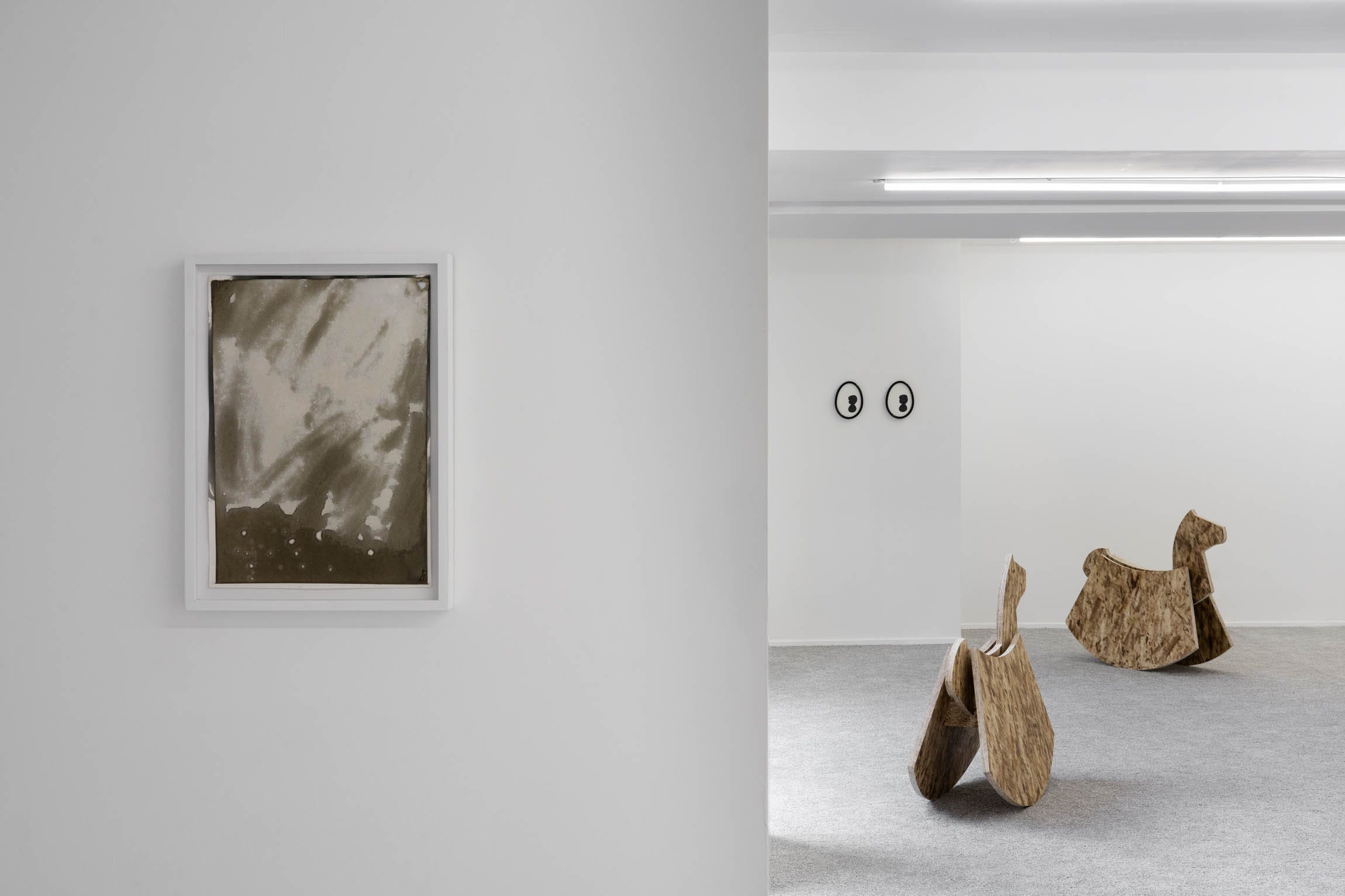
Jacob Kassay, installation view of “Show Yourself” (Von Ammon Co.)
MOST OF THE OBJECTS IN JACOB KASSAY’S “SHOW YOURSELF” evoke childhood, but perhaps they refer more generally to lost innocence. The New York artist’s multi-media show at Von Ammon Co. features four sets of silhouetted children’s heads of the sort that were commonly made before photography became ubiquitous, as well as 3D outlines of rocking horses and headboards made of simulated particle board. (The simple objects’s surfaces are actually photographs of rough wooden textures.)
Also included are five silver rectangles, contained by white frames. These objects resemble mirrors, but are pointedly nonfunctional. As the gallery’s statement notes, “the contours of human experience become ... blurred.”
The show’s most intriguing items are the silhouetted photograms. All are titled “Pupils,” a reference to eyes as well as young students. Similar but not identical, the paired head-and-shoulder silhouettes illustrate Kassay’s observation that “the senses are mostly bicameral.” In three of the duos, both heads face the same way, but in one they gaze at each other, as if contemplating themselves in each other. Three of these stark sets are in stereo, but in this exception to the dominant strategy, two becomes one.
THE EXTREME HORIZONTAL ORIENTATION OF SEVERAL PAINTINGS in Chris Gregson’s “Expedition” immediately suggests landscape. But the heathered color-field pictures in the Northern Virginia artist’s Fred Schnider Gallery show are actually streetscapes of a sort. During several extended stays in Paris, Gregson was inspired by the cursive script of shop signs in the city’s Marais district. This led to partly calligraphic oil-paint abstractions such as “Transition,” in which a flurry of orange strokes appears to float atop a green-and-black field.
Usually the gestures are less distinct, and so densely overlaid that they nearly vanish into the whole. The most thickly patterned picture, “Early,” is almost entirely green, but with more lightly dappled patches where other colors show through.
One of Gregson’s strategies is to acknowledge the borders of his compositions by thinning the brushstrokes near the edges. He also does this at the margins of each section in such lengthy paintings as “Quintet,” one of three mural-like works rendered on four contiguous panels. The result is to add intriguing variations to the overall play of forms and hues, but also to call attention to the process of producing the intricate yet expressionist pictures. These imaginary landscapes come into existence not from seeing, but from making.
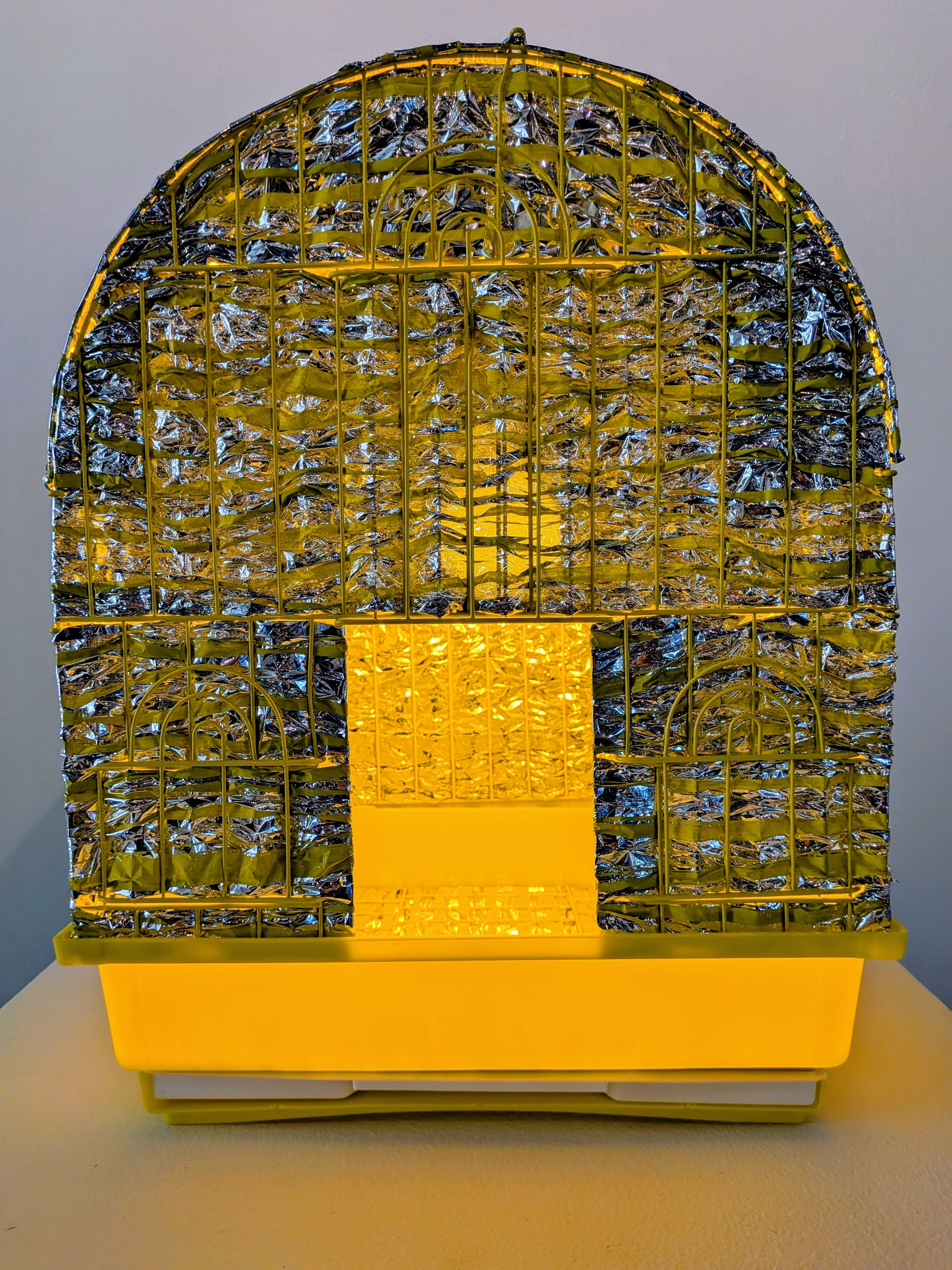
Fabiola Alvarez Yurcisin, “They/Their/Theirs” (photo by Mark Jenkins)
LATIN-AMERICAN HERITAGE UNITES BUT DOESN’T RESTRICT the work of the five local participants in “Puntadas Invisibles (Invisible Stitches),” an exhibition at Brentwood Arts Exchange. Among the realistic offerings are Glory Paredes’s crisp acrylic paintings of people at work in locales that range from agricultural fields to a laboratory, as well as Fabiola Alvarez Yurcisin’s cast-cement sculpture of battered water jugs. But the latter’s other contributions are less realistic, as are pieces by Gerardo Camargo, Irene Clouthier, and Sandra Pérez-Ramos.
Curated by Wilfredo Valladares, the show is heavy on mixed-media assemblage. Three of Alvarez Yurcisin’s offerings are repurposed birdcages, each in a separate color scheme, wrapped in a silvery emergency blanket, and lighted from within. The illumination turns these modest combines into enticing beacons. Camargo similarly transforms found objects, often from local construction sites, into early-modernist-style 3D collages whose glittery regions are actually found sandpaper. Clouthier’s pieces include a globe wrapped in colorful vinyl strips and two large painted PVC keys inscribed with a single fraught word. (The ones here read “love” and “future.”)
There are sculptural assemblages among Pérez-Ramos’s five pieces, but the most striking ones are mixed-media drawings of cosmologies derived from African and indigenous-Caribbean myths. These pictures are appealingly bold, bright, and forceful. They’re also a reminder that Caribbean culture itself is a sort of assemblage.
In Brentwood’s other gallery is an eclectic retrospective, “Appalachian Fall: Drawings and Poetry by Jack McMichael (Michael) Martin.” The writer and artist (1936-2023) is represented by wall-mounted poems and prose, but also by a large drawing studded with glass shards from a car windshield. On one wall is a slide show of photographs and drawings keyed to a soundtrack of Martin’s poems set to music by his son, Alex Martin, who lives in Prince George’s County. As cars rush past on Rhode Island Ave., music and images offer a sense of Martin’s remote alpine life.
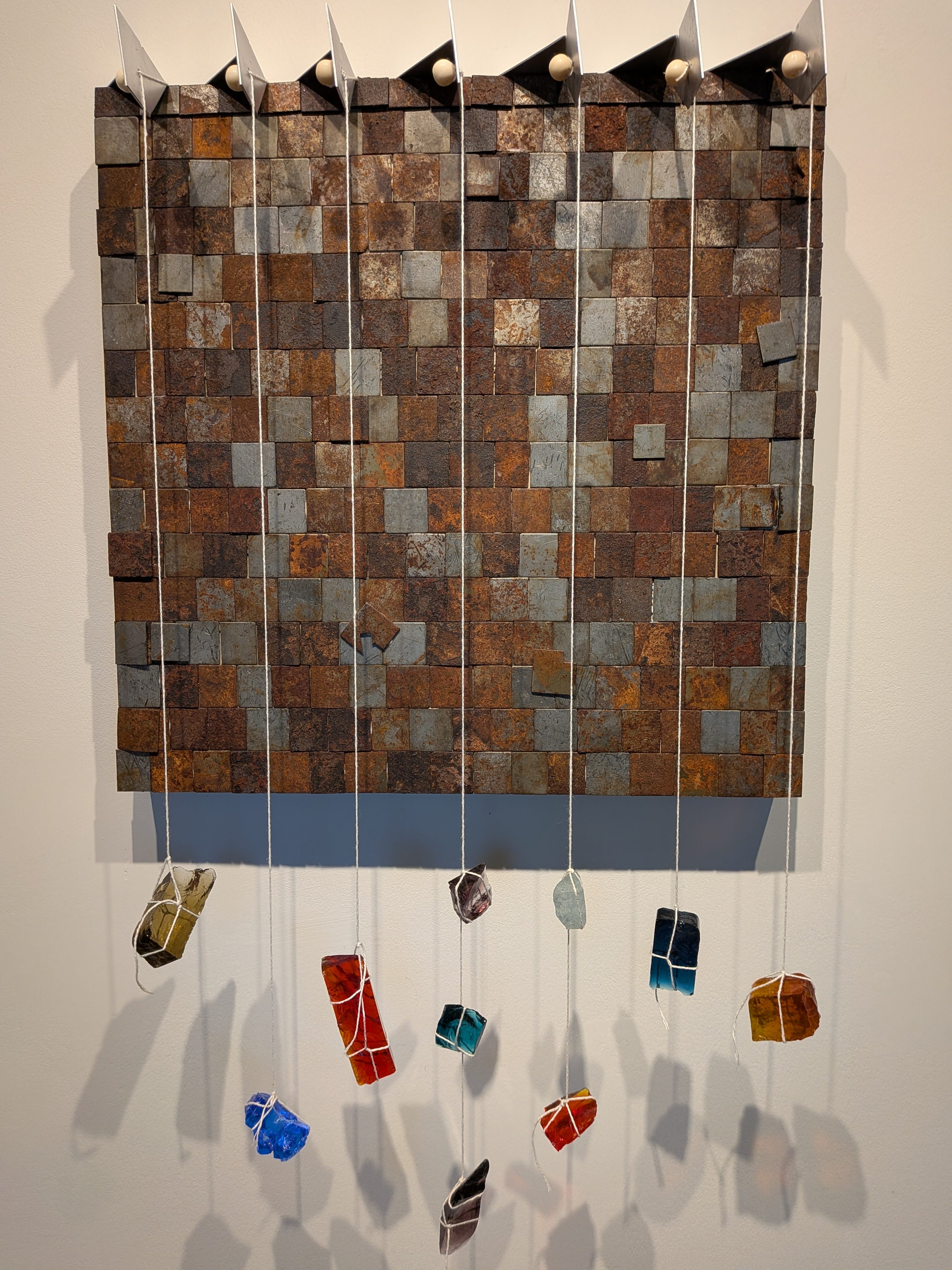
Timothy DeVenney, “Near-at-Hand #1” (photo by Mark Jenkins)
STAINED GLASS REINVIGORATES ABANDONED TOOLS in Timothy DeVenney’s “Near-at-Hand,” a show of modestly scaled mixed-media sculpture at Portico Gallery at Studio 3807. The D.C. artist juxtaposes glass rondels in various hues with old saws, drills, and other hand-powered devices. The circular glass pieces turn the other objects from functional into decorative, and also enchant their immediate surroundings by producing small pools of colored illumination.
DeVenney’s other light touch is to dangle some of the ingredients, found parts that include hanging chandelier crystals and a glass drawer pull. One of the bulkiest collages is the wall-mounted “Near-at-Hand #1,” whose main element is a patchwork of metal squares in different shades of silver and copper. From the heavy-metal checkerboard hang 10 chunks of rock and glass that cast delicate shadows on the wall beneath the sculpture, while the colored-glass slabs catch the sunlight. Light and shadow contrast industrial materials so effectively that all that’s solid appears very nearly to melt into air.
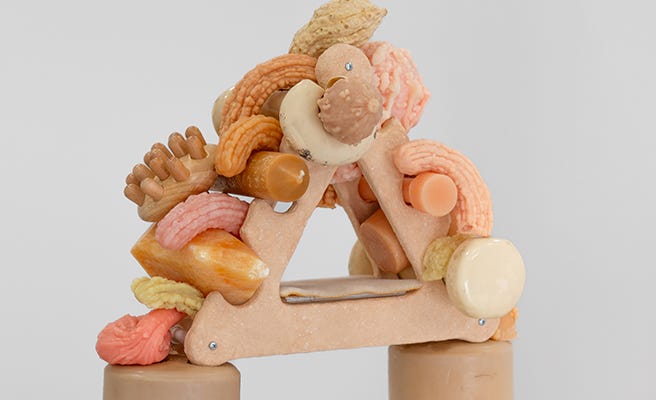
Danni O’Brien, “Sad Beige Pyramid Scheme” (VisArts)
JUGGLING MINIMALISM AND ABSURDISM, Danni O’Brien grafts abandoned consumer products into sculptural assemblages. As seen in VisArts’s “Toning Systems,” the Baltimore artist’s fabrications can be ungainly. But O’Brien usually combines objects of a single color or in a close range of hues, which gives the resulting contraptions a certain visual rigor. The exhibition also features three line drawings that present the artist’s purposeless hybrid devices as if they’re inventions potentially worthy of patents.
As the show’s title hints, most of the original items were made for athletic activities or cosmetic effects. The ingredients of the 3D collages include weights, a thigh master, a yoga ball, hair curlers, an ergonomic back supporter, and a diagram from a 1970 patent for a bust enhancer. Such gadgets for enhancing the human body have now been gathered into “cyborgian creatures” -- according to Maura Callahan’s essay on the artist’s work -- with possible existences beyond their intended purposes. Those existences, however, are just whimsical fantasies. Some of O’Brien’s gizmos look as if they might be useful, but they’re actually all form and no function.
Foon Sham: Tunnel Vision
Through Oct. 25 at Cody Gallery, Marymount University Ballston Center, 1000 N. Glebe Rd., Arlington. marymount.edu/academics/college-of-business-innovation-leadership-and-technology/school-of-design-and-art/cody-gallery/ 703-522-5600.
Jacob Kassay: Show Yourself
Through Nov. 2 at Von Ammon Co., 3210 Grace St. NW. vonammon.co. 202-893-9797.
Puntadas Invisibles (Invisible Stitches)
Appalachian Fall: Drawings and Poetry by Jack McMichael (Michael) Martin
Both through Oct. 25 at Brentwood Arts Exchange, 3901 Rhode Island Ave., Brentwood. pgparks.com/facilities/brentwood-arts-exchange. 301-277-2863.
Chris Gregson: Expedition
Through Oct. 27 at Fred Schnider Gallery of Art, 888 N. Quincy St., Arlington. fredschnidergalleryofart.com. 301-852-8042.
Timothy DeVenney: Near-at-Hand
Through Oct. 25 at Portico Gallery at Studio 3807, 3807 Rhode Island Ave., Brentwood. portico3807.com. 202-487-8458.
Danni O’Brien: Toning Systems
Through Oct. 26 at Concourse Gallery, VisArts, 155 Gibbs St., Rockville. www.visartscenter.org. 301-315-8200.