
Black Power
A Black History Month show is more about essence than events, and Tim Davis converses. Also: Horizon lines, hard and soft; printmakers (and photographers) go big; nature as metaphor or as science
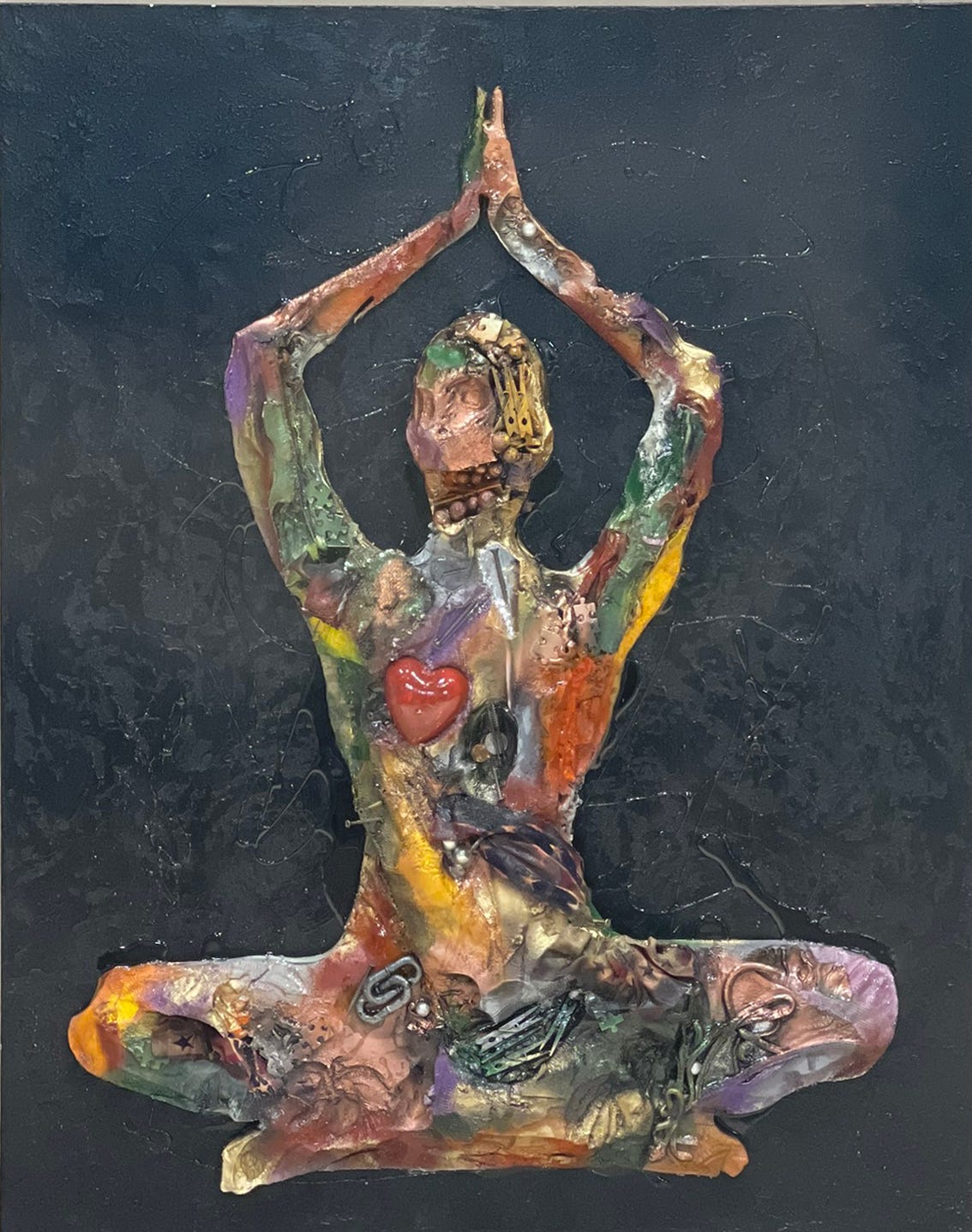
Reggie Gillumo, “Art of Meditation” (Zenith Gallery)
BLACK HISTORY IS MORE PRIMAL THAN INDIVIDUAL in Zenith Gallery’s 23-artist salute to Black History Month. There are renderings of notables from Black American history in the work of Ashley Joi, including a portrait of Frederick Douglass with 3D hair, made by the artist in collaboration with her teenage daughter. But these historical pictures also incorporate flowers, leaves, and vines that link them to Joi’s better-known paintings, fantastic visions in which people merge with plants.
That Black history is rooted in soil -- whether African or American -- is a principle also expressed by Chris Malone’s playful collage-sculpture, “Branching Out,” in which leaves emerge from a mythic creature’s sleeves and vines emerge from his head. An elemental connection between trees and humanity is always implicit in the sculptures of Bernie Houston, who somehow extracts people from pieces of found driftwood that he partly carves, then finishes with deep-hued paint.
Equally vegetal is “The Green Man,” one of two talismanic relief sculptures by Anne Bouie, whose head is wreathed by yellow-edged green leaves. “Green Man” and its engrossing companion piece, “The Dark Sacred Night” -- both tall enough to play in the NBA -- are imposing and mythic. The latter’s impassive face sits within a halo of black-painted clam shells, suggesting that Black identity was born from the sea as well as the earth.
More painting than sculpture, but still chunky with found objects, are Reggie Gillumo’s relief studies of single figures, whether meditating or making music. The artist employs metallic pigments that complement the many small steel objects encompassed by the thick pigment. Again, the pieces evoke a sense of emergence from a larger environment, becoming singular while retaining fundamental material.
Anyone who’s familiar with Zenith’s art-packed walls will understand that not all the work fits the themes discussed above. There’s more straightforward work in a variety of modes, from conventional portraits to decorative abstraction. But the idea of germination, whether physical or psychological, unites many of the strongest pieces.
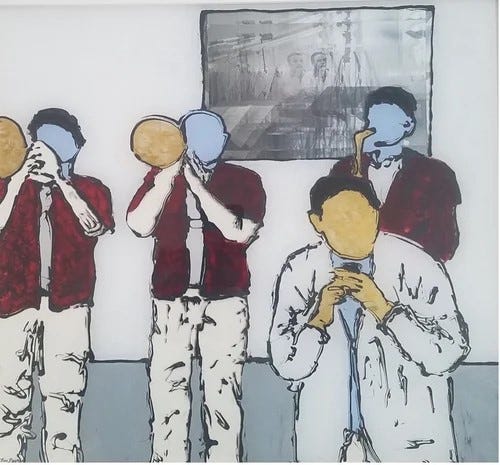
Tim Davis, “Dedicated to ‘Q’ ‘‘ (courtesy of the artist)
ARTHUR ASHE, FELA KUTI, AND QUINCY JONES INSPIRED three of the collage-paintings in Tim Davis’s show at Fred Schnider Gallery of Art, but the pictures are not literal portraits. Most of the local artist’s recent work depicts multiple people in some sort of dialogue, which is why the exhibition is titled “Conversations.” A few of these interchanges are depicted at an art gallery such as International Visions, which Davis ran from 1997 in 2019 in Woodley Park.
The artist’s worldview is indeed international, and one of the pieces commemorates a trip to Malawi. As is typical of these pictures, the main image was rendered on clear acrylic, which permits layers of imagery and regions of transparency. The drawn and painted figures are usually faceless, distilled primarily to line and color. Behind them may be a map, a swirl of color, or the photographs that sit at the lower level of “The Memory of the Smiles of Africa,” the Malawi-recalling picture. The conversations Davis symbolically documents are among people and cultures, but also among contrasting visual elements.
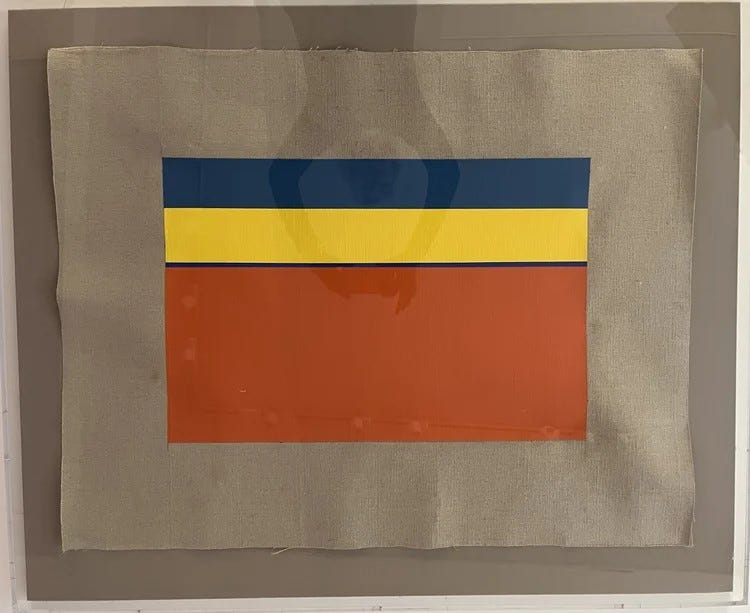
Arleen Cheston, “Looking Beyond” (Watergate Gallery)
ACCORDING TO MANY OF THE 35 CONTRIBUTORS to Watergate Gallery’s current show, “Beyond the Horizon” is not a literal location. There are more than a few landscapes and several cityscapes in the wide-ranging selection, but also pure abstractions.
Of the lines that center compositions, some are wavering and drawn by nature itself, like the bisecting ribbon of sunlight in Julienne Clevenger’s elegantly chiaroscuro “Amelia Island Beach Sunset.” Intriguingly, two artists executed a similar idea but with very different results: Paul Cunningham’s “Twilight Sky, Provincetown” and Arleen Cheston’s “Looking Beyond” are both hard-edged stripe paintings on rolling canvases that hang softly to curl the geometric forms. But the former is vertical in pink and purple, while the latter is horizontal and defined by an expanse of unpainted linen.
The landscape itself is under threat in Anamario Hernandez’s precisely rendered “Global Warming,” in which nature blooms inside a central circle but cracked-earth desolation looms beyond it. Fabric-like patterns extend from people to their urban habitat in Helen Zughaib’s “Blue City,” packed with stripes and checkerboards that are flat yet conjure depth. Angela Iovino’s closeup painting of eggs and shells turns breakfast into a landscape, while Antonia Ramis Miguel partly abstracts boat sails into Cubist-style triangles.
Of the sculptures, the most striking is Alex Kasten’s “Opposing Curves,” two intersecting swoops of green-painted wood fixed in a sort of dance. With this piece, the visible horizon changes with the viewer’s vantage point. The same is true of Leslie Harris’s pigment and cold-wax painting, “A Remembrance of Things Past,” an all-over abstraction whose mottling of gold, green, and red shifts toward the last color at the bottom. There’s no “beyond” in this complex picture, just an near-infinite within.
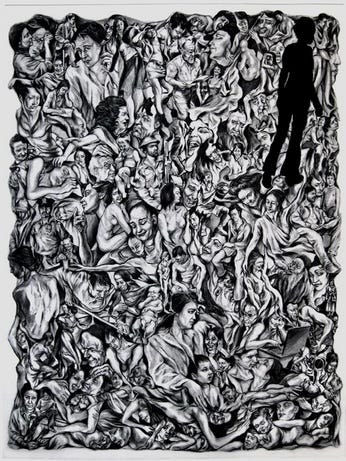
Matina Marki Tillman, “Density,” (Washington Printmakers Gallery)
JUST AS MOST PRINTS ARE MADE FROM MYRIAD SMALL LINES, many of the large pictures in Washington Printmakers Gallery’s “Big” consist of a series of images. The most intricate example of this is Deborah Schindler’s “Tic-Tac Tango X’s and O’s,” a black-and-white linocut in which 18 silhouetted couples dance inside one of those two letters. The composition is contrived with near-mathematical precision, while the sense of human motion is lively and playful. Even denser, but clumped rather than charted, are the dozens of people in Matina Marki Tillman’s also black-and-white “Density,” which depicts a Brueghel-like tumult.
Among the other suites of a sort are two floral arrangements: Nina Muys’s pretty “Life Force,” a three-plate print of various flowers, and Rosemary Cooley’s less naturalistic “Quattro Fiore,” executed in red and gray with touches of gold. From its aerial perspective, trees in fall colors look like flowers in Claire Wright’s photograph, “Firework,” which is bisected by a curving road that suggests a line drawn in the landscape.
Several of the multi-part pictures, all abstract, emphasize their individual components by pushing them into the third dimension. Ron Meick cut earth-toned prints into slices, fitted them on wooden slats, and overlapped the pieces in a jazzy jumble that reveals lots of white wall. Barbara Bitondo’s mostly black-and-white array of multiple prints and cyanotypes is suspended freely inside a glass-covered case. A photograph of a tree anchors Suzanne A. Bartlett’s multi-layered piece, which is overlaid with printed gauze.
There’s also a hint of a hanging banner in Kristine DeNinno’s scratchy-textured two-plate print of a red-and-yellow vertical panel on a gray-green field. The energy flows similarly, but horizontally, in Susan Wooddell Campbell’s monoprint, whose grainy colors are accented with colored pencil. Both pictures take their power less from size than from their swirling sense of movement.
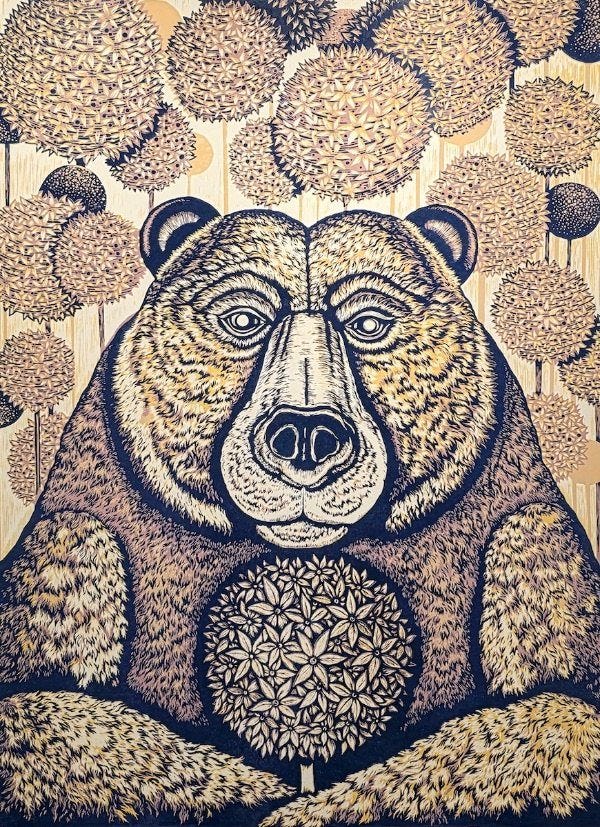
Jun Lee, “100 Days of Prayer” (IA&A at Hillyer)
TWO ROOSTERS WHO PROCLAIM “FREE DC” are among the newer creatures in Jun Lee’s menagerie, as glimpsed in “Unbreakable Elements,” the local artist’s show at IA&A at Hillyer. A virtuoso of reduction woodcuts, Lee has shown her work at many local venues. Many of the images in this exhibition were seen at Artists & Makers about six months ago, although not necessarily in the form they assume here. Lee varies the menu by offering the original plywood masters of some prints, and by remaking a previously exhibited print -- depicting another rooster -- as a cast-glass sculpture.
For those who haven’t previously encountered Lee’s whimsical and impressively detailed work, this show is a fine introduction. It includes one of the printmaker’s best known prints, “Whisper and Wait,” in which a group of delicately haired rabbits contemplate a moon that appears as fuzzy as they are. Lee writes that her work depicts “competition in our society” and “the pressures of survival.” Yet her animals are so lovingly rendered that they seem to be enjoying charmed lives.
Plants rather beasts dominate Calliandra Marian Hermanson’s “of permutations and patterns,” on exhibit in the adjacent gallery. The Baltimore printmakers’s style is visually compatible with Lee’s, but her approach is more scientific. There are slides of microorganisms, a shelf of books, and a notebook for visitors to add suggestions. Riffing on the ways that botany and printmaking developed, sometimes in tandem, Hermanson splits simple outline pictures of plans across more than two dozen sheets of paper. However wildly nature grows, humans can’t resist fitting the results into an orderly grid.
Black History Month
Through Feb. 28 at Zenith Gallery, 1429 Iris St. NW. zenithgallery.com. -202- 783-2963.
Tim Davis: Conversations
Through Feb. 28 at Fred Schnider Gallery of Art, 888 N. Quincy St., Arlington. fredschnidergalleryofart.com. 301-852-8042.
Beyond the Horizon
Through March 7 at Watergate Gallery, 2552 Virginia Ave. NW. watergategalleryframedesign.com. 202-338-4488.
Big
Through March 1 at Washington Printmakers Gallery, 1675 Wisconsin Ave NW. washingtonprintmakers.com. 202-669-1497.
Jun Lee: Unbreakable Elements
Calliandra Marian Hermanson: of permutations and patterns
Through March 1 at IA&A at Hillyer, 9 Hillyer Court NW. athillyer.org. 202-338-0680.