
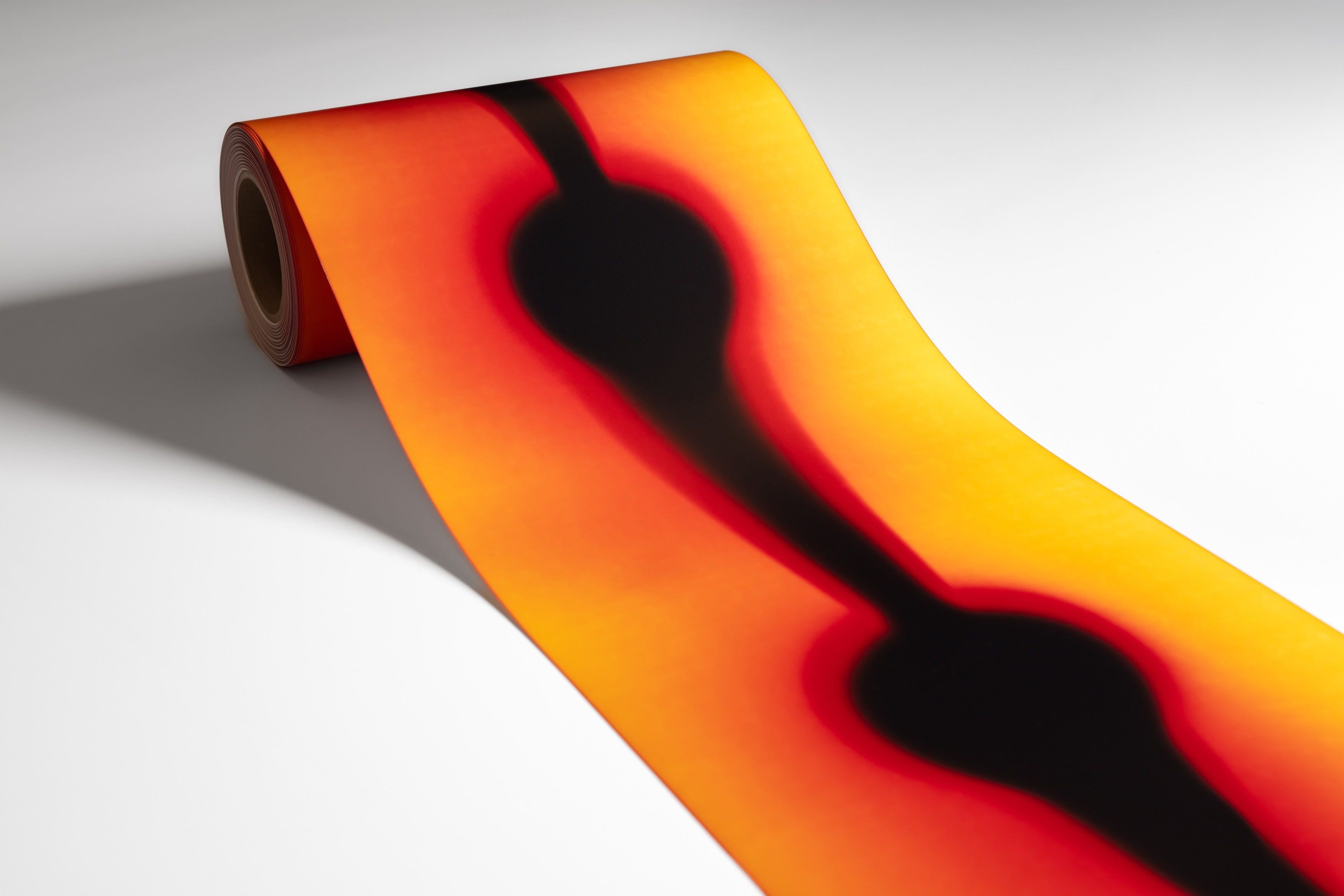
Kei Ito, “Sungazing Scroll” (Phillips Collection)
MOST OF THE 56 WORKS in “Tomorrow the Sun Will Rise: The Phillips Collection Juried Exhibition” are not explicitly political. But the impetus for the show is revealed by one of its requirements for participating artists: that their work date from after November 2020, the month Americans learned that Donald Trump would return to the White House. The introductory wall text says nothing about this, but it does begin with lines from a defiantly hopeful samba Chico Buarque wrote while enduring Brazil’s 1964-1985 military dictatorship.
The show, curated by Tie Jojima and Tsedaye Makonnen, drew submissions from 1,500 Washington-Baltimore artists. The organizers selected 48 participants, about half of whom are often shown in D.C. galleries, with multiple pieces chosen by a few of them. The contributions were divided into five themes -- gazing, archiving, challenging, processing, and experimenting -- that are flexible enough to encompass video, photography, textile pieces, and a soundscape. There are even a few paintings.
In his remarks at the press preview, museum director Jonathan P. Binstock said that the show continues the Phillips’s original dedication to living artists. But the selection demonstrates how much art -- and the Washington area -- has changed since Duncan Phillips’s day. Where the Phillips originally collected art by Europeans and European-influenced Americans, “Tomorrow” includes work by participants rooted in Africa, Asia, and the Middle East. Most of it has little to do with the museum’s founding aesthetic.
Thus one of the show’s highlights -- and one of five pieces from the show that the museum has acquired -- is Kei Ito’s “Sungazing Scroll,” the Baltimore artist’s latest meditation on his grandfather’s survival of the A-bombing of Hiroshima. The eerie orange-and-black photogram consists of 108 panels, a number derived from Buddhism’s teaching that 108 worldly desires must be overcome to achieve enlightenment.
Non-Euro culture and personal identity are common motifs. Quezon City-born Thea Canlas offers four hanging miniature brooms wrapped in a human hair, which is widely exported from the Philippines. Alexandra Chiou’s wispy 3D collage-painting was inspired by a trip to Taiwan, her father’s birthplace. Sharon Cheuk Wun Lee’s engraved aluminum panel is based on postcards that reminded her of Hong Kong. The backdrop of Nami Oshiro’s primary-colors portrait of a woman is a traditional Okinawan pattern. Two paintings by Paloma Vianey in her trademark style depict her native Mexico within the confines of a partly zipped jacket. Negar Ahkami uses painted fabric to simulate Persian ceramics.
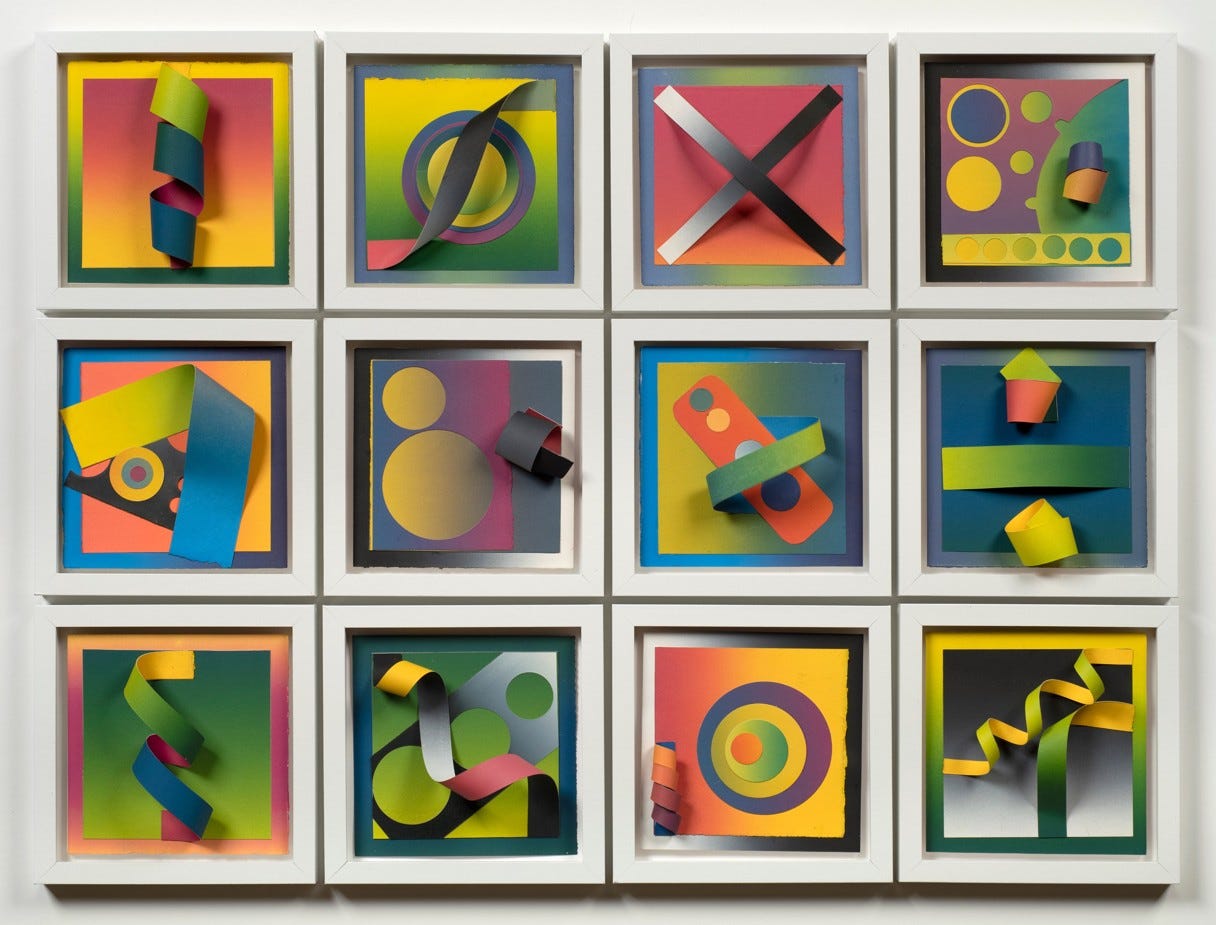
Gail Shaw-Clemons, “Shorthand Revisted” (Phillips Collection)
Several pieces are parables of oppression. Savannah Faith Jackson’s curtain-flanked ocean video evokes the middle passage of enslaved Africans to the Americas. Mojdeh Rezaeipour’s video installation was inspired by women’s protests in Iran. Adam Chamy’s small paintings on pages from a Orientalist Victorian adventure novel attempt to reclaim his Palestinian heritage. In Aynex Mercado’s fiber picture, a submerged Statue of Liberty struggles to survive a devastating storm.
While Gail Shaw-Clemons’s 12-panel sculptural collage-print is a tribute to her mother’s work as an IRS clerk-typist, its brilliant hues and precise forms place it in the older Phillips tradition. Also formally powerful are Mary Early’s veil of fragrant beeswax bars, strung together and hung in closely positioned vertical strands, and Alexandra Silverthone’s photograph of interlocking New Orleans trees, a picture softened by submersion in Mississippi River water. The latter is, of course, not purely imagistic; it’s also a warning about climate change.
Ironically, the entry that is most directly connected to the Phillips is Ringo Lisko’s text piece, whose letters were painstakingly written with dust and debris collected at the museum. The resulting banner, stark and minimalist, could hardly be less like the colorful paintings for which the Phillips is known. But it neatly represents contemporary practitioners’s desire to commune, however humbly, with an institution that helped shape American visual culture.
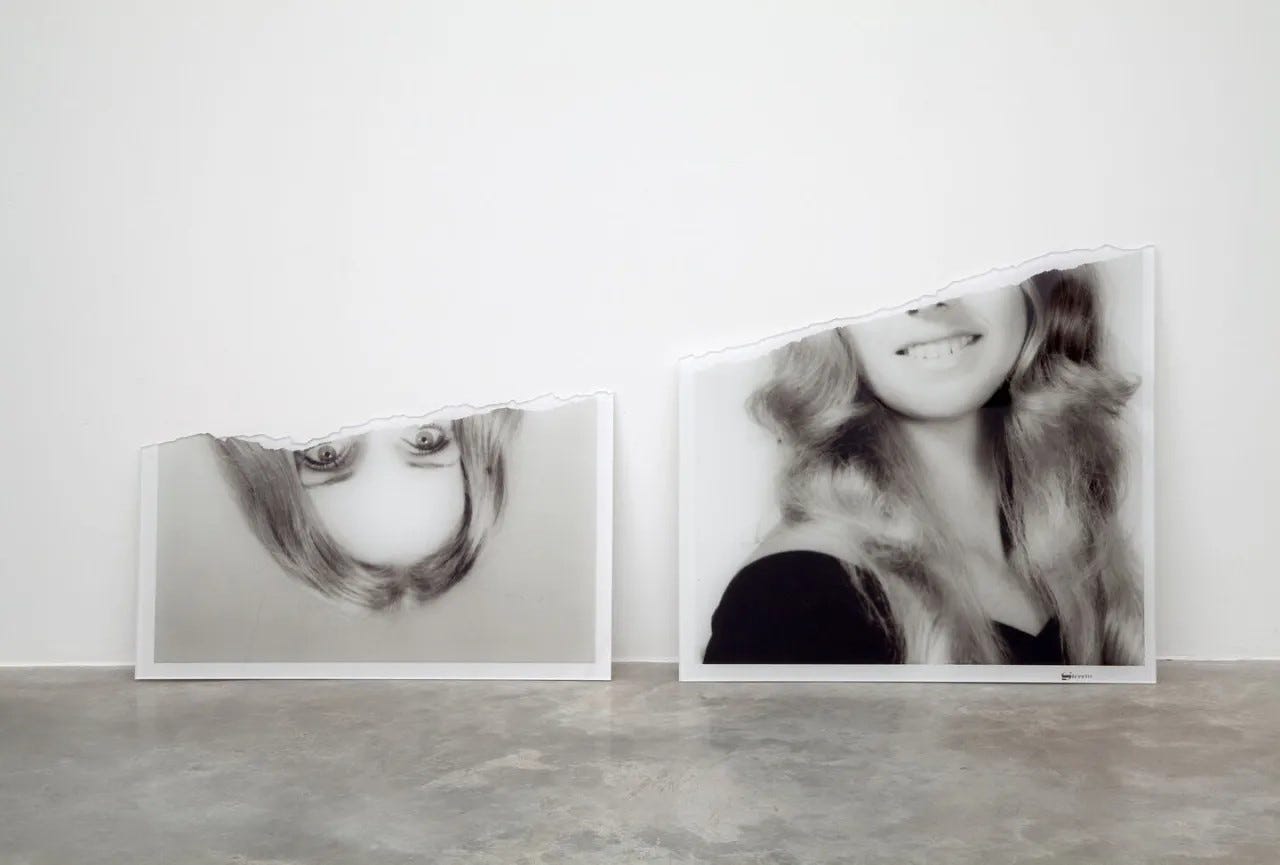
Marlo Pascual, “Untitled” (National Museum of Women in the Arts)
ALTHOUGH TRAINED AS A PHOTOGRAPHER, Marlo Pascual ultimately came to make pictures by remaking existing pictures. The artist is sometimes grouped as a member of the “pictures generation” -- alongside Cindy Sherman, Barbara Kruger, and Sherrie Levine -- but she pushed toward sculpture in her later work. Several of the pieces in the National Museum of Women in the Arts’s “Making Something out of Something” incorporate found objects or minimalist 3D wooden elements.
Pascual lived just 47 years, dying of cancer in 2020. The 17 untitled artworks in this show were made between 2009 and 2014 and are from the museum’s permanent collection, having been donated by Tony Podesta or Heather and Tony Podesta. All are based on photographs Pascual found or purchased, and most begin with bland black-and-white images of the faces of unknown women.
Many of these faces have been sliced, shattered as if made of glass, or overlaid with a second picture that seems to lessen the importance of the countenance. The show’s central gallery offers eight variations on the same portrait, upstaged by such prosaic things as celery, ducks on water, or a spider in its web. A second room contains large photos, also of faces, that have been cut or torn apart. The pieces are reassembled or juxtaposed in ways that emphasize the rupture. One picture looks like a yearbook photo of a young woman; the top third of her head has been ripped from the rest and placed upside down adjacent to the rest.
The final gallery contains the sculptural pieces, two of which forgo faces for other body parts, such as clothed leg and a hand with a finger that points to black board that’s titled against the wall and leaning against the photo. The leg connects to the other work, since it’s one of the images superimposed on that portrait given eight different contrasting overlays.
It’s easy to see Pascual’s work as a commentary on the objectification of women, especially when she places such everyday domestic items as an illuminated lamp squarely atop the image of a woman’s face. But in interviews the artist stressed her interest not in social commentary but in disrupting staged, artificial photos and activating them with various tactics. Cleaving an old photo was a means of opening it up to new life.
Tomorrow the Sun Will Rise: The Phillips Collection Juried Exhibition
Through Sept. 20 at the Phillips Collection, 1600 21st St. NW. phillipscollection.org. 202-387-2151.
Marlo Pascual: Making Something out of Something
Through Feb. 28 at National Museum of Women in the Arts, 1250 New York Ave. NW. nmwa.org. 202-783-5000.