
Animal Spirits
Multiple facets of Joan Danziger’s art at the AU Museum. Also: textiles that talk, or bedeck horses
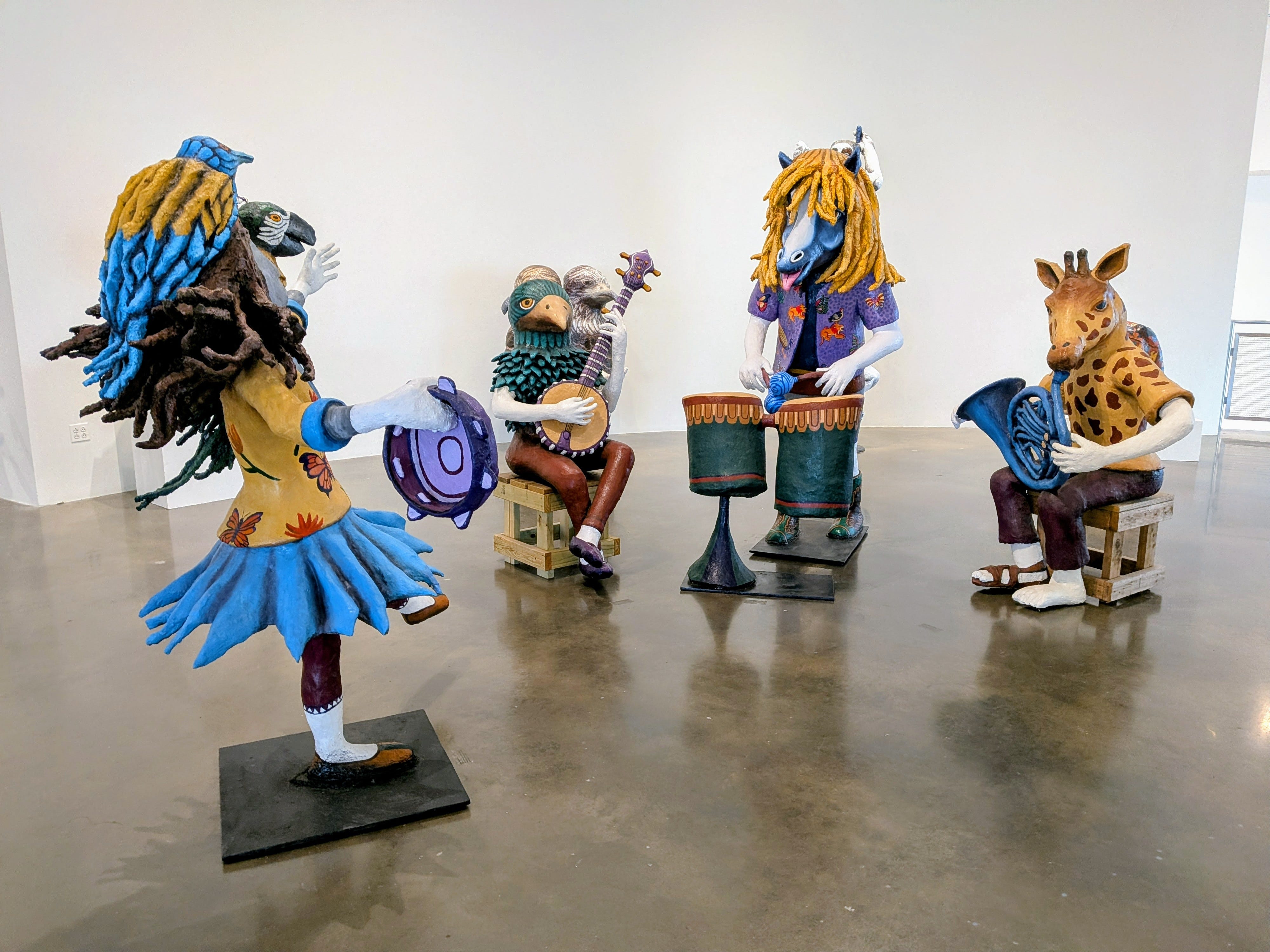
Joan Danziger, “Sunshine Girl Love Band” (photo by Mark Jenkins)
JOAN DANZIGER HAS TWO DIFFERENT SHOWS currently at the American University Museum. Or, one might say, two different Joan Danzigers have shows currently at the museum.
The larger of the exhibitions, both of which were curated by museum director Jack Rasmussen, is “The Magical World of Joan Danziger,” a wide-ranging retrospective. It includes many of the whimsical, human-sized sculptures for which the 91-year-old D.C. artist is known. But the selection also reveals her earlier work, reaching as far back as 1958, a decade before the New York City native relocated to Washington.
While all of Danziger’s art could be categorized as surrealist, her pre-1968 drawings and paintings are starker and sometimes more grotesque. The artist’s best-known pieces suggest children’s-book illustrations that wriggled off the page and grew into towering mixed-media sculptures. She began, however, in a more ominous mode. The pre-D.C. pieces feature some of the same visual motifs as the later ones, but are rendered in a severe style that appears more indebted to European precursors. (One of her influences is Lenore Carrington, the British surrealist who spent much of her life in Mexico, where she explored themes both psychological and mythological.)
Many Danziger sculptures take the form of anthropomorphisized animals, some of whom look like creatures freed from an old-fashioned merry-go-round. So it’s intriguing to encounter the artist’s 1958 painting, “Carousel,” in which some people ride a merry-go-round while others dance in a circle in front of it. Save for a few owls, all the figures in the picture are human, and are naked. The painting is not confrontational, but it is wilder than the animal-musicians of “Sunshine Girl Love Band,” all of whom are fully clothed.
In addition to hybrid animal-humans, Danziger’s mostly peaceable kingdom is full of trees, flowers, musical instruments, bicycles, and scooters. Much of her imagery is fanciful: A rhino transforms into a tree, a basket of fish perches incongruously amid a large sculptural flower arrangement, and ceremonial statues of cats dominate a diorama of an Egyptian-style temple. Yet the overall impression is of pleasant daydreams, not nightmares.
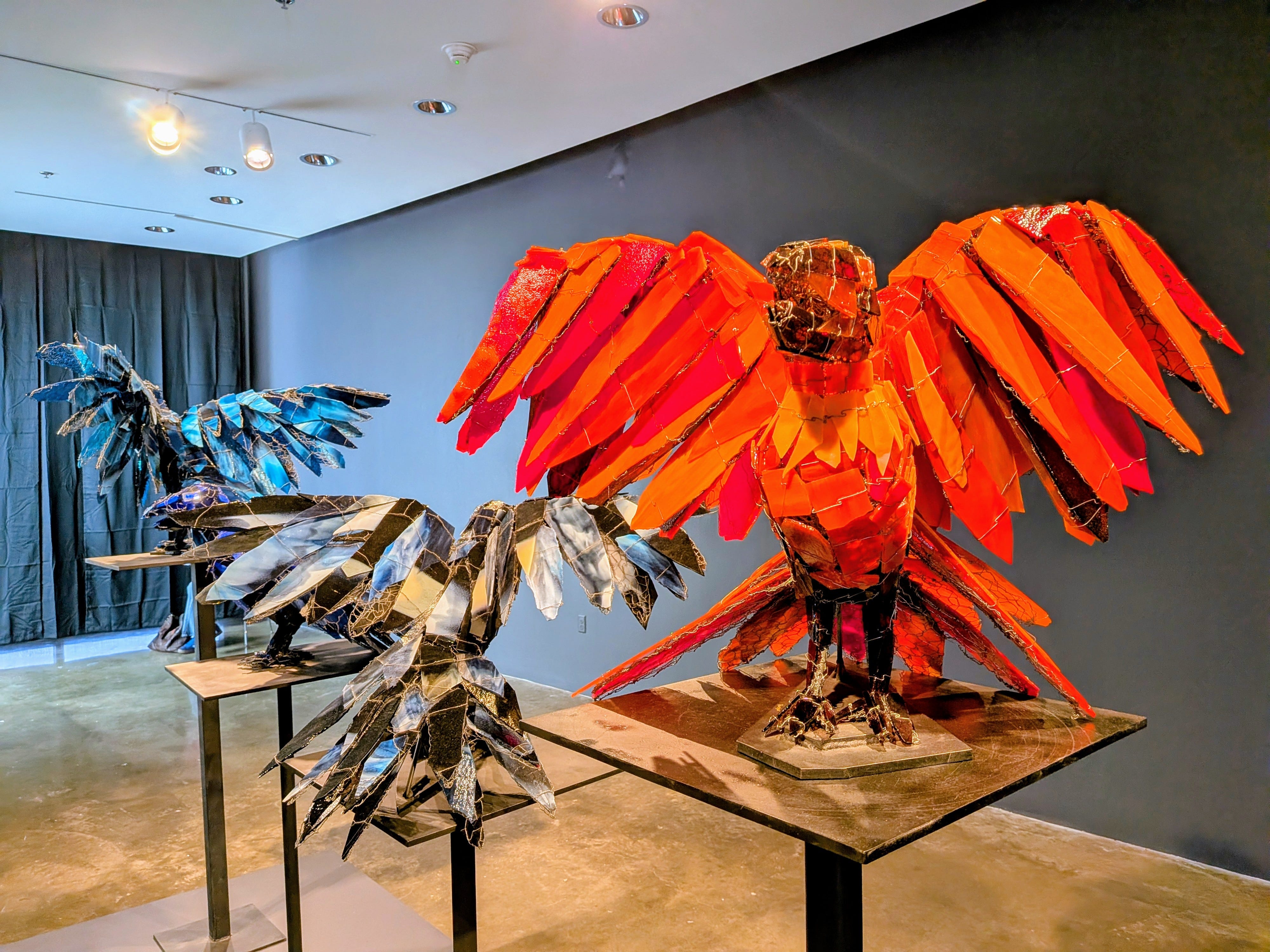
Joan Danziger, “Inferno” and other ravens (photo by Mark Jenkins)
Gallery goers probably won’t immediately notice some of the most recent works, oversized beetles constructed of glass shards. They’re mounted high on the wall, almost out of sight. These glimmering insects are cousins to the hard-edged sculptures in the adjacent show, “Ravens: Spirits of the Sky.” Made between 2023 and 2025, the birds represent a far more feral breed of fantastic beast than the artist’s scooter-riding bird or sousaphone-playing giraffe.
Like Danziger’s earlier sculptures, the ravens are built on wire armatures. But the skeletons of her trademark creations are covered in clay or fiberglass, which is rounded and painted to give the statues a cozier aspect. The ravens are made of sharp, jagged pieces, usually in a single color or a narrow range of similar hues. These red, blues, and greens are luminously unnaturalistic, even when they’re dark enough to approach the ebony of an actual raven’s plumage.
The artist has called ravens “demons of death,” and this fierceness is sometimes conveyed by the prey in their mouth: doomed frogs and beetles, also made of glass, are clenched in resolute jaws. The ravens use their mouths to kill, not to play music.
The ravens are edgier than the artist’s best-known sculptures. They’re also more beautiful. Whether perched or suspended in midair, the birds catch, refract, and intensify the light. The resulting sparkle complements the potency of the ravens’s forms, which are elegant yet craggy. Danziger’s demons of death bristle like assemblages of glass daggers, giving them a sense of menace that is entirely welcome.
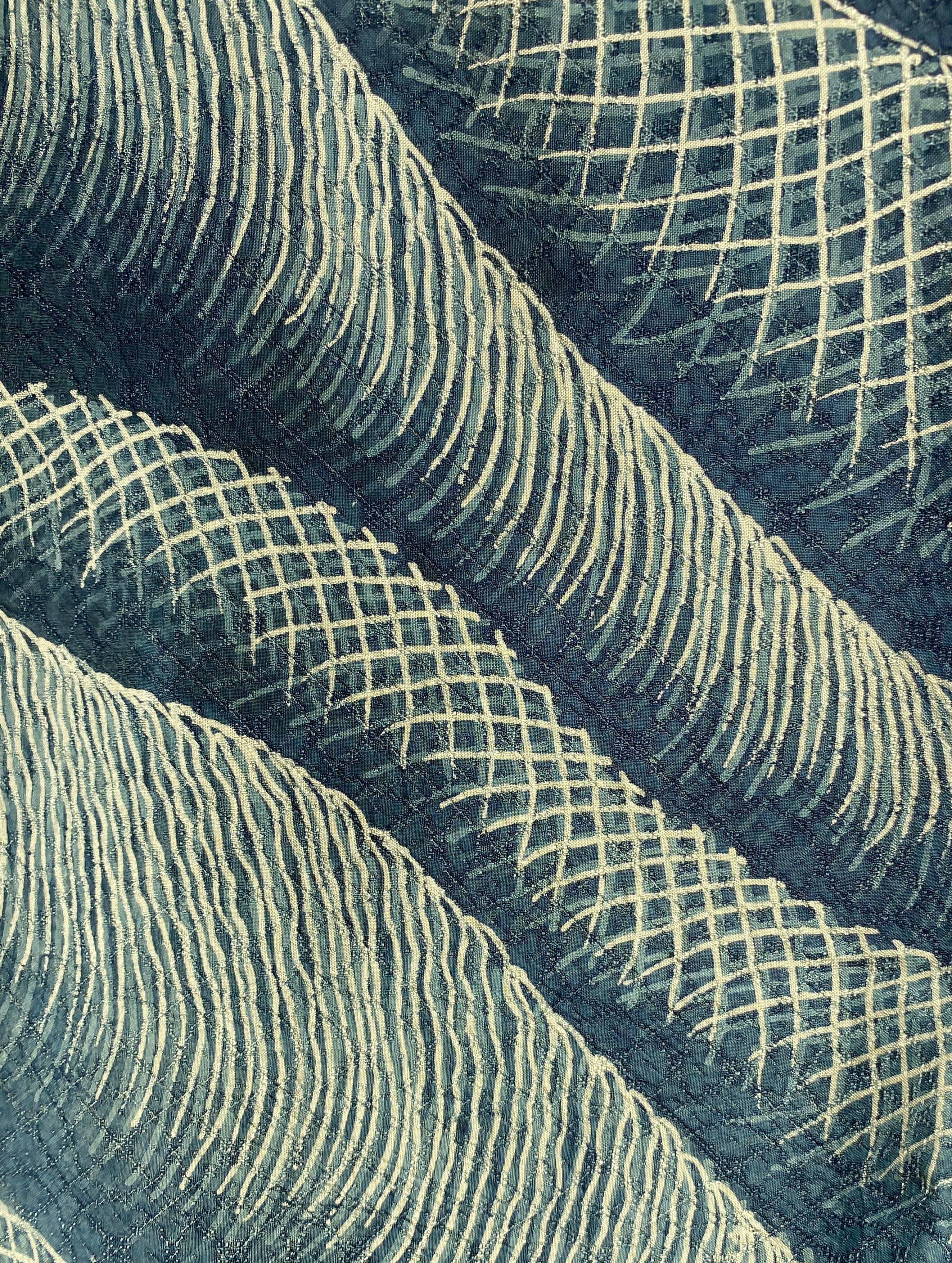
Dudung Alie Syahbana, “Ombauk Laut” (Amy Kaslow Gallery)
PATTERNS ARE INHERENT IN TEXTILES, since they’re constructed from individual fibers. Such motifs can be barely noticeable or fundamental, and examples of each approach are included in Amy Kaslow Gallery’s “Folk Art Is Fine Art: Textiles that Talk.” This wide-ranging show offers fabric art by 22 artists or collectives from Asia, Africa, and Latin America. Much of the work resulted from the efforts of organizers or groups who seek to better the lives of vulnerable women.
The talking that these pieces do is mostly rhythmic, but the selection includes some narrative imagery, as well as designs with supernatural intent. One notable example of the latter is a cosmic banner made by Turkish and Armenian artists led by Mehmet Çetinkaya. This dynamic piece features a magic eye meant to protect girls and women.
Basic needlework can become embellishment, as in the traditional Bengali pieces made at Basha, which employs 120 at-risk women. In quilts made of repurposed saris, colorful target shapes are accented by regularly spaced white stitches, simple and inexorable. In a much more affluent country, Japan, Tsuyo Onodera takes a more free-form approach to stitching together worn kimonos, with beautifully battered results.
The show’s palette is mostly earthy, so the blue figure in a reverse-applique piece by Panama’s Guna Artists is strikingly unexpected. The color suggests water, an elemental source of found patterns and endless variations. This is the explicit inspiration for Dudung Alie Syahbana’s “Ombauk Laut (Ocean Waves, Blue),” an example of Javanese batik on silk. Like so much of this show, the piece appears rooted in tradition and yet contemporary.
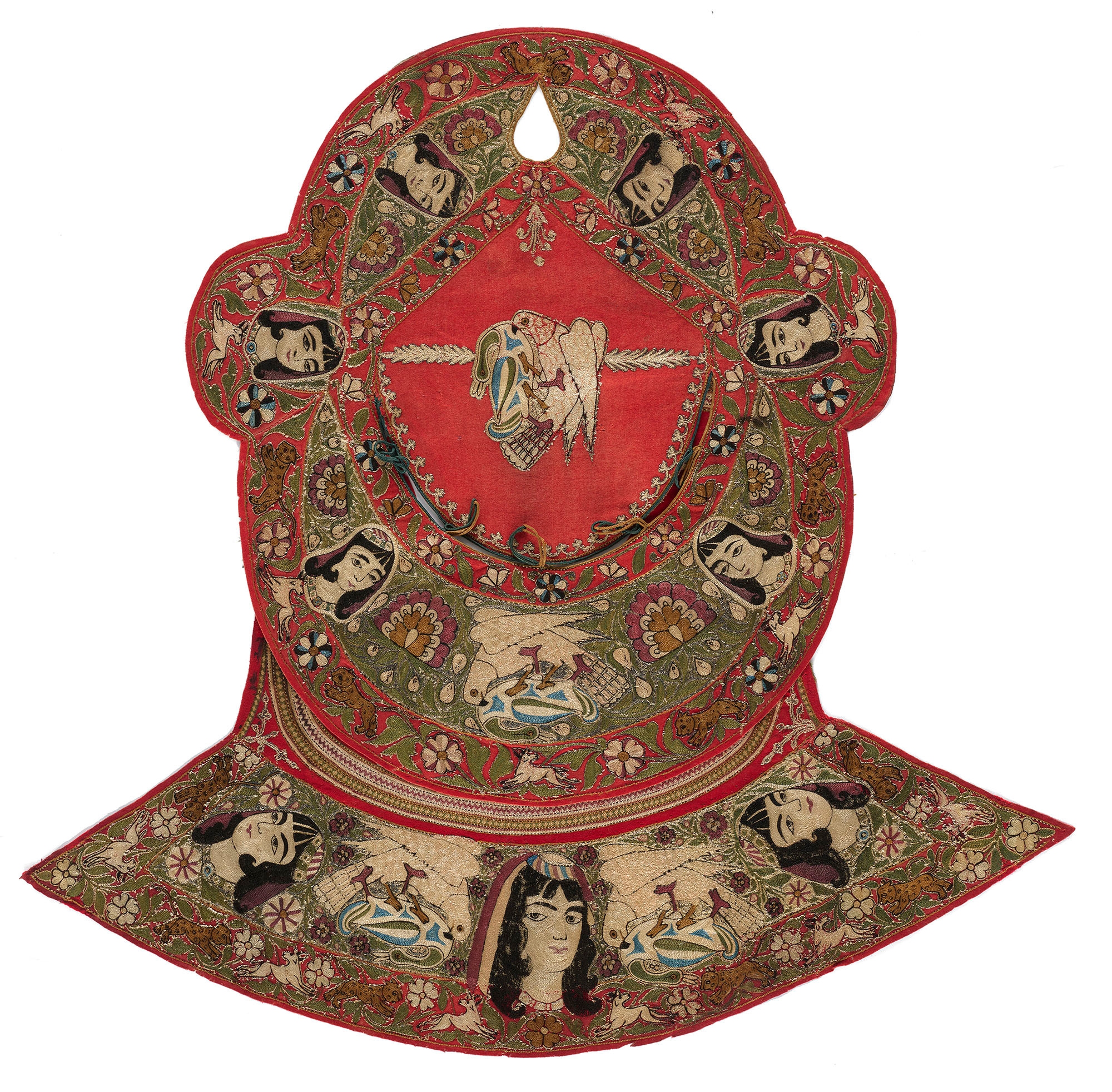
Saddle cover, Iran, 1800-1825 (The Textile Museum Collection)
AMONG THE ITEMS PRODUCED BY ÇETINKAYA’S WORKSHOP is a depiction of “storm catchers” on horseback, rendered flatly yet energized by vibrant hues. This piece is “Textiles that Talk’s” only representation of the creature at the center of “Adorning the Horse: Equestrian Textiles for Power & Prestige.” The latter exhibition, at the George Washington University Museum and the Textile Museum, includes two life-sized 3D horses, but they’re just mannequins whose purpose is to showcase a few of the more than 60 saddle covers, horse covers and blankets, and related objects on display.
Two aspects of the exhibition are timely, although only one of those is by the design of co-curators Lee Talbot and Sumru Belger Krody: According to the Asian zodiac, this is the year of the horse. The other is less auspicious: The largest number of objects, 19, is from currently embattled Iran. (Tibet is second with 17.)
Textiles are fragile, so most of the items date from the 19th century or later. Yet the assembled rarities include one exceptionally antique horse cover, made in central Asia between the fifth and seventh centuries. The faded piece is not the most colorful thing on display, but its intricate design intriguingly features not just horses but other creatures, some of them far from naturalistic.
Many of the design motifs seen here are abstract, probably in large part because of Islam’s proscription on depicting sentient beings. But a Chinese robe -- made for rider, not steed -- sports a dragon, and a blue Japanese “rump cover” is decorated with white rabbits in reference to a much-told folk tale. Such embellishments suggest that the horse was prized not only for its strength and endurance, but also a symbol of mankind’s interconnection with all of nature.
The Magical World of Joan Danziger
Joan Danziger: Ravens: Spirits of the Sky
Through May 17 at the American University Museum, Katzen Arts Center, 4400 Massachusetts Ave. NW. american.edu/cas/museum
Folk Art Is Fine Art: Textiles that Talk
Through April 5 at Amy Kaslow Gallery, 7920 Norfolk Ave., Bethesda. amykaslowgallery.com.
Adorning the Horse: Equestrian Textiles for Power & Prestige
Through June 20 at the George Washington University Museum and the Textile Museum, 701 21st St. NW. museum.gwu.edu. 202-994-5200.