
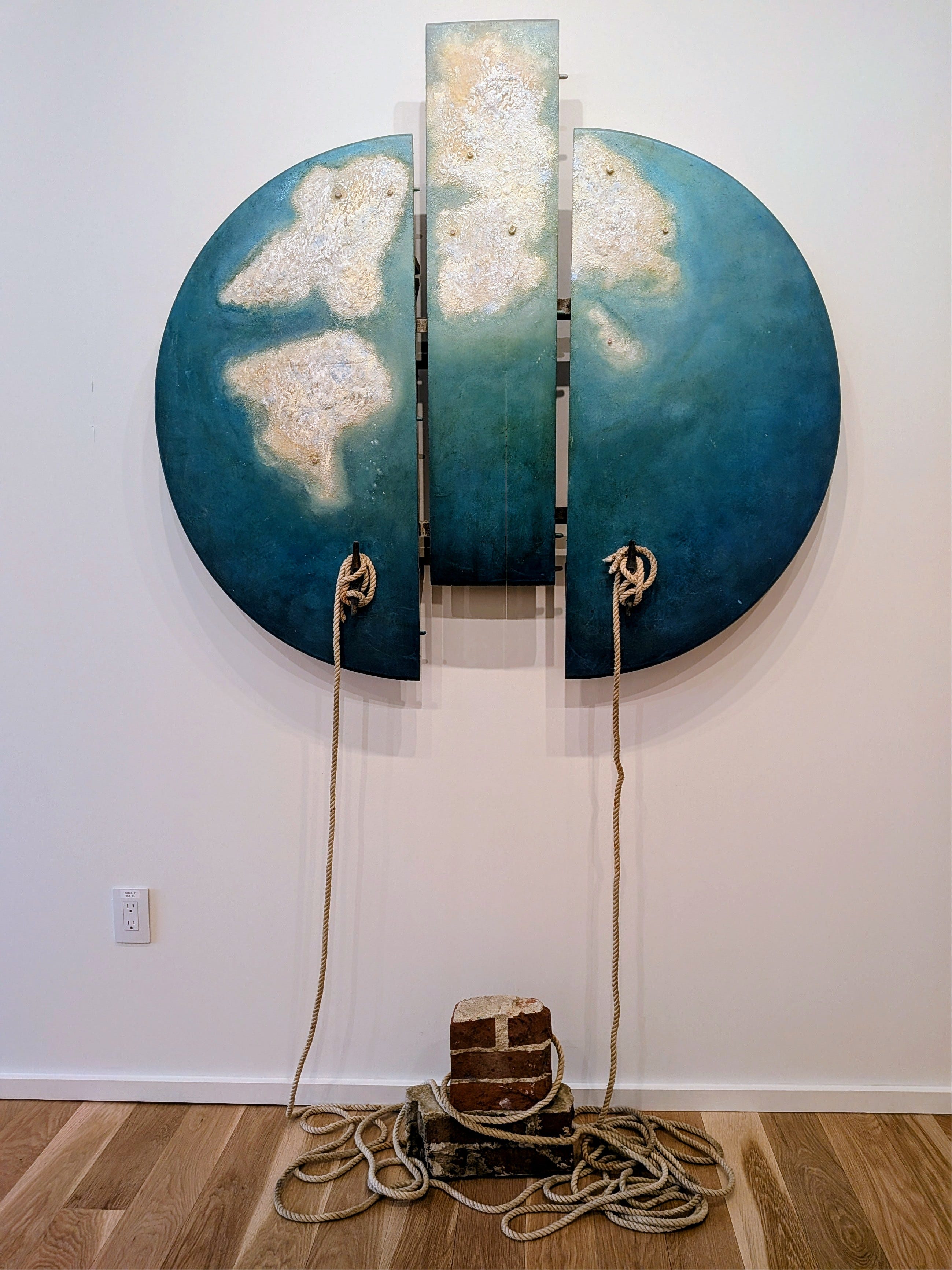
Ellington Robinson, “On the Oracle” (photo by Mark Jenkins)
ELLINGTON ROBINSON IS A GEOGRAPHER OF SORTS, but the territory he charts is as much psychological as physical. The D.C. artist, who teaches at two local colleges and spends part of his time in the Virgin Islands, makes mixed-media drawings and paintings that sometimes incorporate found objects or escape the picture plane entirely. One key to his immaculately executed work is the title of his Spilt Gallery show, “Place Time - A Marronage.” Marronage was a term for the escape of enslaved people of African origin, who formed communities in remote areas, notably but not exclusively in the Caribbean region.
Two large drawings the artist calls “architectonics” actually look more like topographics, albeit imaginary ones. These elaborate graphite renderings are embellished gently by ink, colored pencil, and tiny plastic discs. The pictures seem partly abstractions, partly aerial views of mountainous territory. The vantage also looks to be straight down in “Atlantic Ouroboros,” which could depict a craggy coast and the adjacent ocean, vivid blue edged in green. “Akwamu,” whose liquid forms center on a collision of gorgeous mineral tones, ruby and turquoise, appears even less literal. But it’s named for an actual place, an empire that arose in the 17th century in what is now Ghana.
More than a decade ago, Robinson had a show at Project 4 Gallery (a precursor of the new Spilt) whose landscape-like abstractions were punctuated by patterns that resembled railroad tracks. One of the apparent inspirations for his recent work seems to be sailing ships; several of these pieces incorporate ropes and cleats, perhaps to anchor themselves in the world.
The largest of these moored pieces is the elegant “On The Oracle,” a rounded wooden semicircle form painted blue with cloud-like patches of white. The construction is sliced into three parts, with the center portion elevated as if in the process of escaping. Cleats are attached to the two side pieces, and ropes tether them to a stack of bricks. If this is a vision of the world’s coming apart, it’s a very tidy one. Whatever alarms Robinson may deliver, his craftsmanship is eminently reassuring.
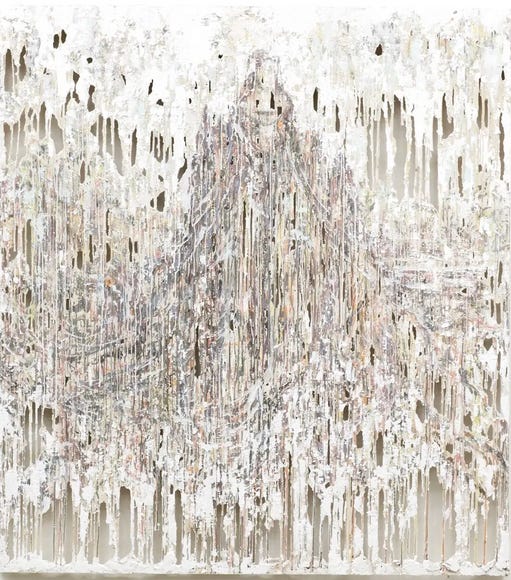
Diana Al-Hadid, “Lionless” (de la Cruz Gallery)
THE SENSE OF ENTERING DIANA AL-HAHID’S WORLD is literal at the multi-media artist’s show at Maria & Alberto de la Cruz Gallery, “unbecoming.” A large ragged archway bisects the gallery, so that visitors must travel through the Brooklynite’s realm of lacy, seemingly unraveling forms. Al-Hadid produces prints and sculptures, but most of the pieces in this show are made of paper and fabric pulp, sometimes reinforced by steel and fiberglass. These apparently fragile constructions appear to be clumping and dissolving at the same time.
The latter process is one meaning of “unbecoming,” which can also refer to things that are inappropriate or unattractive. The term is a rebuke that has commonly been directed at women, whose status is an essential theme of Al-Hadid’s art. Among the mythical and literary figures she depicts -- so loosely as to be abstract -- are Scheherazade, said to have saved 1,001 women’s lives by spinning tales to distract a murderous king.
Al-Hadid was born in Syria, and moved to the United States when she was five. In addition to exalting Scheherazade, the artist invokes the land of her birth with a bronze of a jasmine plant, Syria’s national flower. Not all of Al-Hadid’s cultural references are to the Middle East, however. Two of her pictures loosely portray Medusa, the goddess of Greek myth long considered a monster but more recently claimed as a feminist icon. A print and a mixed-media assemblage are based on a 1475 German-Flemish allegorical painting in which a woman’s chastity is shielded by a mountain and guarded by lions.
One of Al-Hadid’s riffs on this 15th-century canvas is aptly titled “Lionless.” There’s a lot of “less” in the artist’s work, much of which is characterized by cracks and voids and partly drained of color. This show, which was organized by the Eli and Edythe Broad Art Museum at Michigan State University and curated by Assistant Curator Rachel Winter, has an almost geological feel -- it’s full of crags and chasms. But these features aren’t just exercises in sensuous disarray. They’re also expressions of historical gaps and psychic breaches.
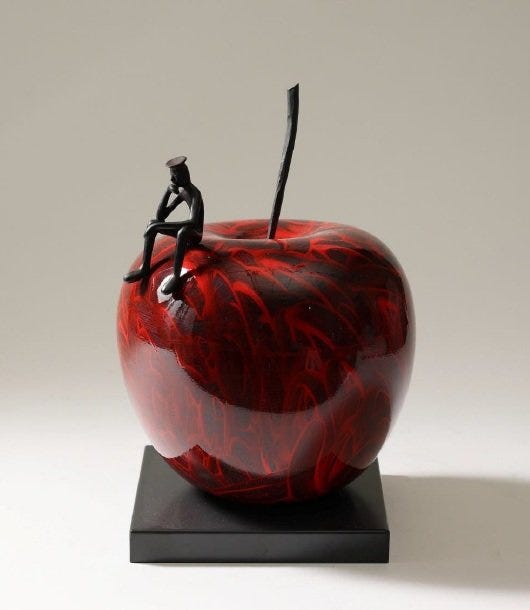
Hwang Nam Kyu, “Sweet Dream” (Korean Cultural Center)
AN ANTHOLOGY OF SLIGHTLY EERIE TOY STORIES, the Korean Cultural Center’s current show combines child-like enthusiasms with high-tech precision. The six contributors to “Transcending Boundaries: Discovering Contemporary Korean Artists” often depict as hard-edged icons such soft things as apples, flowers, and hearts. Even Sung Jin Min, whose abstractions attempt to convey sensations and the nature of time, makes loose paintings that are composed so tightly that they suggest Roy Lichtenstein’s pop-art parodies of expressionist brushstrokes.
Even tighter are the brightly colored pictures of Park Jae Young, who renders a world whose every object -- candles, smiley faces, soft ice cream -- appears to be knitted of wool. Similarly, Shin So Young paints wings, often furled into the shapes of hearts, in a mode that is both elegant and cartoonish. Equally meticulous but more surreal are the pink-heavy oils of Kim Min Jeong, whose principal subjects seem to be flowers, but ones that sometimes have doll-baby faces.
Hwang Nam Kyu is a sculptor whose painted-metal apples sport a high-gloss finish that resembles the sleek surfaces furnished by the show’s three representational painters. Like Kim Min Jeong, Hwang insinuates a human presence, posing small stick-figure people on the gleaming but sometimes intentionally flawed fruit. They’re dwarfed by the apples, but seem more oblivious than intimidated.
Human faces gaze out from some of Kim Jing Wuk’s holograms, the show’s least traditional artworks. The smallest of the venue’s three galleries is darkened and devoted entirely to these green-tinted, two-layer artworks, which complement the other five artists’s juxtaposition of realism and unreality. Appropriately, one of the holograms depicts a toy robot. For all the grown-up sophistication of these artists’s styles, childhood seems central to their outlooks.
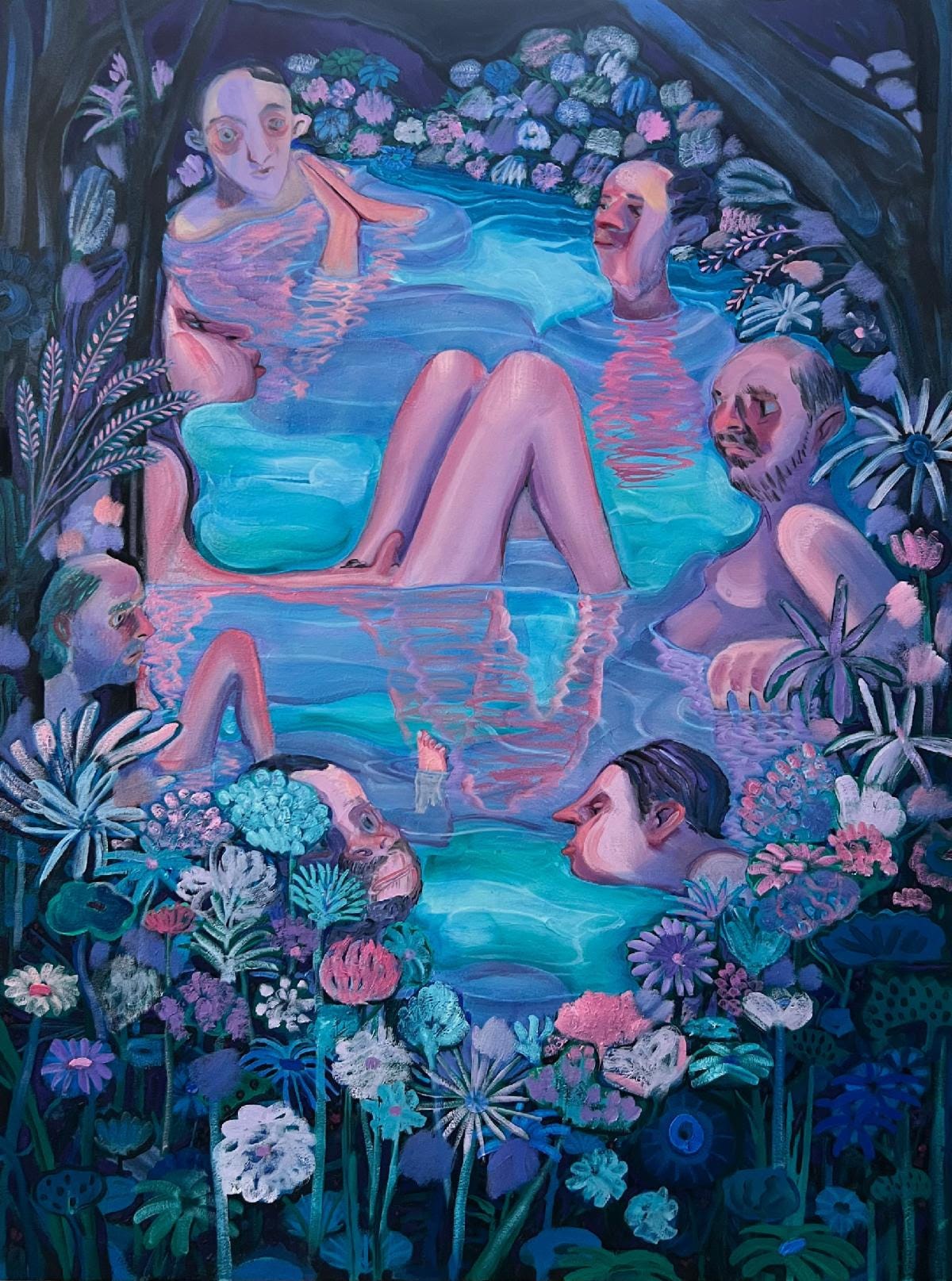
Jason Sho Green, “Secret Society” (Morton Fine Art)
THE DOMESTICATED FAUNA THE JAPANESE CALL “SALARYMEN” seek nature in Jason Sho Green’s recent paintings. The pictures in “This Is a Garden and We’re All Flowers,” Green’s Morton Fine Art show, are partly transcendental and partly satirical. Inspired by his stints in corporate jobs, the Japanese-American artist depicts besuited men who sprawl in clearings, perch in tree canopies, and attempt to shake hands with branches.
These jokey scenarios lampoon contemporary urbanites’s ambiguous relationship with the natural world, but also demonstrate a Shinto-like reverence for skies, woods, and mountains, and especially bathing spots in the wild. In “Secret Society,” a half-dozen naked figures lounge in a forest pool, their pink flesh gleaming in turquoise water. Green often keys his paintings to shades of blue, which range from the light aqua of “Hideaway” -- another pool party -- to numerous nighttime scenes whose blues tick toward midnight.
The artist, who lives and works in upstate New York, paints loosely in a style that occasionally suggests Matisse. His figures are cartoony, and sometimes appear to grow out of an elementary pattern: The rubbery man at the center of “Flower Power” can be seen as an extension of the curling stripes on his pants. But then curving lines, whether of a tree’s trunk or an elaborate series of switchbacks, are typical of Green’s compositions. The artist was previously an electrical engineer, so it seems telling that his paintings contain so few straight lines. Green’s curvilinear images, just like his forests and ponds, are a form of escape.
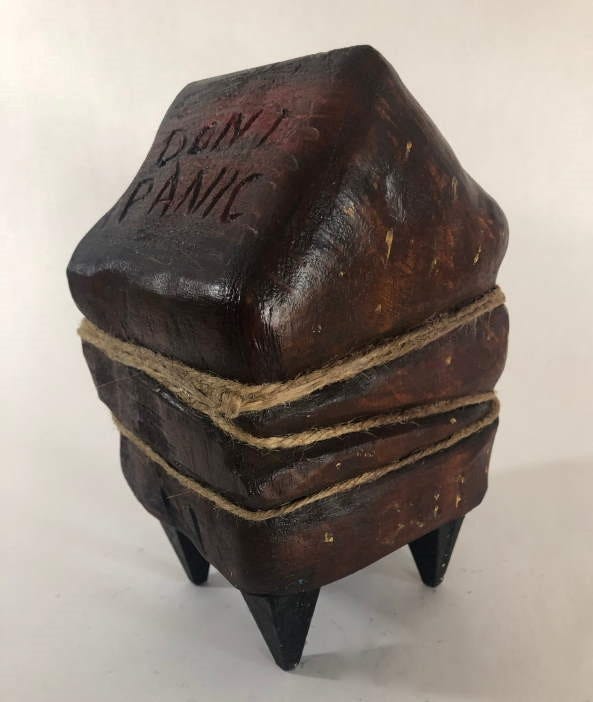
Linda Atkinson, “Housebound” (Zenith Gallery)
SHOWS AT ZENITH GALLERY ARE MERE RIPPLES in the ocean of art that fills the jam-packed venue. That’s especially true of the current “48th Anniversary Exhibition,” which contains work by about 60 artists. Many of these will be familiar to Zenith regulars, and some pieces are still in place from last month’s Black-history show.
Fittingly, one of the highlights is a picture of a gallery -- the National one, rendered by Bradley Stevens with his customary fastidiousness. The painting is named for another painting depicted within it: “The Prodigal Son,” by Pierre Puvis de Chavannes.
Stevens’s neoclassical style is welcome at Zenith, but not typical of the gallery’s fare. The current selection includes lots of sculptures, and several paintings that verge on sculpture. Among the intriguing smaller pieces are a half dozen house-shaped wooden blocks by Linda Atkinson. While most of them are painted, the most striking is a mahogany mini-mansion bound in twine that appears to be cutting into it. The sculpture is powerful as a metaphor of confinement, and also as a subversion of its materials’s innate qualities.
Wood is impersonated by paper in Roni Jolles’s diptych of a grove of birch trees, some of which are 3D and placed literally in the foreground. Only slightly flatter is Carolyn Goodridge’s luminous encaustic painting of a cosmic orb whose surface is traced by a beautiful green corona. The picture fits well with Patricia Skinner’s lush pastel of a near-eclipse, whose complex texture is partly due to its rendering on sandpaper; and a characteristically fluid Anne Marchand painting that’s purely abstract but includes a translucent white orb that could be a moon. All these pictures are in Zenith’s basement, but are looking at the stars.
Ellington Robinson: Place Time - A Marronage
Through April 18 at Spilt, 2529 P St. NW. spiltdc.com.
Transcending Boundaries: Discovering Contemporary Korean Artists
Through April 10 at the Korean Cultural Center, 2370 Massachusetts Ave. NW. washingtondc.korean-culture.org/en. 202-939-5688.
Diana Al-Hadid: unbecoming
Through April 12 at Maria & Alberto de la Cruz Gallery, Georgetown University, 3535 Prospect St. NW. delacruzgallery.org. 202-687-8039.
Jason Sho Green: This Is a Garden and We’re All Flowers
Through April 18 at Morton Fine Art, 52 O St. NW, #302. mortonfineart.com. 202-628-2787. Open by appointment.
48th Anniversary Exhibition
Through April 18 at Zenith Gallery, 1429 Iris St. NW. zenithgallery.com. -202- 783-2963.